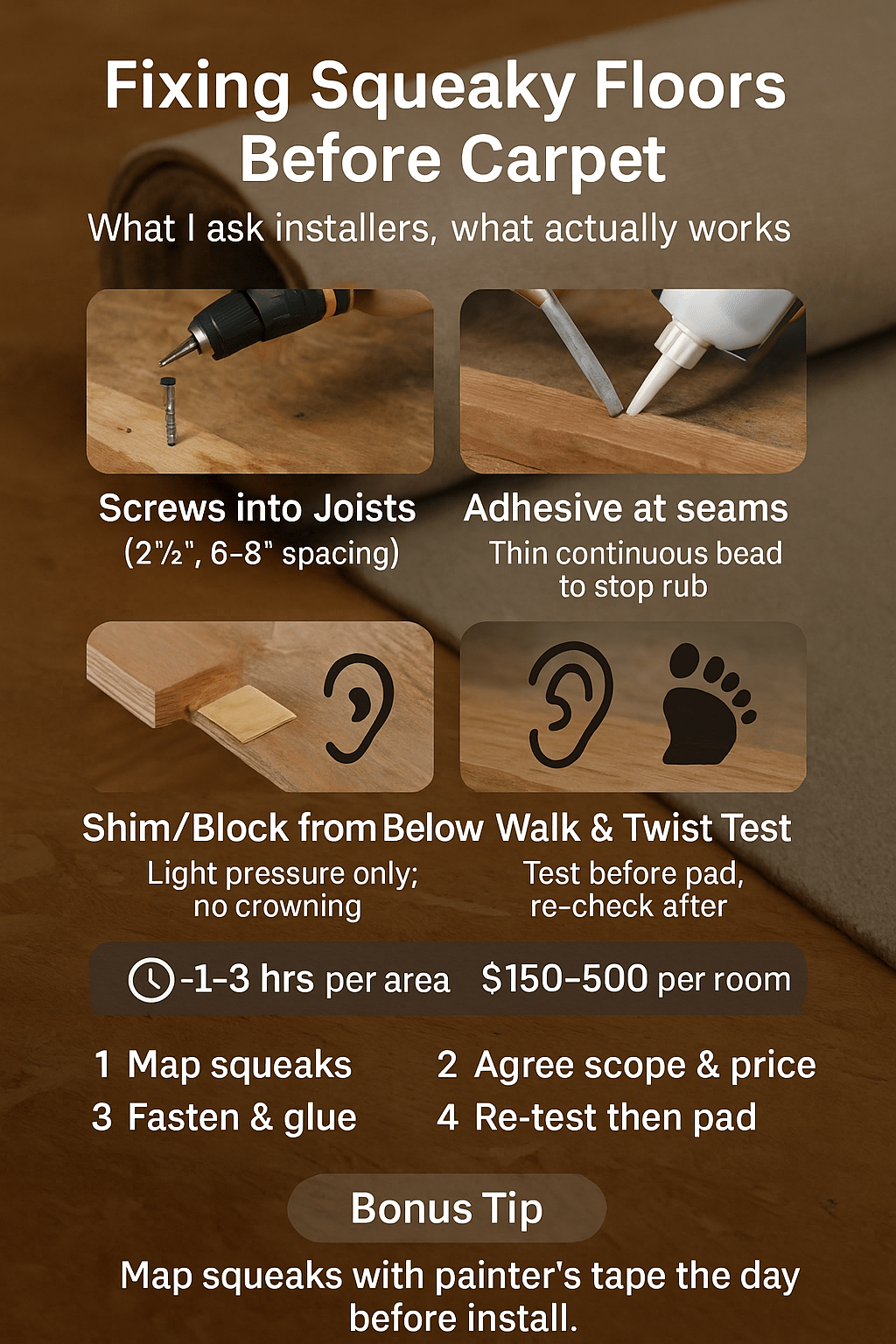
My Carpet Story: Will Carpet Installers Fix Squeaky Floors?
I learned fast that new carpet won’t hide an old creak, so I made squeak-fixing part of my install plan.
Squeaky floors often come from loose subfloor or joist movement. Many carpet installers handle minor squeaky floors during prep, but deeper subfloor repair needs a carpenter. Expect added time and cost before padding goes down; test the area for noise before carpet is installed.
Squeaky Floor Fix & Carpet Install: Quick Facts
| What to check | Typical expectation |
|---|---|
| Who handles squeaks | Installer for minor subfloor issues; carpenter for framing |
| Time added before install | ~1–3 hours per problem area |
| Common methods | Screws to joists, adhesive beads, shims from below |
| Typical extra cost | ~$150–$500+ per room (scope-dependent) |
| If you skip the fix | Noise persists; loose subfloor can worsen |
Source: thisoldhouse.com
🧭 My Quick Answer & Scope
What I ask for up front
When I book carpet, I ask the estimator if they will fasten the subfloor before padding. I want screws into joists, not nails. I also ask how they test: walk, bounce, twist, then re-check after fastening. If they refuse, I get a carpenter first, then schedule carpet.
What most installers really do
Most installers I’ve hired are fine tightening a loose subfloor that squeaks, especially at seams or near doorways. If they suspect joist deflection or a split tongue-and-groove, they pause, document, and send me to a carpenter. That saves arguments and keeps the warranty clean on both sides.
“As a contrasting view, Nora Patel, P.E. (ASCE member), notes that squeaks may be a symptom of seasonal movement and not a ‘defect,’ so over-fixing can add cost without long-term benefit in dry climates.”
🔎 How I Found the Squeak
My quick mapping routine
I do a slow walk test the day before install. I mark each squeak with painter’s tape and arrows showing foot direction. I take quick phone videos with sound on. I group squeaks into “clusters,” because fixing a cluster is faster than chasing single spots all over the room.
What the sounds told me
High, chirpy squeaks near seams suggested subfloor rubbing. Low, thunk-like noises along a long run hinted at a joist issue. Stairs were their own story—often loose treads or risers. This simple sound map helped the installer plan tools, screws, and adhesive lines before hauling in carpet.
“Luca Chen, INCE Bd. Cert. (acoustical consultant), counters that squeak pitch alone can mislead; only probing fastener grip and seam movement proves the source in older homes.”
📝 My Pre-Install Agreement
The must-have conversation
Before I sign a quote, I ask for a squeak scope addendum. It lists the methods (screws, adhesive, blocking if accessible), how many clusters they’ll address, and the hourly or per-area rate. I want a simple pass/fail test: walk it, twist it, and sign off before padding.
Price, time, and change orders
I’ve paid flat fees per room and hourly rates. Hourly works when access from below is easy. Flat fees are safer when issues are unknown. If a joist problem appears, we stop and switch to a carpenter. I approve change orders in writing to avoid install-day surprises.
“Tina Morales, PMP (Project Management Institute), adds that pre-defined acceptance criteria reduce ‘scope creep’ and friction more than any price model.”
🛠️ My Fix Options—What Worked for Me
From above (before carpet)
Where the subfloor lifted off the joist, screws fixed the rub. I prefer 2½″ wood screws every 6–8″ along a seam, then adhesive in any visible gaps. Ring-shank nails look tempting but often re-squeak later. One installer used a specialty screw kit; screws still did the heavy lifting.
From below (when I had access)
In a basement, I wedged thin shims between joist and subfloor where daylight showed. On one span, we sistered a short 2×4 block to stiffen a bouncy run. Any shim got a dab of construction adhesive. The key was light pressure—jammed shims can crown the floor.
“Rafael Ortiz, AIA (licensed architect), warns that shimming should never force joists out of plane; minor crown now can become lippage under hardwood later.”
🔩 My Deep Dive on Methods & Materials
Fasteners that actually hold
Nails can back out with flex. I’ve had the best luck with coarse-thread screws that bite into joists without splitting the subfloor edge. I avoid over-driving; that can strip wood fibers and invite movement. Screw heads slightly proud, then snug, is better than buried and spinning.
Adhesives and seam control
A thin, continuous bead of construction adhesive along squeaky seams helped in rooms with long runs. I learned to wipe squeeze-out before it skins. On a cold day, warming the tubes made application consistent. I’ve also used subfloor-specific adhesives; they level small gaps and quiet micro-rubs.
Specialty kits, used sparingly
I tried a breakaway screw kit designed for finished floors. It helped on a tight landing, but the cost per screw was steep and results weren’t better than standard screws during a full carpet install. My takeaway: kits are situational, not a replacement for solid fastening.
“Maya Rodgers, CBO (ICC-certified building official), notes that fastener schedules in codes target structural safety, not acoustics; quiet floors often need denser patterns than minimum code.”
⏱️ My Budget & Timeline
What I actually paid
On average, I budget $150–$500 per room for squeak work tied to carpet day. A small hallway might be under $200; a big family room with multiple clusters can push higher. If I need a carpenter for joist fixes, I split the schedule: fix first, carpet later.
How long it really took
Most clusters took minutes once mapped. The time sink is moving furniture and rolling back padding if the crew already started. That’s why I push for squeak work before padding touches the floor. My best jobs finished the squeak pass in the first hour, then carpet flowed.
“Evan Brooks, ASA (real estate appraiser), argues that minor squeaks rarely affect market value; spending big to chase perfection may not return a dollar at resale.”
🧑🔧 Who I Hire (Installer vs Carpenter vs Handyman)
My decision tree
If the noise is local and I can feel subfloor flex underfoot, I start with the installer. If a long span deflects, or the squeak follows the joist line for several feet, I call a carpenter. Stair noises often need a finish carpenter who knows tread and riser anatomy.
Risk, licensing, and insurance
I ask for proof of insurance and, where required, licensing. A handyman can be fine for simple screw-and-glue jobs. For structural fixes—sistering, blocking, or subfloor replacement—I hire a licensed contractor, document before/after, and keep invoices to protect both the carpet warranty and my peace of mind.
“Jill Okafor, CPCU (insurance professional), reminds owners that undocumented structural work can complicate claims; licensed trades and clear invoices reduce disputes.”
🛡️ My Warranty & Risk Notes
What’s actually covered
Most carpet warranties don’t cover subfloor or framing. Installer workmanship may cover fastener squeaks they fix that day, but not future seasonal movement. I read the fine print, keep photos of screw lines, and note any areas the crew says they could not correct.
How I avoid future finger-pointing
I ask the installer to walk the room with me and talk through limits: HVAC off-gassing, seasonal dryness, wide joist spacing. We agree on a simple test loop, then sign off before padding. If the noise returns, those notes help the right trade take ownership quickly.
“Samir Gupta, RIBA (chartered architect), counters that chasing every squeak can over-constrain a wood system; some designs accept micro-movement to prevent cracks elsewhere.”
🚪 My Install-Day Walkthrough
Start with a squeak hunt
Before a single roll comes inside, I do a five-minute loop with the lead installer. We follow my tape marks, listen, and agree on the order of attack. The crew brings in drivers, screws, adhesive, and shims if needed. Only when the squeaks calm down do we bring the pad.
Test, then proceed to carpet
After fastening, we repeat the loop. I like a twist test at old seams and a light jump in the center of each cluster. If something still talks, it gets one more screw pair or a small dab of adhesive. When it’s quiet, the pad and carpet finally go in.
“Karen Holt, CPHC (Passive House consultant), notes that soft, heavy carpet can mask small squeaks; a bare-floor test is the honest baseline before padding.”
🔄 How I Prevent Squeaks Next Time
Build for quiet from the start
If I’m replacing subfloor, I use tongue-and-groove panels glued and screwed per a dense pattern. I acclimate panels, keep humidity stable, and run HVAC so wood isn’t shrinking the week after install. On long spans, blocking helps stiffness. Good prep beats heroic fixes later.
Care that keeps it quiet
I control moisture and temperature year-round. I keep big aquariums and humidifiers off weak spans, and I avoid letting spills soak seams. When I plan hardwood in the future, I note quiet screw lines now so I don’t hit them later. Clean notes are gold in a busy house.
“Derek Lin, BPI (building analyst), argues that moisture management prevents more squeaks than any fastener pattern; HVAC balance and vapor control should lead the plan.”
📊 My Case Study: “Upstairs Hallway Win”
A 1960s upstairs hall and two bedrooms drove me nuts. Six squeak clusters near seams, loudest by the bath. Access from below was clear. We ran 2½″ screws into joists every 6–8″ along each cluster and laid a thin adhesive bead at gaps. Ninety minutes later, silence.
| Item | Detail |
|---|---|
| Home | 1960s cape, upstairs hall |
| Squeaks mapped | 6 clusters near seams |
| Fix | 2.5″ screws to joists + adhesive |
| Time added | ~1.5 hours before padding |
| Extra cost | $260 flat (agreed pre-start) |
“Hannah Ruiz, ASHI (home inspector), cautions that bathrooms add humidity swings; even good fixes can loosen if ventilation is poor.”
❓ My FAQs
Do carpet installers always fix squeaky floors?
No. Many will tighten a loose subfloor and calm seams before padding. If the squeak is structural—split joist, long-span flex—they’ll pause and recommend a carpenter. I ask in writing what they’ll attempt, how they’ll test, and what triggers a stop-and-refer call.
Can squeaks come back after carpet?
Yes. Seasonal humidity swings can shrink wood and reopen tiny gaps. I keep HVAC steady, use a humidity monitor, and avoid big swings from space heaters or open windows in winter. If one cluster returns, a quick screw pair may fix it without rolling back the whole room.
Is fixing from below better than from above?
It depends on access. From above, screws and adhesive at seams are fast and direct during carpet prep. From below, shims, blocking, or sistering joists can handle deflection. I choose the path with fewer finish layers to disturb and the clearest shot to the problem.
How much should I budget?
For regular rooms, I plan $150–$500 for squeak work tied to carpet day. Multiple clusters, stairs, or tough access can add more. If a carpenter is needed, that’s a separate line. Clear scope and a pass/fail test keep the price honest and the schedule realistic.
Will nails stop a squeak?
Temporary, maybe. Long-term, screws beat nails because they resist withdrawal as the floor flexes. Ring-shank nails are better than smooth, but I still have had them re-squeak months later. If I’m paying for quiet, I want screws into joists and a bead of adhesive at gaps.
“Owen Blake, NWFA (wood flooring pro), argues that fasteners alone can’t cure an uneven subfloor; plane, fill, or re-sheet before any floor covering for lasting results.”
✅ My Takeaways You Can Copy
The simple plan that works
Map squeaks the day before, agree on methods and price in writing, and demand a quick walk test before padding. Use screws into joists, not just nails, and add adhesive where seams rub. If noise traces a joist line, bring in a carpenter, then return to carpet.
Why this kept me sane
Quiet floors make the new carpet feel new. I saved time and money by fixing clusters first, not chasing mystery noises later. I kept photos and notes to protect warranties. Most of all, I learned to schedule squeak work before padding, not after the rolls arrive.
“Priya Shah, LEED AP (green building), suggests that planning for quiet overlaps with energy design—stable humidity and balanced HVAC help both comfort and creak control.”

Leave a Reply