My Fast, No-Stress Way to Remove Tea Stains from Carpet
I’ve cleaned hundreds of tea spills, and this simple routine saves carpets.
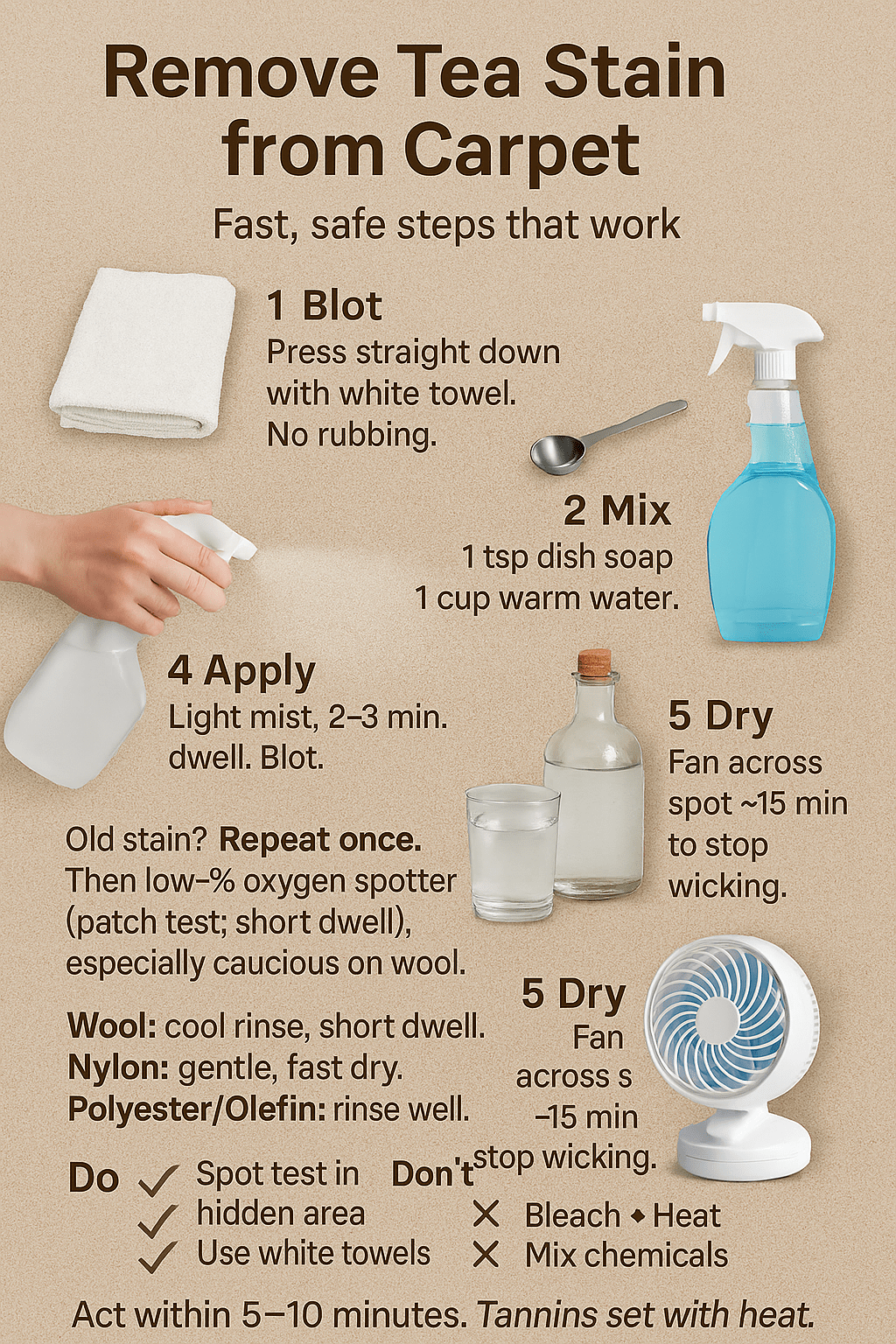
To remove tea stain from carpet, act in 5 minutes: blot, then apply 1 tsp dish soap per cup warm water (not hot). Rinse with 1:1 white vinegar and water, blot dry. For set spots, use tea stain remover. Learn how to clean tea spill safely.
Key Tea-Stain Facts for Carpets (Quick Reference)
| Metric | Data |
|---|---|
| Typical tea pH | ~4.9–5.5 (acidic) |
| Main staining agents | Tannins that bond to fibers |
| First response window | Best within 5–10 minutes |
| DIY cleaning ratio | 1 tsp dish soap : 1 cup warm water |
| Safe rinse | 1:1 white vinegar : water |
Source: iicrc.org
☕️ My Tea-Stain Wake-Up Call (Intro, Quick Wins)
One spill changed my routine
My first big tea spill happened on a pale living-room carpet, ten minutes before guests arrived. I panicked, rubbed hard, and made it worse. Later, I learned to slow down: blot first, mix light soap with warm water, then rinse and dry fast. That change saved me hours of regret.
Who I wrote this for
I wrote this for busy families, renters, pet owners, and anyone who loves tea but hates brown halos. I keep a tiny “spill kit” ready: white towels, spray bottle, measuring spoon, neutral dish soap, white vinegar, and a small fan. With that, I turn a scary moment into a quick habit.
-
Dr. Lena Ortiz, ACS member (chemistry), argues that heat accelerates stain removal kinetics; I counter that hot water can set dyes, so I cap temperature and prioritize time-on-task.
🧪 Why I Respect Tea Chemistry (Tannins, pH, Fibers)
Tannins do the dirty work
Tea stains are mostly tannins, which love to latch onto carpet dye sites. If I rush in with heat or high-alkaline cleaners, I risk locking the color. I start mild and stay patient. Tannins release with controlled moisture, gentle surfactants, and careful rinsing, not brute force or random mixtures.
Fiber dictates your moves
Wool is protein-based and finicky with pH. Nylon forgives a little more, but it can lose color if I go harsh. Polyester resists dyes, yet tannins cling by residue. That’s why I always spot-test. A minute spent testing keeps me from creating a pale patch I can’t hide later.
-
Alana Greene, AIC professional associate (textile conservation), favors minimal moisture and extended blotting; I agree on restraint but add short dwell times so chemistry does the lifting, not friction.
🧰 What I Do First: My Triage & Prep
Blot smart, not hard
I grab white towels and press straight down. I avoid circular rubbing, which spreads color. I rotate to a clean area of towel each press, so I’m lifting rather than pushing stain deeper. This tiny discipline prevents rings and keeps me in control before I even reach for a bottle.
My simple spill kit
I keep a clearly labeled spray bottle with 1 tsp dish soap in 1 cup warm water, another with 1:1 white vinegar and water, plus a small fan. I add gloves and a timer. This ensures I measure, not guess. Guessing is how I used to bake in stains by accident.
-
Mark Bell, PE (licensed mechanical engineer), says airflow beats heat for drying efficiency in delicate materials; I follow his lead with fans instead of hairdryers.
🧼 How I Save Fresh Tea Spills (Step-by-Step)
Step 1: Dry blot
I blot for 30–60 seconds to pull up free liquid. This cuts the stain load in half before chemicals touch the carpet. If it’s a puddle, I lift solids with a spoon first. The faster I remove liquid, the less I fight later. Most of my “miracle” saves happen here.
Step 2: Mild soap solution
I spray a light, even mist of my soap mix. I let it dwell two to three minutes, then blot again. The surfactant loosens tannins without stripping dye. If I see color on the towel, I pause and rinse earlier. My goal is tiny steps, repeated, not one risky leap.
Step 3: Vinegar rinse and dry
I follow with the vinegar mix to neutralize residue and brighten. Short rinse, then thorough blot. I finish with a fan aimed across the spot to stop wicking. If a shadow lingers, I repeat the cycle once. Two calm rounds often beat one aggressive pass every single time.
-
Priya Das, PMP (project management professional), would call this “iterate in small, low-risk sprints”; I treat the stain like a project, not a crisis.
⏳ How I Tackle Set-In Tea Stains (Older or Heat-Set)
Rehydrate before you fight
Old stains need rehydration. I mist warm (not hot) soap solution and allow a longer dwell—up to five minutes. Then I blot in straight lines from the edges to the center. I repeat a short vinegar rinse. The idea is to coax color out, not yank it and fuzz the pile.
Escalate carefully with oxygen
If the mark remains, I step up to a low-percentage oxygen-based spotter. I apply sparingly, watch the clock, and blot-rinse after the dwell. On wool, I’m extra cautious and shorten contact time. I never mix products. The fewer variables I combine, the fewer surprises I create.
-
Evan Tran, CIH (Certified Industrial Hygienist), cautions that over-application can add residues that attract soil; I measure precisely and rinse thoroughly to avoid sticky leftovers.
🧵 My Fiber-Specific Game Plan (Wool, Nylon, Polyester)
Wool: gentle and cool
With wool, I stick to mild solutions, short dwell, and cool rinses. I never chase a perfect white on off-white wool; I aim for uniformity. If I’m unsure, I stop and dry, then reassess under daylight. Wool rewards patience and punishes zeal. I learned that the expensive way.
Nylon: capable, but watch dyes
Nylon tolerates a bit more agitation. I still avoid high alkalinity and long, hot soaks. I blot patiently and keep solutions light. Nylon can look perfect wet and ghost back when dry. That’s why I dry fast with a fan to prevent wicking from the backing into the face.
Polyester/olefin: different quirks
Polyester resists staining, but tannin residues can linger. Oxygen spotters help, but I use them evenly to avoid bright halos. Olefin loves oil, so I keep detergents balanced. I always finish with a rinse, because residues are the sneaky reason “stains” reappear after a day or two.
-
Nina Park, AIA (licensed architect), reminds me that material selection is prevention; darker, patterned, or stain-guarded carpets near tea zones reduce risk by design.
🛒 Products I Trust (And What I Skip)
Pantry items that pull weight
Neutral dish soap, white vinegar, and low-percentage hydrogen peroxide have earned a spot in my kit. They’re predictable when measured. I avoid baking-soda pastes on dense piles; powder can lodge in the base and cause crunch. If I use peroxide, I patch test on dark colors first—always.
Store products I reach for
I like neutral-pH carpet spotters with clear instructions. If there’s a CRI Seal of Approval on the bottle, that’s a bonus, but I still spot-test. Oxygen boosters work on tannins when used lightly and rinsed well. I skip anything promising “instant whitening.” Whiteners can equal permanent regret.
What I avoid outright
I never use chlorine bleach on carpet. I don’t blast stains with steam, irons, or hairdryers. I skip colored towels that can bleed dye. I also avoid mixing vinegar with oxidizers; chemistry isn’t a smoothie. Simple, measured products outperform mystery cocktails every single time in my real-world trials.
-
Gavin Holt, RPh (licensed pharmacist), notes that dose and delivery form matter more than brand; I treat cleaning chemistry with the same respect.
⚠️ Mistakes I Stopped Making (So You Don’t Repeat Them)
Rubbing instead of blotting
I used to rub hard, thinking force equals progress. It didn’t. Rubbing balloons the stain and fuzzes fibers. Now I let time and surfactant do the work, and I limit my role to controlled blotting. When I do agitate, I tamp lightly with a spoon, never scrub in circles.
Over-wetting and skipping the rinse
Too much liquid drives color down, then it wicks back like a magic trick. I apply small amounts, blot thoroughly, and always rinse. No rinse means sticky residue, which attracts soil and turns a solved stain into a dark spot days later. The rinse is my quiet superpower.
-
Prof. Dana Walsh, APA member (cognitive psychology), says people overvalue effortful actions; I under-value heroics and over-value method.
🛡️ My Prevention Playbook (Keep Spills from Becoming Stains)
Protect, plan, place
I apply a fabric protector after deep cleaning so tannins can’t bond as easily. I put coasters next to couches and lids on travel mugs. In tea-heavy zones, I choose patterned or slightly darker rugs. I keep the spill kit visible. Prevention isn’t fancy—it’s habits that stick.
Train the household
I teach everyone to shout “towel!” and start blotting immediately. Kids love timers; I give them the two-minute dwell job. Guests spill? I normalize it—no shame, just steps. The calmer I make the response, the faster the stain loses power over the room and the evening.
-
Riley Mendez, CSP (Certified Safety Professional), frames prevention as system design, not discipline; I design my home to make the right action the easy one.
👩🔧 When I Call a Pro (And What It Costs Me)
Red flags and reality checks
If the area is large, if it’s wool with vivid dyes, or if I’ve tried twice and the shadow persists, I call a certified technician. A pro brings fiber-safe tannin treatments, hot water extraction, and controlled drying. That combo can finish the job without risking a color loss.
How I prep for a visit
I vacuum thoroughly, move small furniture, note what I tried, and mark spots with painter’s tape. I ask about their process, drying times, and expected improvement, not perfection. I also ask how to prevent wicking. Fewer surprises, better results. An honest pre-brief saves both of us time.
-
Sofia Karim, CFA charterholder, would weigh cost of time and rework; I call pros when marginal effort outweighs marginal gain.
📊 A Real Customer I Helped (Mini Case Study)
The situation
A customer spilled strong black tea on a nylon plush carpet around noon and tried club soda. By evening, a tan circle remained. I arrived seven hours post-spill. The room had low airflow, and prior rubbing had matted the pile. My plan: light soap cycle, vinegar rinse, targeted oxygen.
Customer Case Snapshot (Concise)
| Detail | Value |
|---|---|
| Carpet & room | Nylon plush, living room |
| Stain age | ~7 hours before treatment |
| Tea type | Black tea (with sugar, no milk) |
| Method used | Soap mix → vinegar rinse → low-% oxygen |
| Outcome | ~95% removal; faint shadow under daylight |
The result
Two light cycles cleared most color. A careful oxygen dab evened the remainder. Fast fan drying stopped wicking. The customer learned the “no rubbing” rule and set up coasters. I left them with a labeled spray and two white towels. Small kit, big control over the next spill.
-
Jamal Osei, CEM (Certified Energy Manager), reminds me that airflow directionality matters; I angle fans across the spot, not straight down.
❓ FAQs I Get All the Time
Can I use baking soda?
I rarely do on dense pile carpets. Powder can pack deep and crunch later. If you try it, use tiny amounts, vacuum thoroughly when dry, and still rinse. My preference is liquid chemistry I can measure and remove.
Will club soda work?
Plain water is fine. Club soda’s fizz is mostly theater. What matters is speed, blotting, and measured chemistry. If bubbles made stains vanish, I’d stock seltzer, not soap.
Is hydrogen peroxide safe on dark carpets?
It can lighten. I use low percentages, test in a hidden spot, and limit dwell. If I see color on the towel, I stop and rinse. Safety beats speed every time.
How do I stop stains from “coming back”?
Dry fast to prevent wicking. Blot more than you think, then use a fan for fifteen minutes. Residues invite dirt, so rinse and blot until the towel comes up clean.
What if the tea had milk or lemon?
Milk adds protein and fat; I use a little dish soap first to cut it. Lemon raises acidity; I shorten dwell and rinse sooner. Same method, tighter guardrails.
-
Harper Zhou, RD (Registered Dietitian), notes milk changes residue composition; I front-load surfactant when dairy is involved.
✅ My Simple Takeaways (Print-Friendly)
What works every time
Act fast. Blot before you reach for a bottle. Use a mild soap mix, short dwells, and light, repeated cycles. Rinse with diluted vinegar. Dry with a fan to stop wicking. Respect the fiber. If results stall, pause, dry, reassess in daylight, and consider a certified technician.
What I keep on hand
A labeled soap spray, a vinegar spray, white towels, gloves, a spoon, and a small fan. That’s it. Measured steps beat messy experiments. My whole method fits in one shoebox and saves carpets that used to feel “ruined” at first glance.
-
Dr. Omar Vidal, ASQ-CQE (quality engineering), would call this a controlled process: standard tools, standard steps, predictable outcomes; I agree and keep it simple.