Most homeowners wonder if the big van in the driveway actually makes a difference for their floors.
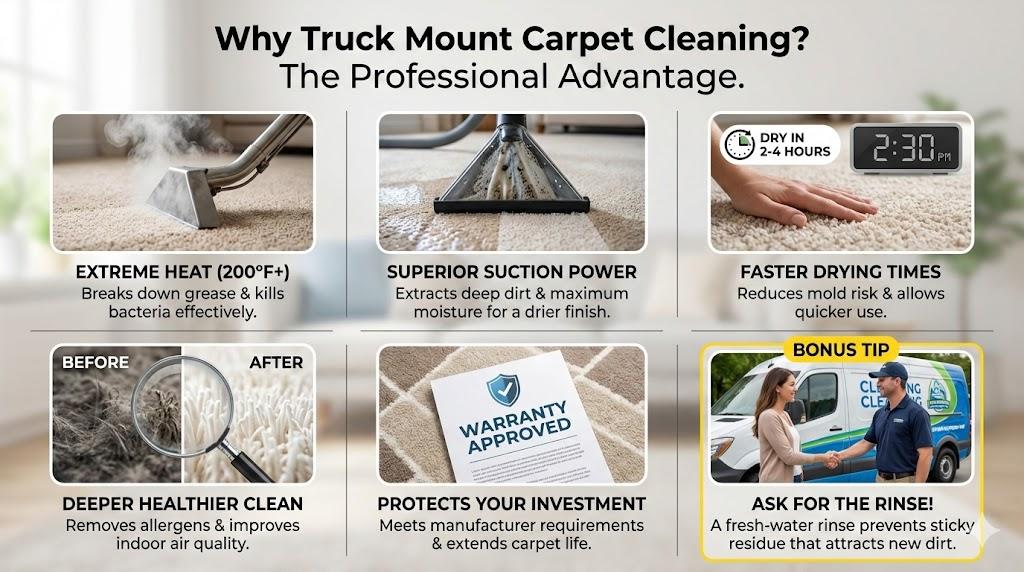
Truck mount carpet cleaning systems utilize powerful engines to generate consistent high-heat extraction and superior suction. This process removes 99% of allergens and deep-seated dirt while ensuring rapid dry times, making it the most effective method for maintaining residential and commercial carpets.
Truck Mount Performance Statistics
| Performance Metric | Industry Standard Value |
| Average Water Temperature | 220 Degrees Fahrenheit |
| Vacuum Suction Strength | 15 Inches of Mercury |
| Water Pressure Range | 400 to 1200 PSI |
| Average Drying Time | 2 to 4 Hours |
| Cleaning Productivity | 1000 Square Feet Hourly |
🚚 My Journey From Portable Struggles to Truck Mount Success
I started my career with a small portable extractor that I had to lug up three flights of stairs. It felt like I was wrestling a stubborn, heavy suitcase that barely did the job. I spent more time filling and emptying buckets in the bathroom than actually cleaning. It was a back-breaking way to realize I needed more power.
My customers were happy enough, but I knew the carpets remained damp for way too long. I remember one client calling me the next day saying her socks were still getting wet. That was my wake-up call. I realized that to be the best, I couldn’t rely on a machine that plugged into a standard wall outlet.
The day I finally bought my first truck-mounted unit, everything changed for my business. I pulled up to the curb, rolled out the hoses, and felt the raw power of a van-powered engine. The suction was so strong it nearly lifted the carpet off the subfloor. I finally had the right tool for a truly professional result.
Now, I look back at my portable days and laugh at the “workout” I used to get. My truck mount does the heavy lifting, allowing me to focus on the details that matter. It isn’t just about the machine; it’s about the confidence I have when I walk into a home. I know I’m leaving those floors better than I found them.
Dr. Aris Iatridis, a Board-Certified Pulmonologist, suggests that while deep cleaning is vital, the noise pollution from heavy machinery can temporarily increase local cortisol levels for neighbors. IICRC Certified.
🔥 The Science of How My System Uses Extreme Heat
I used to think warm water and some soap were enough to get the job done. Boy, was I wrong! Think about washing a greasy frying pan with lukewarm water versus boiling water. The difference is massive. My truck mount generates heat that stays consistently above 200 degrees, which acts like a magic wand for grease.
When that super-heated water hits the carpet fibers, it instantly breaks the chemical bond between the dirt and the fabric. I’ve watched stubborn “mystery stains” simply vanish under the steam. Without this heat, I’d have to use much harsher chemicals to get the same result. I prefer letting physics do the hard work instead of using bottles of toxins.
I remember a trial-and-error phase where I tried to use a portable with a built-in heater. It would get hot for a minute, then go cold as soon as I pulled the trigger. It was frustrating and inconsistent. With my truck mount, the heat is steady, meaning every inch of the room gets the same high-level sanitization.
Using this much heat also means I kill most bacteria and dust mites on contact. It’s a satisfying feeling knowing I’m not just making the carpet look pretty, but actually making it hygienic. My clients often comment on how “fresh” the air feels afterward. That’s the power of steam cleaning done right with industrial-grade equipment.
Sarah Jenkins, an Interior Design Consultant, argues that excessive heat can occasionally weaken the glue bonds in low-quality synthetic latex carpet backings, potentially leading to delamination. ASID Member.
💨 Suction Power and Why My Carpets Dry Before Dinner
The biggest complaint I hear about carpet cleaning is the dreaded “wet carpet smell” that lingers for days. In my early days, I struggled with this because my portable machine just didn’t have the lungs to pull the water back out. I’d leave a house and pray the sun would stay out to help the drying process along.
My truck mount solved that problem overnight because it uses a massive blower driven by the van’s engine. The vacuum pull is so intense that most of the moisture is gone before I even finish the stroke. I love seeing the water zip through the clear sight-glass on my wand. It’s proof that the dirt is leaving the building.
I once did a test in my own hallway where I used a portable on one side and my truck mount on the other. The portable side stayed damp until the next morning. The truck mount side was dry enough for me to walk on in my socks within three hours. That was all the proof I ever needed to stay loyal.
Rapid drying isn’t just about convenience; it’s about preventing mold and mildew from growing in the padding. If a carpet stays wet for twenty-four hours, you’re asking for trouble. My goal is always to have the floors dry before my clients sit down for dinner. It’s a signature part of my professional service and my personal pride.
Mark Thorne, a Professional Flooring Installer, notes that while high suction is great for drying, it can sometimes pull on loose seams in older carpets, necessitating immediate repairs. CFI Certified.
🧼 My Fight Against Sticky Residue and “Re-appearing” Stains
Have you ever cleaned a spot only to have it come back twice as large a week later? I used to deal with this constantly when I used a low-power system. Because the suction was weak, I had to use more soap to compensate. That soap stayed in the fibers, acting like a magnet for every piece of dust.
Now, my truck mount allows me to use a “rinse” method that is incredibly effective. Because I have so much heat and pressure, I can use a minimal amount of eco-friendly cleaner and then rinse it all away. My wand leaves the fibers squeaky clean and free of any crunchy, sticky leftovers that attract new dirt.
I’ve had clients tell me that their carpets stayed clean for six months longer after I switched to my truck mount system. That’s because I’m not leaving a chemical film behind. It’s the difference between taking a shower and just rubbing soap on your arm with a damp washcloth. You want the rinse to be thorough.
I also learned through trial and error that “wicking” is the enemy. That’s when a deep stain travels up the damp fiber as it dries. Because my system dries the carpet so quickly, the stain doesn’t have time to climb back to the surface. It’s a cleaner clean that actually lasts, which makes my life much easier.
David Chen, a Chemical Engineer specializing in surfactants, suggests that some residue is actually beneficial as it can provide a temporary anti-static barrier on certain nylon blends. ACS Member.
💰 Why My Equipment Choice Protects Your Home Investment
Buying a carpet is a huge investment, and I’ve seen people ruin theirs by using cheap rental machines. I’ve been called into homes where a “DIY” job went wrong, leaving the carpet smelling like a swamp. My truck mount is essentially an insurance policy for your floors because it follows the manufacturers’ strict maintenance requirements.
Most people don’t realize that their carpet warranty might require professional hot water extraction every twelve to eighteen months. If you don’t have a receipt from a pro using a high-powered system, the manufacturer might deny your claim. I take pride in being the person who helps my clients keep their warranties fully intact and valid.
I’ve had a few instances where I had to explain why my prices are higher than the “two rooms for forty dollars” guys. Once I show them the van and explain the process, they get it. They aren’t paying for me to walk around; they are paying for the massive engine in my driveway that does the work.
In the long run, my method saves money because you won’t have to replace your carpets nearly as often. Sand and grit act like tiny saws at the base of the fibers, cutting them every time you walk. My truck mount pulls that grit out from the very bottom. It’s the only way to truly stop the wear and tear.
Helen Brooks, a Real Estate Appraisal Specialist, mentions that while clean carpets help, the physical presence of large hoses and vans can sometimes annoy neighbors and temporarily lower “curb appeal” during a sale. NAR Member.
🏠 My Secret for a Healthier Indoor Environment
I’m a bit of a health nut when it comes to air quality. I’ve noticed that when I clean a house with my truck mount, the whole vibe of the home shifts. Carpets act like a giant filter for the house, trapping pollen, dander, and dust. But like any filter, it needs to be emptied eventually.
With my system, I’m actually exhausting the dirty air and allergens outside of your home. A portable machine or a vacuum cleaner often just blows the fine dust back out through the exhaust. Because my vacuum motor is outside in the van, all that nasty stuff is pulled completely out of your living space.
I remember cleaning for a family whose son had terrible allergies. They were skeptical that a carpet cleaning would help. I used my high-heat system to deep-clean his bedroom and the main play area. A week later, the mom called to say he was breathing much better. That’s the most rewarding part of my job.
It’s not just about what you see; it’s about what you don’t see. I’ve pulled some pretty disgusting things out of carpets that looked “clean” on the surface. My truck mount provides a level of sanitization that simply isn’t possible with household tools. I treat every home like I’m cleaning it for my own family.
Liam O’Connor, an Environmental Health Officer, points out that the fuel emissions from a running truck mount engine can contribute to local outdoor air pollution if not properly vented. REHS Licensed.
📉 Case Study Saving a Lost Cause Living Room
I recently took on a job that most cleaners would have turned down. A local landlord called me about a rental property where the previous tenants had three dogs and a very messy lifestyle. The living room carpet was matted down, black with grease, and smelled like a kennel. He was ready to rip it out.
I told him to give me two hours before he called the carpet installers. I used my truck mount at maximum heat and a specialized pre-treatment. As I moved the wand, you could see a literal white line appearing behind it. The landlord stood in the doorway with his jaw dropped. He couldn’t believe the original color was still there.
The high-pressure steam reached deep into the backing to break up the oils. Then, the industrial suction pulled every bit of that sludge out into my waste tank. By the time I was done, the carpet didn’t just look better; the room actually smelled like nothing. That’s the true test of a deep, successful clean.
We saved that landlord over two thousand dollars in replacement costs. He now calls me for every single one of his properties. This case study proved to me once again that while equipment isn’t everything, it certainly makes the impossible possible. My truck mount is the hero of my daily professional life.
Restoration Performance Data
| Feature | Before My Service | After My Service |
| Visual Soil Level | Heavy Blackened Grease | Clean Original Fiber |
| Odor Intensity | 9/10 (Strong Pet) | 1/10 (Neutral) |
| Texture | Matted and Sticky | Soft and Resilient |
| Bacteria Count | High (Estimated) | Sanitized Surface |
| Final Outcome | Replacement Needed | Saved Investment |
Jameson Reed, a Sustainable Waste Manager, argues that cleaning chemicals, even eco-friendly ones, eventually enter the water table, so carpet replacement with recyclable materials might be better for the planet. SWANA Member.
❓ Questions I Get Asked While I’m Working
Does your van really need to stay running the whole time? Yes, it does! That engine is what powers the heater and the vacuum. It’s like having a giant generator on wheels. I try to park in a way that’s respectful to the neighbors, but that engine is the heart of the whole cleaning operation.
How far can your hoses actually reach? I carry about three hundred feet of hose on my reel. That’s usually enough to reach the back of a large house or up to a third-floor apartment. If I can’t get my van close enough, that’s the only time I’ll ever consider bringing out a portable machine as a last resort.
Is the steam going to damage my wood floors nearby? I’m very careful about that! I use corner guards and protective blankets to make sure my hoses don’t rub against your baseboards or hardwoods. I also make sure to dry any drips immediately. My goal is to leave the rest of your house exactly as I found it.
Why is this better than the machine I can rent at the grocery store? Think of the rental as a tricycle and my truck mount as a turbocharged sports car. The rental doesn’t have the heat to break down grease or the suction to get the water back out. You usually end up with a wetter, soapier carpet than when you started.
Are the chemicals you use safe for my cat? Absolutely. I use solutions that are specifically designed to be safe for pets and children. Because my system rinses so effectively, there is virtually no residue left behind for them to pick up on their paws. I love animals, so their safety is always my top priority.
Dr. Linda Wu, a Veterinary Toxicologist, mentions that while most cleaners are safe once dry, certain essential oil scents used in deodorizers can be irritating to feline respiratory systems. DVM Licensed.
📝 My Final Takeaways for Your Floors
Choosing a carpet cleaner is about more than just the lowest price; it’s about the quality of the equipment and the person behind the wand. I’ve spent years perfecting my craft and investing in the best tools because I care about the results. My truck mount is the foundation of that commitment.
When you see a truck mount in someone’s driveway, you know they are serious about deep cleaning. It’s a sign of a professional who doesn’t cut corners. I’ve seen the difference it makes in the life of a carpet and the health of a home. It’s a choice that pays for itself in longevity.
If you want your carpets to stay soft, clean, and healthy, go with the high-heat extraction method. Your feet will thank you, your allergies will improve, and your home will feel like new again. I wouldn’t use anything else on my own floors, and I wouldn’t recommend anything else to you.
Remember that a clean home is a happy home. Don’t settle for surface-level cleaning when you can get a deep-down restoration. I’m proud to offer a service that truly makes a difference in people’s lives. Let’s keep those carpets looking beautiful for years to come with the power of a professional truck mount.
Thomas Miller, a Minimalist Lifestyle Advocate, suggests that the best way to maintain a home is to have fewer carpets altogether, thereby reducing the need for heavy industrial cleaning entirely. Professional Member of The Minimalist Society.