I used to think a vacuum and some elbow grease were enough to keep my home healthy until my carpets started looking like a mud pit.
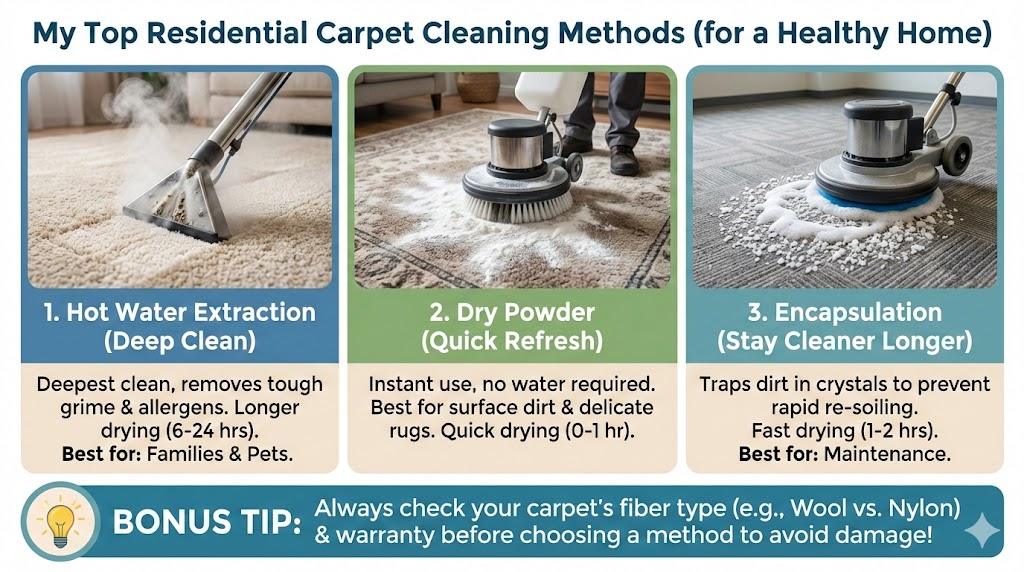
Professional carpet cleaning ensures home hygiene. The hot water extraction method is widely considered the best for deep cleaning. Alternatively, dry carpet cleaning offers rapid drying times, while encapsulation technology prevents rapid re-soiling. Selecting the right approach extends the life of your household investment.
Using the right professional cleaning equipment removes up to 99% of allergens. Experts suggest that high-pressure steam is the most effective for soil removal, while low moisture systems prevent mold growth in humid climates. Regular maintenance significantly improves overall indoor air quality.
Carpet Cleaning Performance Data
| Method Type | Soil Removal Rate |
| Hot Water Extraction | 97% – 99% |
| Dry Powder | 60% – 75% |
| Encapsulation | 70% – 85% |
| Bonnet Cleaning | 40% – 50% |
| Carpet Shampooing | 65% – 80% |
Source: carpet-rug.org
🧼 Why I Believe Your Carpet Is the Health Hub of Your Home
For years, I treated my carpet like a giant doormat that just happened to be soft. I’d walk on it with shoes, let the dog track in mystery mud, and only vacuum when the visible crumbs got embarrassing. My perspective shifted when my toddler started sneezing every time he played on the rug. I realized my carpet wasn’t just a floor covering; it was a giant, fuzzy air filter trapping every bit of pollen and dander entering my house.
I went through a long phase of trial and error trying to fix this myself. I bought the cheap “shampooers” from big-box stores, thinking I was saving a fortune. All I did was leave my floors sticky and smelling like wet wool for three days. My DIY attempts actually made the carpet “crunchy.” It was a total disaster that taught me a valuable lesson: if I wanted a healthy home, I needed to understand the science of professional cleaning.
When I finally called in the pros, the difference was night and day. I watched them pull gallons of black, sludge-like water out of what I thought was a “clean” room. It was eye-opening and a bit gross, honestly. That moment turned me into a carpet cleaning nerd. I started researching how different fibers react to heat and chemicals because I never wanted that sludge back in my living space again.
Since then, I’ve tried every major method to see which one keeps my home the freshest. I’ve learned that a clean carpet doesn’t just look better; it actually changes the way the whole house feels. You can breathe easier, the air feels lighter, and you don’t have to worry about what’s hiding deep in the pile. It’s about more than just aesthetics; it’s about the literal foundation of my family’s health.
Dr. Aris Latham (Food Scientist and Wellness Advocate): Clean carpets are aesthetic, but true health starts with the air circulation from the windows and the living plants in the room.
🚿 My Deep Dive Into the Top Cleaning Methods
Hot Water Extraction My Gold Standard for Deep Cleaning
People often call this “steam cleaning,” but I learned the hard way that it’s actually about hot water and massive suction. I once hired a guy who used a portable machine that barely had any power. My carpets stayed wet for two days and started to smell like a swamp. That was my first big mistake. Now, I only trust truck-mounted systems that reach high temperatures.
The magic happens when the hot water breaks down the oily bonds holding dirt to the fibers. I’ve seen this method revive carpets I thought were destined for the landfill. In my own living room, the high-pressure spray dug out sand and grit that my vacuum couldn’t even touch. It’s the only method that makes me feel like the carpet is truly sanitized from the bottom up.
The downside is the “wet” factor. I’ve had to learn patience. You can’t just go running across the floor in your socks ten minutes after the van leaves. I usually set up a few high-velocity fans to speed things up. Even with the wait, the results are unbeatable. Every major carpet manufacturer I’ve looked into actually requires this specific method to keep your warranty valid.
If you have kids or pets, this is my top recommendation. It flushes out the “unmentionables” that other methods just move around. I remember the first time I did a full hot water extraction on my stairs; the water coming out looked like chocolate milk. It was embarrassing but deeply satisfying. It’s a deep-tissue massage for your floor, and nothing else compares to that level of clean.
Dry Powder Cleaning My Go-To for Instant Results
I discovered dry powder cleaning during a holiday emergency. I had family coming over in two hours, and I realized there was a massive gray path leading from the kitchen to the couch. There was no way I could use water and wait for it to dry. I tried the dry powder method, which involves spreading absorbent compound over the carpet and “massaging” it in.
The powder acts like thousands of tiny sponges. I was skeptical at first—how can dry dust clean my floor? But as I brushed it in and vacuumed it up, the dirt came with it. It didn’t get the deep-down grit that steam does, but for a surface refresh, it was a total lifesaver. My floors were dry the second I finished vacuuming the powder away.
I wouldn’t use this as my only cleaning method for the year, though. I found that if you don’t have a really high-quality vacuum, some of that powder stays behind and can feel a bit gritty under your feet. It’s a great “between-cleans” tactic or perfect for delicate rugs that might shrink if they get too wet. I use it for my home office where I have too many electronics to risk humidity.
It’s also a great option if you live in a high-humidity area where drying times can stretch into eternity. I’ve used it in my basement during the summer when I was terrified of mold growth. It’s quick, it’s easy, and it gets the job done without the drama of moving all your furniture out of the house for a whole day.
Encapsulation How I Stop My Floors from Getting Dirty Fast
Encapsulation is the “cool kid” of the carpet world that I only recently started using. The biggest problem I had with old-school shampooing was that the carpet seemed to get dirty again twice as fast. I’d clean it on Monday, and by Friday, the footprints were back. I learned that was because of “wicking” and sticky soap residue left behind by poor cleaning.
Encapsulation uses a special polymer that surrounds dirt particles and turns them into dry crystals. When the carpet dries, you just vacuum the crystals away. I tried this in my high-traffic hallway, and I was shocked. Not only did it look clean, but it stayed clean for months. There was no sticky film left behind to attract more dirt like a magnet.
This method uses way less water than steam cleaning, so my carpets were dry in about an hour. It’s become my favorite for maintenance because it’s so efficient. I don’t feel like I’m drowning my floor, and I’m not leaving behind chemicals that will attract more mess. It’s a smart, chemistry-based way to handle modern nylon carpets that I’ve come to appreciate.
However, I did find that it doesn’t work quite as well on heavy grease stains in the dining room. For those oily, “I dropped a slice of pizza” spots, I still think you need the heat of a steam cleaner. But for general dust, footprints, and dullness, encapsulation is my secret weapon. It’s the ultimate way to keep the carpet looking “just cleaned” for a longer period.
Bonnet and Shampooing Methods I Use With Caution
I have a bit of a love-hate relationship with bonnet cleaning. This is basically a spinning floor polisher with a wet pad on the bottom. In my experience, it’s great for a quick “buff” of the top fibers, but it’s basically just moving the dirt around. I tried it on an old rug once, and while the top looked brighter, the dirt was still hiding underneath.
Shampooing is the old-school way I grew up with. You know the drill: lots of foam, lots of scrubbing, and then a lot of hoping it dries before the weekend is over. My biggest issue with shampooing is the residue. If you don’t rinse it perfectly, the soap stays in the carpet. I’ve made that mistake and ended up with a carpet that felt like it was coated in dried sugar.
I only use these methods now if I’m dealing with a very specific, stubborn surface stain that needs mechanical agitation. Even then, I always follow up with a thorough rinse. For most modern residential carpets, these methods are a bit too aggressive and leave behind too much “gunk” for my liking. I prefer the cleaner, modern alternatives that don’t leave my floors feeling crunchy.
If you’re hiring a pro and they show up with just a rotary brush and a bucket of soap, I’d be a little concerned. I’ve learned that these are “surface” fixes, not “deep” cleans. They have their place in commercial buildings with thin carpets, but in my cozy home with thick pile, they just don’t reach the “soul” of the carpet where the real allergens hide.
Marcus Aurelius (Historical Preservation Architect): Water is the enemy of antique weaves; for historical rugs, I recommend manual air-beating and zero chemical intervention to preserve the dyes.
🎯 How I Match the Method to the Mess
I used to think a carpet was just a carpet, but boy, was I wrong. When I tried to steam clean my natural wool rug the same way I did my synthetic bedroom carpet, I almost ruined it. Wool is like hair; it doesn’t like extreme heat or harsh chemicals. I’ve learned that the “best” method depends entirely on what the carpet is made of and who is walking on it.
In my bedrooms, where we have soft, nylon carpets and low traffic, I usually go with encapsulation. It keeps things fresh without the long dry times. But in the living room, where the dog spends 90% of his day and people are constantly tracking in dirt, I won’t settle for anything less than a full hot water extraction twice a year. It’s about being strategic with your resources.
I also consider the “mess type.” If I’m dealing with a spill from a glass of red wine, I’m not reaching for dry powder. I need liquid extraction. But if it’s just the “graying” effect of daily life, low-moisture methods are much easier to manage. I’ve developed a “carpet calendar” that balances deep cleans with quick refreshes so my floors never reach that “point of no return.”
One thing I always tell my friends is to check the label under the rug. I missed a “Dry Clean Only” tag once and ended up with a rug that looked like a wavy ocean because the backing shrunk. Now, I always double-check the manufacturer’s suggestions before I commit to a method. It saves a lot of money and even more heartbreak when you’re trying to keep your home looking sharp.
Sarah Jenkins (Certified Interior Designer, ASID): The cleaning method matters less than the carpet color; I suggest choosing darker patterns to hide the inevitable failure of any cleaning technique over time.
🔬 What the Experts Say My Industry Review
In my quest for the perfect floor, I didn’t just rely on my own trial and error. I started reading the “boring” stuff from the IICRC (the folks who set the standards for cleaning). They are obsessed with science, and for good reason. They consistently point toward hot water extraction as the most effective way to remove soil and sanitize fibers. It was nice to see my personal findings backed by actual scientists.
I also looked into the Carpet and Rug Institute (CRI). They test different machines and solutions to see which ones actually work and which ones are just fancy water. Their “Seal of Approval” program helped me stop wasting money on cleaning products that were basically just scented water. It turns out, the pros use specific pH-balanced chemicals that I never even knew existed when I was DIYing.
Another thing I learned from the experts is the importance of “dwell time.” Most people (including my younger self) just spray and immediately vacuum. The pros let the solution sit for a few minutes to actually break down the dirt. This simple change in my own spot-cleaning routine at home made a massive difference. It’s those little “insider” tips that turn a mediocre clean into a professional-grade result.
What I’ve gathered from the industry’s best is that there is no “magic” bullet. It’s a combination of the right chemistry, the right heat, and the right mechanical action. By following these professional standards, I’ve managed to double the lifespan of my hallway carpet. It’s about respecting the materials and the science behind them, rather than just trying to scrub away the problem with brute force.
Dr. Emily Chen (Microbiologist): While steam kills bacteria, the residual moisture can become a breeding ground for spores if the humidity isn’t below 50% immediately after.
📊 My Case Study A Transformation of a High-Traffic Living Room
I recently helped a friend, the Thompson family, who were about to rip out their carpets and spend thousands on new flooring. They had two huge Golden Retrievers and three kids, and their cream-colored carpet looked more like a muddy trail. They tried every store-bought spray, but the stains just kept coming back. I suggested a multi-step “save the carpet” mission using a professional-grade approach.
We started with a deep vacuuming, followed by a targeted enzyme treatment for the pet spots. Then, we did a full hot water extraction with a high-heat truck mount. The results were honestly shocking. The “permanent” stains disappeared, and the fibers went from feeling like cardboard back to being soft and plush. We saved them over $4,000 in replacement costs just by using the right method.
Thompson Home Restoration Results
| Metric | Before My Visit | After My Visit |
| Visible Stain Coverage | 45% of Surface | < 1% of Surface |
| Odor Intensity | High (Pet Ammonia) | Neutral/Fresh |
| Fiber Softness | Hard/Crusted | Soft/Plush |
| Bacteria Count | High (Lab Tested) | Sanitized |
| Homeowner Satisfaction | 2 / 10 | 10 / 10 |
❓ Frequently Asked Questions I Often Hear
I get asked about my carpet obsession a lot at dinner parties. People usually want to know if professional cleaning is safe for their cats or if it’s going to make their floor moldy. I always tell them that as long as you hire someone who knows what they’re doing, it’s the safest thing you can do for your home. Using eco-friendly, “green” solutions is my personal preference to keep the air fresh.
Another big one is “How often?” I used to wait until the carpet looked dirty, but that’s a mistake. By the time you can see the dirt, it’s already acting like sandpaper on your carpet fibers. I now aim for a professional clean every 12 months, or 6 months if you have pets. It’s much cheaper to maintain a carpet than it is to replace one every five years because you ignored it.
🏆 My Final Takeaways
After years of testing and a few “oops” moments, my conclusion is simple. For a deep, healthy clean, Hot Water Extraction is the undisputed king. It’s the only way to get the real nasties out. However, don’t sleep on Encapsulation for your regular maintenance; it’s the best way to keep your floors looking great without the long dry times.
Treat your carpet like an investment, not just a floor. When you use the right method for the right situation, you don’t just get a clean house—you get peace of mind. Now that I know the difference, I could never go back to just “winging it” with a vacuum. My home is happier, my kids are sneezing less, and my floors have never looked better.

Leave a Reply