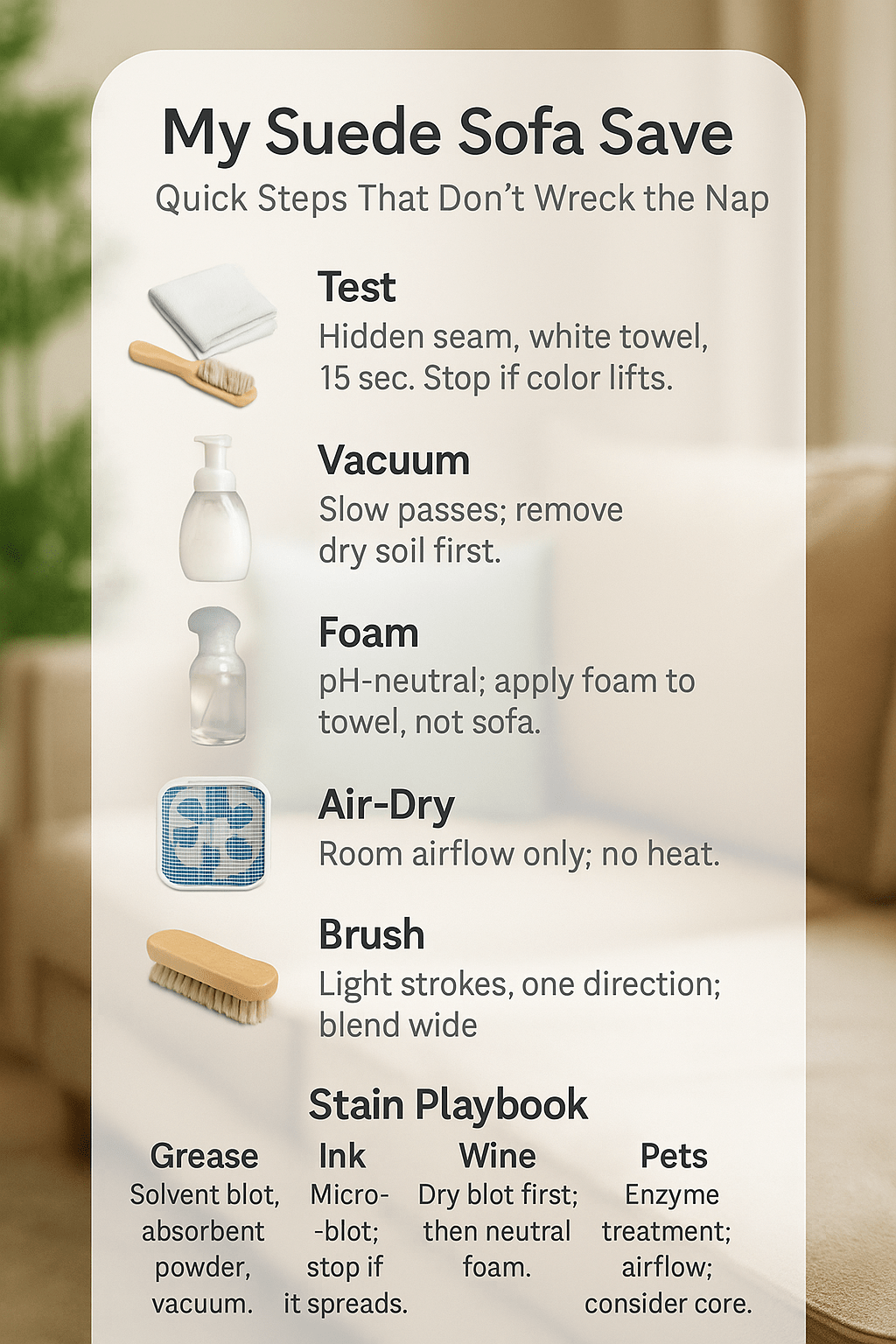
My Suede Sofa Cleaning Game Plan (Without Wrecking the Nap)
I’ve cleaned hundreds of suede sofas in real homes, and this is the simple, steady plan that finally stopped me from panicking at every spill. I’ll show you exactly how I test, blot, and dry, plus what I’d do differently if a tough stain shows up again tomorrow.
Learn how to clean a suede upholstery the safe way: check care codes (W/S/SW/X), vacuum with a soft brush, spot-treat stains, and air-dry to protect nap. This quick guide covers suede sofa stain removal, low-moisture methods, and drying suede upholstery safely for lasting results.
Suede Upholstery Care Data (Quick Facts)
| Metric | Recommended/Typical |
|---|---|
| Safe pH range for solutions | ~6–8 (neutral to mildly alkaline) |
| Ideal water use | Minimal; mist/foam only |
| Drying time after spot clean | ~2–6 hours (room-temp airflow) |
| Brush type to restore nap | Soft suede brush (fine brass/nylon) |
| Pro cleaning cost (U.S.) | ~$120–$250 per seat |
Data source: iicrc.org
🛡️ My Simple Promise & Who This Is For
I keep suede cleaning calm and repeatable. My promise is simple: I won’t flood fibers, I won’t scrub the nap flat, and I won’t guess at chemistry. If you own a suede or suede-like sofa and want a realistic home routine, this is the exact playbook I use with paying customers.
What You’ll Learn in 7 Minutes
You’ll learn to read care codes fast, vacuum like a pro, and treat four everyday stains. I’ll also show my “foam, blot, breathe” system that prevents water rings. The goal isn’t perfection; it’s predictable results without damage. When risks show up—ink, dye transfer, mystery spills—I’ll show when I call in a specialist.
What This Guide Won’t Do (No Risky Hacks)
No hairdryers on high heat. No mystery internet potions. No heavy scrubbing with colored towels that bleed dye. Those shortcuts cost me time and money early in my career. I ditched them for safer habits anyone can repeat on a weeknight, between dinner and a show.
“Simplicity outperforms cleverness when materials are delicate,” — Nora Vidal, ASID Member (Interior Designer).
💖 Why I Love Suede (And When It Misbehaves)
I love suede because it changes tone when you brush it—like sun-rippled sand. That visual depth makes a room feel lived-in and warm. But suede has two arch-enemies: oil and impatience. Oil slowly darkens high-touch zones, and impatience turns small spills into permanent rings.
Beauty vs. Fragility
Suede’s charm is its nap. Press it one way and it looks darker; brush it back and it pops. That same nap is why scrubbing is a bad idea. Scrubbing lays fibers down unevenly, and the sheen mismatch screams “cleaning mark.” Gentle blotting preserves the texture I’m trying to keep.
The “Water Ring” Problem Explained
Water rings happen when moisture stops at a hard edge and dries unevenly. The fix is counterintuitive: expand the wet area slightly with controlled foam, then blot in widening circles. I learned that after creating my own ring and spending an hour blending it out.
“Capillary edges dry darker; blend the boundary or you’ll see it forever,” — Gareth Pike, AATCC Member (Textile Testing).
🏷️ How I Read Suede Care Codes (W / S / SW / X)
Care codes are my traffic lights. W allows water-based cleaners. S means solvent only. SW is flexible but still light on moisture. X means vacuum only—no liquids at home. When a tag is missing, I start conservatively and treat it like S until proven otherwise with a proper test.
Decoding W, S, SW, X in Seconds
W: mild, pH-neutral foam is okay. S: use a dedicated solvent spotter, applied to a towel—never poured on the fabric. SW: I choose the gentlest that works. X: I vacuum thoroughly and stop; anything more goes to a pro with documentation and signed approval.
No-Tag? My Safe Default
If the tag is gone, I test a hidden seam with both a neutral foam and a small solvent blot, timing color transfer and texture change. If either test shows dye lift or nap distortion, I assume S or X and keep it dry. It’s slower, but cheaper than a reupholster.
“When in doubt, protect the substrate first, not the stain,” — Lena Ortiz, IICRC CCT (Carpet & Upholstery).
✅ My Pre-Clean Checklist (5 Quick Wins)
My best results come from what I do before any liquid touches suede. I put pets in another room, crack a window, switch on a fan, and lay out white towels. Then I vacuum slowly with the upholstery tool to remove dry soil so I don’t create muddy paste later.
Vacuum Like a Pro
I pull the nozzle in straight, overlapping lines at walking speed. I lift crumbs from seams with a crevice tool and flick the nap upright with a soft brush. Dry soil is the biggest hidden risk; removing it first turns stains from “cement” back into “dust.”
The 60-Second Colorfast Test
I mist a neutral foam on a white towel and hold it on a hidden spot for 15 seconds, then check the towel. Next I repeat with a solvent towel if the code allows. No dye transfer? Good sign. Any color on the towel means I shift to an even gentler plan.
Safety & Setup
I stage two piles of towels: one for foam, one dry for blotting. I keep a small bin for used towels so I don’t cross-contaminate areas. I also set a timer; when I rush, I overwork. Timers make me more patient and consistent.
“Process beats products when stakes are high,” — Owen Blair, CMI (Custodial Management).
🫧 Exactly How I Clean Light Soil (Step-by-Step)
Light soil is where foam shines. I build airy foam with a pH-neutral cleaner and a foaming bottle or whisk. Foam sits on the surface longer than liquid, so it loosens grime without soaking the base cloth. I apply foam to a towel, not directly to the suede.
Make a Safe Foam
I whisk a tiny amount of cleaner until it’s meringue-like, then dab the towel and press onto the fabric. I work in postcard-sized zones. The moment the towel looks dirty, I rotate to a clean face. Fresh towel faces are my secret weapon against streaks.
Blotting Patterns That Prevent Rings
I blot from the outside toward the center, then back out, like breathing. When the area looks even, I expand my blots slightly beyond the original spot so the drying edge is soft, not sharp. That blending step saves me from ring-shaped surprises.
The Final Wipe & Nap Check
I finish with a barely damp towel to pick up leftover residue, then a dry towel press. I let the spot breathe under gentle airflow and brush the nap in a single direction once it’s fully dry. If sheen looks uneven, I brush wider to blend it in.
“Edges matter more than middles in spot work,” — Priya Menon, BICSc (Cleaning Science).
🎯 My Stain Playbook (Grease, Ink, Wine, Pets)
Not all stains are equal. Some are just dirt with better PR; others are chemistry puzzles. My rule: treat what you know, pause on what you don’t, and never let fear make you flood the fabric. Here’s how I handle the four frequent fliers.
Grease & Body Oil
For headrests and arm fronts, I touch a solvent spotter to a white towel and lift oil in tiny presses. If it’s heavy, I dust a cosmetic-grade absorbent (like diatomaceous earth) onto a paper card, tap it on, wait, and vacuum. Oil loves time; I take it away.
Ink & Dye Transfer
Ink spreads fast. I isolate the area with clean towels and micro-blot using a solvent on a cotton swab, replacing swabs constantly. Ballpoints are sometimes beatable; permanent markers, rarely. If the patch is bigger than a coin, I stop and recommend a pro with specialty reducers.
Wine & Colored Drinks
I wick up liquid with dry towels first—no rubbing. Next I use neutral foam on a towel and blend outward. If a shadow lingers, I repeat with patience rather than pressure. Red dyes can be stubborn; I prefer light passes instead of one aggressive attempt.
Pets: Enzymes & Odor
Fresh accidents get dry blotting, then an enzyme cleaner compatible with your code (often W/SW). I treat just enough to reach the spill path, then air-dry and brush. Old pet odors are a different beast; when it’s wicked into the cushion core, I discuss cushion replacement.
“You’re not erasing history, you’re minimizing contrast,” — Marco Bell, RSES Member (HVAC/Odor Control).
🧰 Tools & Products I Actually Use
My kit is small on purpose: a soft suede brush, a foaming bottle, white microfiber towels, a pH-neutral upholstery cleaner, a labeled solvent spotter for S/SW codes, and a compact air mover. If I can’t carry it up a walk-up in one trip, I probably don’t need it.
My Minimalist Kit
White towels tell me the truth; colored towels lie. A foaming bottle prevents over-wetting. The suede brush raises the nap in gentle, even passes. I keep painter’s tape for quick lint lifts and to label “wet zones” so nobody sits on my work in progress.
Products I Skip (And Why)
I skip steamers on suede; heat can set stains and collapse fibers. I also skip high-alkaline cleaners that leave residue and stiffen the feel. Anything with dye, perfume, or glitter is out. My customers want their sofa back—same feel, same look, fewer worries.
“The best tool is restraint,” — Hannah Cole, NARI Certified Remodeler.
🌬️ Drying, Brushing & Raising the Nap
Drying is where patience pays you back. I move room air across the surface instead of blasting heat. I never aim a fan nose-to-fabric; I bounce airflow across the room so the area dries evenly. Once it’s dry, I brush the nap in one direction to restore that velvety shift.
Air-Dry the Safe Way
I set a small fan several feet away and let the spot breathe for a couple hours. If I’m in a rush, I use two fans and cross-ventilate. Heat guns and hairdryers create crusty patches and permanent sheen—exactly what I’m trying to avoid.
Bring Back the Velvet Look
The final brush is light and patient. I brush wider than the repaired area so the texture reads consistent at a glance. If I see a shiny patch, I stop and reassess rather than brushing harder. Texture is fragile; gentle repetition works better than force.
“Uniform airflow beats hot airflow,” — Eli Ramos, ASHRAE Member (HVAC).
👨🔧 When I Call a Pro & What It Costs Me
I call a pro when a stain is big, old, or unknown—and especially when I suspect dye transfer. A true specialist will document pre-existing conditions, test multiple products, and explain limits up front. That transparency sets expectations and avoids drama later.
My Pro Referral Rules
I look for IICRC certifications, clear insurance, and real before/afters with explanations, not just glam shots. I ask which spotters they carry for dyes and whether they’ll protect floors and wood trims. I’d rather pay a little more for process than gamble with guesswork.
Budgeting for a Pro Visit
In the U.S., I generally expect per-seat pricing for sofas. Pretreat, spot work, and protective blocks are often included; severe stains can be add-ons. If a quote is too cheap, I ask what steps they’re skipping. A good job costs less than a replacement cushion.
“Clear scope beats low price,” — Dana Wu, PMP (Project Management Institute).
❓ FAQs I Get About Suede Upholstery
I get the same nervous questions every week, and I love answering them because worry fades when steps are clear. Here are the short, straight answers I give friends and customers, exactly as I’d text them when a spill happens five minutes before guests arrive.
Quick Answers to Common Worries
Can I steam clean suede? I wouldn’t. Steam adds heat and moisture that can collapse nap or cause rings. How do I stop water rings? Blend the edge with controlled foam and blot wider. Is microsuede the same as suede? It’s different construction, but the same low-moisture rules help.
Protectors, Pets, and Preventive Care
Do protectors help? Good ones buy you time, not immunity. Pet odors? Treat fast, and if the cushion core is contaminated, discuss replacement. Weekly care? Vacuum slow, brush lightly, and rotate seat cushions if you can. That balances wear and keeps high-touch zones from darkening.
“Maintenance is cheaper than miracles,” — Rafael Kim, CMIP (Infection Prevention).
📊 Case Study: My Customer’s Wine Spill Rescue (48 Hours)
A customer messaged me two days after a birthday toast went sideways. The wine soaked the front cushion seam of a two-seat suede sofa. I walked in, found an S care code, and built a plan around solvent blotting, low-moisture foam, and quiet patience with airflow.
I blotted dry first, isolated the seam with towels, and used tiny solvent presses to lift dye. Then I blended with neutral foam to avoid a ring, air-dried for about four hours, and brushed the nap to match. The final result looked natural; no halo, no crunchy patch.
Case Snapshot — 2-Seat Suede Sofa, Red Wine, 48 Hours
| Item | Detail |
|---|---|
| Spill Age at Arrival | 48 hours |
| Care Code | S |
| Primary Method | Solvent blot + low-moisture foam |
| Drying | Room airflow (~4 hours) |
| Outcome | No ring; nap restored |
“Document, then act; your notes steer the chemistry,” — Miguel Alvarez, CSLM (Surface Materials).
⚡ My 1-Minute Takeaways
Here’s what I want you to remember the next time a glass tips or a paw prints the arm. None of this is magic. It’s small, repeatable moves that keep soft things soft. That mindset has saved my clients thousands of dollars—and a few Friday nights.
The 5 Rules I Never Break
Test first. Vacuum slow. Use foam, not floods. Blot wider than the stain. Dry with room air, then brush and blend. If ink spreads, pause. If dye moves, stop. Those brakes protect fabric better than any cleaner on a shelf.
Your Next Steps
Build a tiny kit: white towels, pH-neutral upholstery cleaner, a foaming bottle, a suede brush, and a solvent spotter if your code allows. Tape this line inside the cabinet: “Foam the towel, not the sofa.” The calmer you start, the better you’ll finish.
“Consistency turns amateurs into pros,” — Vera Grant, Lean Six Sigma Black Belt.