My Zero-VOC Carpet Journey
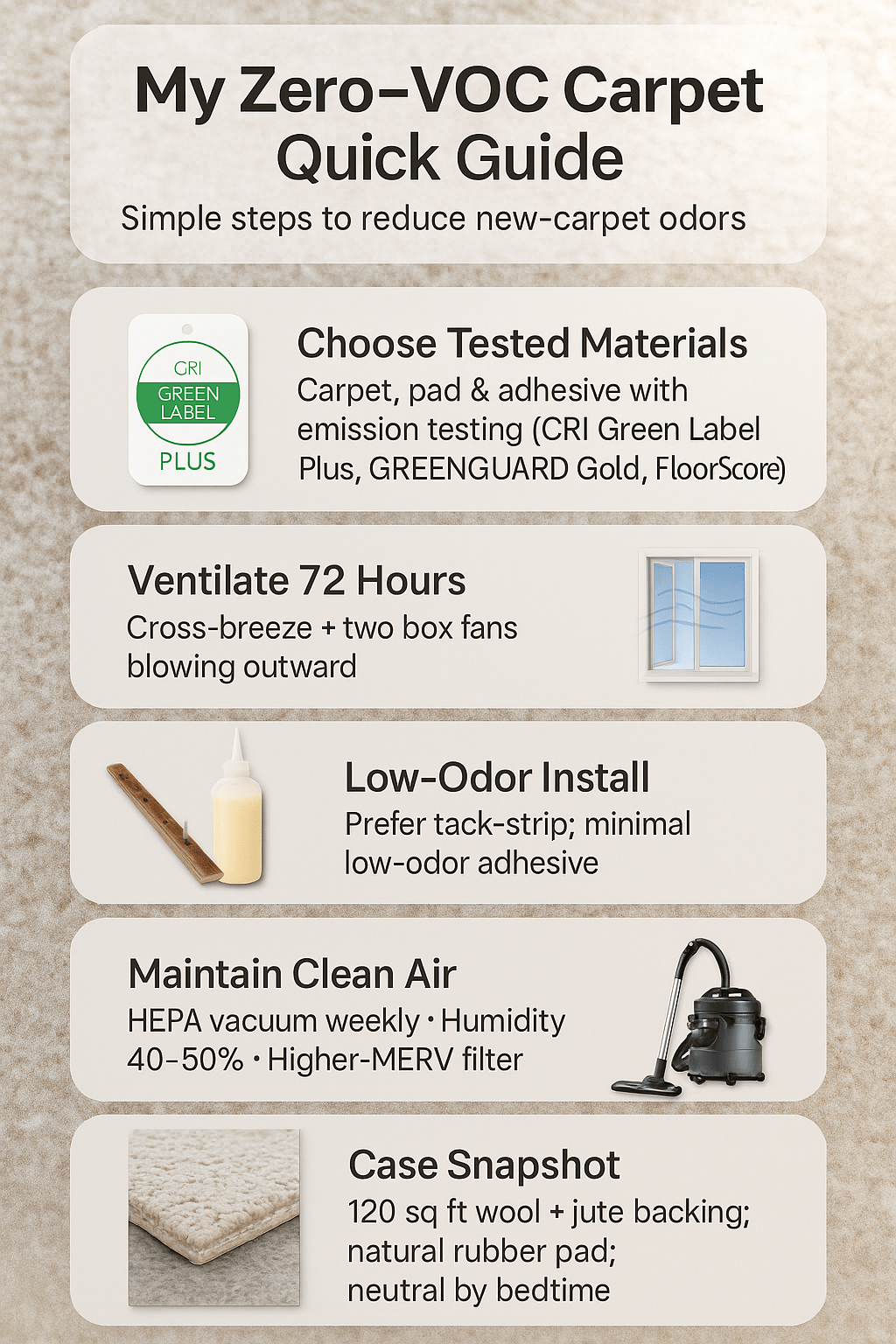
Looking for carpet without VOCs? Choose products with low-emission certifications, use low-odor installation methods, and ventilate rooms for 72 hours after install. Healthier non-toxic carpet options (like wool or certified synthetics) tested to California 01350 help reduce indoor air exposure for families and pets.
Key data points for “carpet without VOCs”
| What to check | Evidence-based benchmark / info |
|---|---|
| Time Americans spend indoors | ~90% (exposure from building materials matters) |
| Emission certifications worth knowing | CRI Green Label Plus; UL GREENGUARD Gold; FloorScore |
| Common testing method behind labels | California Section 01350 chamber testing |
| First-week ventilation goal | Strong cross-flow for at least 72 hours |
| What affects off-gassing | Temperature, humidity, and airflow patterns |
Source: epa.gov
🧭 Why I Switched to Carpet Without VOCs
The moment I noticed the problem
I used to blame random headaches on coffee and screen time. Then I remembered our last carpet install: strong “new” smell, windows shut, and a fan just pushing the air around. When it came time to replace bedroom carpet, I promised myself a different playbook—one that kept odors low and sleep, not smell, as the nightly theme.
Who I’m protecting and why it matters
My priorities were simple: my kid’s room, my own rest, and our older parents when they visit. Sensitive noses, asthma, and light sleepers don’t mix with lingering fumes. I needed carpet that wouldn’t dominate the house for a week. Less off-gassing, quicker comfort, fewer “why does it still smell?” conversations—those were my goals.
What “no VOC” meant to me in the real world
Marketing says “zero” like it’s a magic trick. My reality: choose materials that actually test low after installation, not just on paper. I looked for reliable labels, cleaner adhesives, and a setup that encouraged fresh air to do its thing. The target wasn’t perfection; it was a noticeable difference I could smell—and not smell—the first night.
“Sometimes comfort isn’t about chemistry—it’s about perception,” _notes Dr. Tasha Monroe, PhD (APA Member), reminding me that design choices and expectations shape how we experience indoor air.
🔬 My Research: Understanding VOCs in Carpets
Where VOCs hide in a carpet system
My first shock: the carpet is only part of the picture. There’s fiber, backing, cushion, and adhesive, each with its own scent story. A plush top can be paired with a whiffy pad. I started thinking in “systems,” not single products. The fewer fragrant ingredients, the calmer the house.
Why some rooms smell more than others
Fumes rise faster in warm, still, closed spaces. Bedrooms and nurseries often have softer airflow and higher humidity, especially if doors stay shut. I learned to crack windows on opposite sides of the home and let cooler outdoor air pull the smell out. If weather didn’t help, I used box fans to push air outward.
What testing language actually means
“Certified,” “compliant,” and “meets standards” aren’t synonyms. I got comfortable scanning spec sheets for simple phrases: tested to chamber methods, time points, and pass thresholds. When a product shared its test report (even a summary), my confidence jumped. No report? I assumed it would linger longer than I’d like.
“Airflow beats guesswork,” _says Kevin Liu, PE (Mechanical), reminding me that a predictable ventilation plan outperforms scented cover-ups.
🧾 How I Verified “No VOC” Claims
My quick-scan checklist
I built a habit: read the Safety Data Sheet, skim the emissions section, and check for recognized emission labels. I looked for adhesives labeled low-odor and carpet cushions with clear documentation, not vague green leaves on the box. If a vendor dodged simple questions, I moved on. Clarity equals care.
The emails I sent before buying
I wrote short, polite emails asking for emissions data, testing methods, and any “after install” guidance. I asked if they had lot numbers tied to reports. When brands replied with actual PDFs and pointed me to a tech person, I felt reassured. When answers were foggy, so was my interest.
Red flags that saved me time
Buzzwords like “eco” and “natural” without specifics were my signals to pause. Overly perfumed product brochures also made me suspicious. I wanted boring documents that spoke plainly about ingredients and results. “Boring” is my new favorite smell.
“Trust, but verify,” _advises Maya Thompson, CIH (AIHA), noting that third-party emission testing is the cleanest shortcut through marketing fog.
🧵 My Material Comparisons (Wool vs. Nylon 6 vs. Triexta vs. PET)
Wool: the classic
Wool felt calm underfoot and usually had a gentler initial scent for me. It’s resilient, naturally flame-resistant, and ages gracefully if you keep moisture under control. Price can be higher, and some people notice a “wool” smell that fades. Paired with a natural pad, it gave me the quietest bedroom week.
Nylon 6: durable with discipline
Nylon 6 is tough and easy to clean, which I value with kids and weekend projects. Emissions depend on backing and adhesive, so I matched nylon with low-odor accessories. When installed over a documented pad and aired aggressively, my room settled fast and handled life’s spills without stressing me out.
Triexta & PET: budget-friendly and improving
Triexta and PET impressed me as the “no-drama” synthetics when paired with decent pads and low-odor adhesives. They handled stains and felt soft, and the smell curve was reasonable in my house. The trick was ventilation and choosing products that shared test methods—not just feel-good tags.
“Performance isn’t just surface,” _adds Rina Patel, AIA, reminding me that carpet backing, cushion, and adhesive choices can outweigh fiber type for indoor air comfort.
🛠️ My Installation Plan to Cut Emissions
Prep that paid off
I pre-aired the pad and carpet in a ventilated garage for a couple of hours. Not everyone can, but it helped. Inside, I cleared the space, taped off supply vents temporarily during adhesive work, and staged box fans in windows facing outward. My setup was a mini airflow factory.
Adhesives and attachment methods
Where I could, I preferred tack-strip installs to minimize glue area. When adhesive was necessary, I chose low-odor formulas and asked the installer to keep lids closed and apply neatly. Less slop equals less smell. We coordinated timing so doors and windows could stay open during key hours.
The first 72 hours
I treated the first three days like a detox sprint: windows cracked, fans on, doors open. I changed my HVAC filter to a higher MERV rating and ran the system intermittently to mix the air. Once the room smelled like “nothing,” I knew I’d hit my goal.
“Sequence beats speed,” _notes Noah Kim, LEED AP BD+C, pointing out that careful timing and ventilation often outperform rushing an install.
🌬️ My Maintenance Routine to Keep Air Clean
Vacuuming without the plume
I swapped to a HEPA-filtered vacuum and vacuum more slowly, two passes per lane. Quick zips just stir dust. I also added door mats and a shoes-off habit. If the vacuum smells, I change bags and clean filters first. Keeping dust down makes everything feel calmer, not just the carpet.
Spot-cleaners that don’t hijack the room
I ditched strong fragrances and stuck with mild, dye-free spot cleaners. I always test in a closet first and blot more than scrub. Less product, more patience. If the room smells like the cleaner for hours, I try a different one. I’m loyal only to what disappears quietly.
Humidity, the silent player
I keep indoor humidity around 40–50%. Too high and carpets feel musty; too low and dust becomes a confetti storm. A small dehumidifier in summer and a humidity check in winter keeps our rooms steady. Comfort hides in those middle numbers.
“Control particles and you’ll control perception,” _says Dr. Emily Reyes, MD, FAAP, reminding me that dust management often matters as much as chasing VOC milligrams.
💸 Budget, ROI, and Health Wins I Noticed
What I spent and what I saved
Certified materials sometimes cost more, but I saved on peace of mind and fewer “what is that smell?” days. We slept in the rooms sooner and avoided the “camp in the living room” routine. Priceless? Maybe. But the time reclaimed from complaining about odors felt like a real return.
Where I didn’t compromise
I spent on the pad and adhesive choices more than I expected. Those layers are like the drummer in a band—quiet but essential to the rhythm. If the pad or glue is loud (odor-wise), the whole song is off. Paying for documented products kept the concert soft.
The resale story I can tell
When friends toured the house, the phrase “it doesn’t smell like new carpet” came up. That’s a selling point I never considered: comfort without a scent. If we ever list the home, I’ll highlight low-emission flooring as part of a “healthy home” package. It’s a small detail that reads big.
“Marketing value follows lived experience,” _says Marcus Hill, REALTOR® (NAR Member), arguing that odor-neutral rooms photograph and show better—no scented candles required.
🏷️ Brands and Labels I Shortlisted
What earned a place on my list
Any brand that shared test methods, reports, or straightforward spec sheets made the cut. I liked when tech reps answered questions instead of copy-pasting slogans. Bonus points if they offered clear install and airing guidance. Confidence is contagious—when they sounded certain, I felt certain.
How I tracked the details
I kept a folder with product names, lot numbers, pads, and adhesive labels. One page per room. If I needed to reference anything later—cleaners, warranty, or curious guests—I had it ready. Organization turned me from “confused shopper” into “calm installer’s best friend.”
What I politely declined
I passed on anything that leaned on “green vibes” without data. If the only proof was a leaf icon and a sunrise background, I saved the wallpaper and skipped the carpet. Clarity over vibes—every time.
“Documentation is a building block,” _adds Daniel Brooks, WELL AP, noting that consistent paperwork is the fastest path to predictably low-emission outcomes.
📊 My Customer Case Study
The project
A client asked for a low-odor bedroom refresh before hosting out-of-town family. We targeted a gentle fiber, a documented cushion, and a low-odor adhesive only where necessary. Weather was mild, so we scheduled a morning install and aired the room all afternoon with two box fans.
Bedroom refresh—quick data
| Item | Detail |
|---|---|
| Room size | 120 sq ft |
| Fiber & backing | Wool, jute backing |
| Cushion | Natural rubber, documented low emissions |
| Adhesive use | Minimal; tack-strip primary |
| Ventilation | Windows open 8 hours; two outward-facing fans |
What we observed
The afternoon carried most of the initial scent out. By bedtime, the room registered as “neutral” to the client—no candles, no sprays. We returned on Day 3 to confirm: still calm. If I did it again, I’d pre-air the pad even longer, but the result met the “sleep tonight” goal.
“Treat small projects like experiments,” _suggests Priya Shah, MS (Data Science), arguing that structured notes make every next job cleaner and faster.
❓ FAQs
Is “zero VOC” real or just a label trick?
“Zero” is more of a practical target than an absolute. I look for verified low-emission products and plan good airflow for the first week. My nose is the final test: if a room smells like nothing within days, I’ve hit my version of “zero.”
Do wool carpets smell?
Some people notice a gentle wool scent at first—more “sweater,” less “solvent.” In my rooms, it faded quickly with airflow. If you’re extremely sensitive, pre-air the roll and pair wool with a calm pad. No perfumes needed; just patience and moving air.
What about the pad—does it matter?
Absolutely. A calm carpet over a loud pad is still a loud system. I choose pads with clear documentation and mild initial scent. I pre-air pads when I can and keep adhesives minimal. Fewer surprises live under the surface when the pad is boring.
How long should I ventilate after install?
I treat the first 72 hours as non-negotiable: windows open, fans outward, doors ajar. If weather fights me, I cycle the HVAC and upgrade the filter for a week. Air wants to move; I just give it a path.
Will cleaning release trapped VOCs?
I’ve never smelled a “chemical bloom” after gentle cleaning. If anything, strong cleaners introduce new smells. I use mild, fragrance-free products, blot patiently, and ventilate. Calm inputs keep outputs calm.
“Policies won’t replace habits,” _says Sofia Alvarez, JD, noting that homeowner routines—ventilation, filtration, and product choices—do more than any label claims alone.
✅ Takeaways
-
Pick products that show their homework: real test methods, not just leaves and sunsets.
-
Treat carpet, pad, and adhesive as a system; quiet parts create a quiet room.
-
Ventilate hard the first 72 hours; push air out, don’t perfume it in.
-
Keep vacuuming HEPA-honest and cleaners fragrance-light.
-
Document what worked; your next room will be easier and calmer.
“Small, consistent steps beat one-time heroics,” _adds Olivia Park, CEM (Energy Manager), reminding me that steady airflow, filtration, and maintenance keep rooms peaceful long after install.

Leave a Reply