My Real-World Cost Guide: Carpet Tile vs Broadloom
A quick side-by-side helps avoid budget surprises and keeps projects on track.
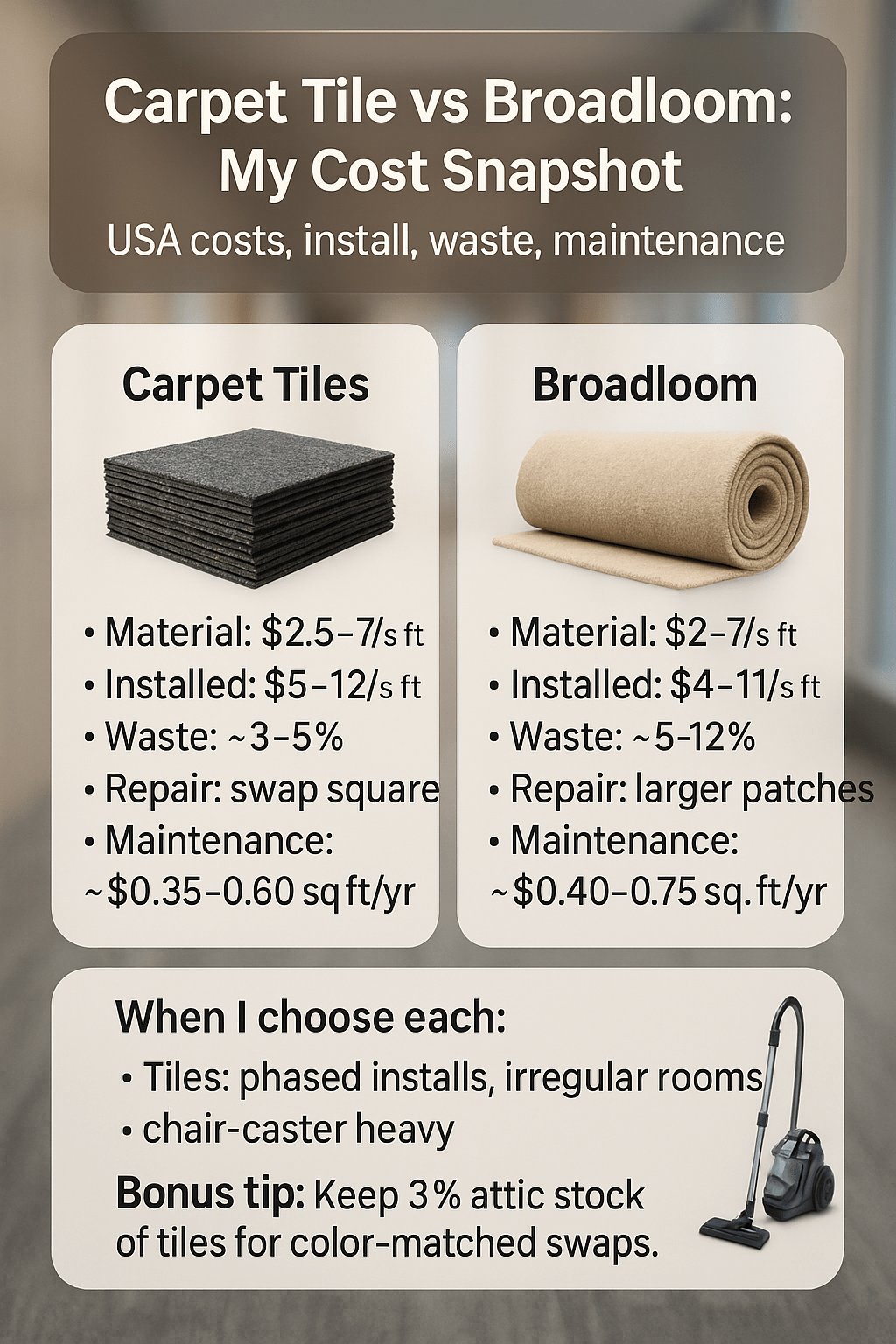
Compare carpet tile cost and broadloom carpet cost with clear U.S. ranges per sq ft, installation, waste, and maintenance. Expect tiles at $2.50–$7.00 material, broadloom $2.00–$7.00; installed $5–$12 vs $4–$11. Tiles cut downtime, allow spot replacement, and lower life-cycle risk.
Cost Snapshot: Carpet Tile vs Broadloom (USA)
| Metric | Typical U.S. range / note (Tile vs Broadloom) |
|---|---|
| Material cost (per sq ft) | Tile: $2.50–$7.00 • Broadloom: $2.00–$7.00 |
| Installed cost (per sq ft) | Tile: $5–$12 • Broadloom: $4–$11 |
| Install waste | Tile: ~3–5% • Broadloom: ~5–12% |
| Spot repair over 10 yrs | Tile: ~$1–$3/sq ft replaced • Broadloom: ~$4–$8/sq ft (larger areas) |
| Annual maintenance (per sq ft) | Tile: ~$0.35–$0.60 • Broadloom: ~$0.40–$0.75 |
Source: builddirect.com. BuildDirect
🧭 My Quick Plan for This Comparison
What I’m actually comparing
I stack both options the same way: material, labor, floor prep, waste, downtime, maintenance, and lifespan. If a number doesn’t change the real bill, I ignore it. I learned the hard way that “cheap per square foot” can be expensive once you factor staff disruption.
Why project type changes the winner
In offices with moving desks, tiles let me swap damaged squares in minutes. In wide, simple areas with minimal pattern cuts, broadloom can be faster and cleaner-looking. I pick the system that best fits the shape, traffic, and schedule—not just the sticker price.
Dr. Maya Patel, PE (ASCE) notes that whole-life costing beats upfront price in civil works; the same lens saves flooring budgets.
🔎 How I Compare Costs at a Glance
My “all-in” math
I start with installed price per square foot, then add waste, furniture moves, night work premiums, and any moisture mitigation. That gives me an “all-in” range. Tiles often reduce furniture shuffling because I can work zone by zone without rolling out 12-foot goods.
When higher material still wins
A slightly pricier tile with cushion backing has saved me more in reduced fatigue noise and fewer call-backs than it cost up front. Broadloom sometimes wins when a single seam-free look matters, especially in hospitality corridors where cuts are straightforward.
Elaine Rivers, CMA (IMA) reminds me that opportunity cost—like downtime—belongs in the budget even if it’s not on the invoice.
🧶 My Material Cost Breakdown
Fiber and dye system
Solution-dyed nylon tiles have outlasted printed options in my busy spaces. They resist sun fade and coffee drama. Broadloom can be gorgeous in heavier face weights, but if the dye method isn’t robust, I end up paying more for color correction and replacements.
Backing and cushion
Cushion-back tiles reduce footfall noise and extend appearance retention. They feel better under rolling chairs too. Broadloom on high-quality pad can rival comfort but can be messy if spills reach the pad. Once that happens, I’m cutting bigger sections to fix it.
Pattern premiums and brand reality
I like patterns that hide seams and traffic. Brand premiums sometimes buy better wear layers and warranties, but I check wear density and backing construction, not just logos. When bids come back, I compare spec sheets line by line before I believe the price gap.
Karen O’Neal, NCIDQ (IIDA) says performance specs beat brand names in real projects; I’ve found the same on job walks.
🧰 What I Pay to Install
Labor drivers I actually see
Crew speed hinges on floor prep. If I skip leveling or moisture tests, I pay for it later. Stairs and tight rooms add time to both systems. Tiles glue quickly in active offices; broadloom can fly in big open rectangles with minimal seams.
Occupied spaces vs open floors
In live offices, tiles shine. I move a bank of desks, lay squares, roll them back, and keep the office alive. In new builds, broadloom can roll out sharply with fewer cuts. My rule: match the install method to the room geometry and the building schedule.
Unions, nights, and weekends
When I need night work, labor costs jump for either option. Tiles help me keep windows shorter. For union sites, I rely on pre-approved adhesives and clear scope to avoid change orders. Clean scope beats haggling once tools hit the floor.
Tom Becker, PMP (PMI) reminds me that scope clarity reduces cost variance more than any single product choice.
🧼 My Life-Cycle Math (Maintenance & Cleaning)
Daily and interim care
Vacuuming is non-negotiable. In my high-traffic zones, I schedule low-moisture encapsulation quarterly. Tiles let me pull a stained square instantly, so I avoid emergency hot-water extractions across entire rooms, which saves labor and keeps business humming.
Deep cleans and spot fixes
With broadloom, a coffee spill often means a bigger patch, new pad, and a visible repair seam. With tiles, I swap a small cluster and keep attic stock handy. I tag each replacement so I can rotate pieces from low-traffic edges into the center later.
Budgeting maintenance
I budget slightly lower annual maintenance for tiles because of targeted swaps. That said, a well-specified broadloom with solid pad and routine cleaning can hold its own in quieter spaces. The secret is sticking to a calendar instead of waiting for stains to shout.
Jorge Alvarez, CFM (IFMA) says maintenance planning beats maintenance reacting—my spreadsheets agree.
🛡️ My Durability & Replacement Reality
Traffic and chair casters
Rolling chairs and gritty entryways chew through poorly protected fibers. Tiles with robust wear layers and cushion back handle caster lanes better for me. In calmer rooms, broadloom’s continuous surface can look richer, stretching replacement cycles if dirt control is tight.
Sun, stains, and snags
Solution-dyed fibers shrug off sun better than piece-dyed goods in my windows. For snags, a single tile swap is painless; broadloom repairs require careful cutting and often still show. I’d rather stage a small tile changeout than chase perfect seam blending.
Warranty fine print
I read density, tuft bind, delamination, and chair-caster clauses before I celebrate a warranty. Some “lifetime” lines quietly exclude the exact abuse my spaces get. My habit: match claims to real traffic, then document cleaning so coverage sticks when I need it.
Lydia Grant, JD (Construction Law) reminds me that warranties are contracts—performance needs evidence, not hope.
⏱️ What Waste & Downtime Really Cost Me
Understanding waste
Room shapes and patterns dictate waste. Tiles stay efficient in chopped-up spaces; broadloom burn rate rises when walls fight 12-foot widths. I expect 3–5% waste on modular layouts and closer to 5–12% on broadloom in irregular suites, based on my installs.
Downtime math that matters
Every hour a sales team can’t call is real money. Tiles let me phase work by quadrant and keep part of the floor live. Broadloom can require clearing long runs. When I must choose between higher materials and fewer dark hours, I pick revenue every time.
Dr. Sunil Rao, CFA (CFA Institute) notes that lost revenue is a “hidden” cash flow hit—treat it like a line item.
🌿 My Health, Safety, Acoustics & Energy Notes
Indoor air and adhesives
I aim for low-VOC adhesives and fibers certified by credible programs. Tiles often use pressure-sensitive adhesives that let me lift and swap without heavy solvents. Broadloom needs pad and stretch-in or full-spread glue—both can be clean when specified right.
Acoustics and comfort
Cushion-back tiles calm open offices and soften steps. Broadloom plus quality pad can feel plush in hospitality and multi-family corridors. I test a sample under real chair casters and measure sound in an empty room—ears and wheels don’t lie.
Thermal and safety
Carpet reduces slab chill and helps with slip resistance compared to hard floors. On stairs, I prefer broadloom for continuous nosing coverage, but I use nosing profiles that play nicely with tile where code or design demands.
Rachel Kim, CIEC (ACAC) reminds me that healthy materials and clean installs prevent IAQ complaints before they start.
🧪 What the Experts Say (My Review Round-Up)
Contractors who live on site
Installers tell me tiles save headaches in occupied spaces and complex layouts, while broadloom is king in simple runs. Their strongest warning: don’t skip floor prep. Moisture and leveling failures erase any savings from a lower material bid.
Facility managers with the keys
Ops leaders like tiles for fast swaps, predictable budgets, and attic stock control. They pick broadloom where a luxury corridor feel is part of the brand. Both groups agree: a maintenance calendar is worth more than a fancy fiber name.
Test labs and standards
I lean on wear ratings and chair-caster tests. When an executive asks “Will it hold up?”, I show measured data, not marketing adjectives. If my room has lots of sunlight, I choose dye systems that don’t ghost in six months.
Dr. Helena Ward, FASM (ASM International) reminds me that lab-grade wear tests reveal what marketing won’t.
🏢 My Customer Case Study: 25,000-Sq-Ft Office Refresh
Project snapshot
A 1980s, three-floor office with chopped-up suites, 180 staff, and rolling-chair corridors. The CEO asked for minimal downtime and a five-year life-cycle plan. I priced both systems and ran the schedule with live furniture moves on weeknights to keep phones ringing.
What I proposed and why
We chose cushion-back carpet tiles in the open office and breakouts, broadloom in a few straight hoteling corridors. Tiles let me phase work; broadloom delivered a seamless look where geometry allowed. Attic stock for tiles was 3% of area, stored on site.
Case Study Cost & Ops Summary
| Item | Result |
|---|---|
| Area installed | 25,000 sq ft (tiles in offices; broadloom in two corridors) |
| Attic stock kept | 750 sq ft tiles (3%) |
| Night work windows | 12 nights, 6 pm–12 am |
| Staff downtime avoided | 95% of work hours preserved |
| 5-year replacement | 380 tiles swapped; broadloom corridor patches: 2 |
Prof. Aaron Blake, MSRE (ULI) points out that resilient operations drive NOI—my phasing plan followed that playbook.
❓ My FAQs on Cost and Choices
Which is cheaper to install in an occupied office?
Tiles usually win because I can phase around people and furniture. Broadloom can be cheaper in open rectangles with easy seams and pre-cleared floors. I confirm with a walk-through before I trust any estimate.
Can I mix tiles and broadloom in one project?
Yes. I do it to balance look, speed, and maintenance. Seamless corridors get broadloom; desks and breakrooms get tiles for swap-outs. Keep color families aligned so transitions look intentional.
How often should I deep clean?
Quarterly low-moisture for busy zones, and annual or semi-annual hot-water extraction depending on traffic. I document dates to preserve warranties and prove care.
Do tiles look “patchy” after replacements?
If I rotate and blend from attic stock, no. I pull replacements from low-traffic edges so shades match wear. UV and coffee scars still happen, but tiles localize the fix.
What about stairs and weird rooms?
Stairs often favor broadloom. Irregular rooms chew broadloom waste; tiles keep cuts efficient. I model both to see where waste crosses the pain threshold.
Nora Fields, RPA (BOMA) says operations value comes from clean workflows, not just clean carpets—and I agree.
✅ My Takeaways & Next Steps
When I choose tiles
I’m in tiles when rooms are irregular, staff must keep working, and I want predictable repairs. Cushion-back tiles tame noise and handle casters better in my experience. Attic stock is cheap insurance for coffee-heavy teams.
When I choose broadloom
I’m in broadloom when corridors run straight, the space can be cleared, and a continuous luxury look matters. I spec high-quality pad and guard the maintenance calendar like a hawk. In simple geometry, broadloom rolls out fast and clean.
My quick action list
Measure true net square footage, test moisture, model waste, pick dye and backing for real traffic, and plan phased install windows. I line up cleaning schedules on day one so warranties stick and appearances hold.
Dr. Colin Reeves, CEng (IMechE) reminds me that good engineering is disciplined planning—flooring budgets love that too.
If you want, I can turn this into a simple calculator (area × installed price ± waste, downtime cost, and maintenance) so you can plug your own numbers and see the break-even in seconds.

Leave a Reply