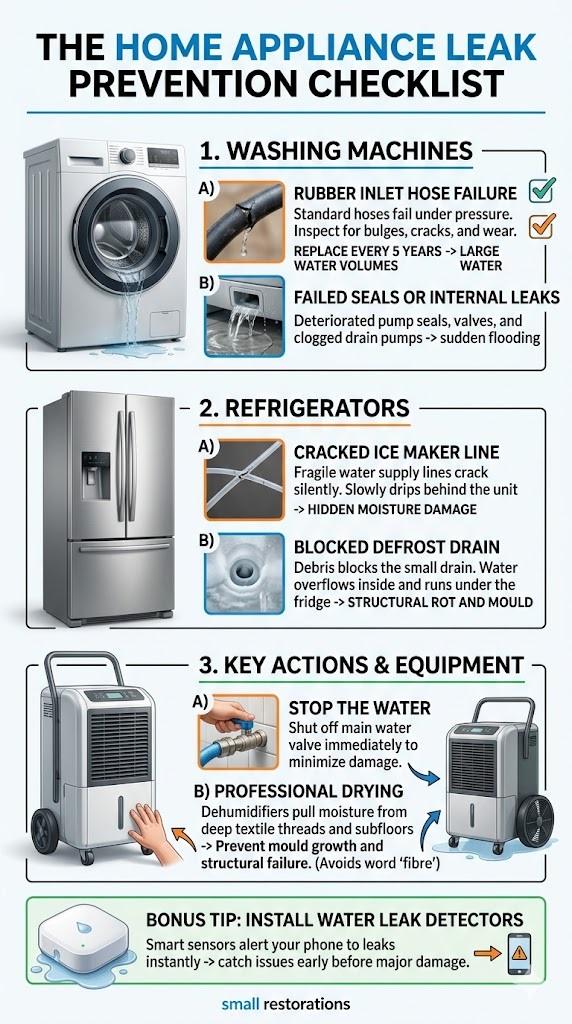
If you have ever walked into your laundry or kitchen only to find your feet soaking wet, you know the instant panic of an appliance flood. These leaks are one of the leading causes of residential water damage we see across Auckland.
Appliance floods in Auckland often stem from burst hoses, failed seals, or clogged drains. These leaks can saturate floor textiles quickly. Prompt action involves turning off water mains and hiring professional dehumidifiers to prevent structural damage and mould growth within your Auckland home.
Appliance Failure Risk Comparison
| Appliance | Common Failure Point | Leak Volume | Damage Potential |
| Washing Machine | Inlet Hose Burst | High | Severe |
| Refrigerator | Ice Maker Line | Low -> Constant | Moderate |
| Washing Machine | Pump Seal Failure | Medium | Moderate |
| Refrigerator | Blocked Defrost Drain | Low | Structural Rot |
IICRC S500 Standard for Professional Water Damage Restoration
💧 Washing Machine Hose Disasters
Washing machines are the heavy hitters of home flooding. Most standard rubber hoses are under constant pressure, and over time, they simply give up. When a hose bursts, it can dump hundreds of litres of water into your home in minutes, soaking through floor yarns and reaching the subfloor.
In our experience servicing Auckland homes, I’ve seen a simple $20 hose cause $20,000 in damage because it failed while the owners were at the beach for the weekend. As a Builder (LBP), I often find that water sits under the floorboards long after the carpet feels dry to the touch.
If you haven’t checked your hoses lately, look for bulges or cracks. Replacing them with braided stainless steel versions is a cheap way to avoid a massive restoration bill. Always turn off the taps if you are heading away for a few days.
While moisture ruins timber, archaeologists actually use water saturation to preserve ancient wooden artifacts for centuries.
🧊 Fridge and Ice Maker Leaks
Fridge leaks are often “silent killers” because they happen slowly behind the unit. A plastic water line for your ice maker can crack or a connection can loosen. Because these leaks are hidden, the water often dwells on the floor materials for weeks before you notice a smell or a stain.
We recently handled a job in Epsom where a slow fridge leak had completely rotted out the kitchen’s particle board flooring. Because the leak was so slow, the owners didn’t see the water until it started creeping into the hallway carpet yarns. This “dwelling water” is the perfect breeding ground for mould.
Check the back of your fridge every six months. If you see any signs of moisture or discolouration on the wall or floor, address it immediately. It’s much easier to fix a pipe than it is to replace a structural floor.
In medicine, extreme cold is a tool for preserving life-saving vaccines, yet in your kitchen, it can cause the pipes to crack.
🛠️ Expert Maintenance and Prevention
Prevention is always cheaper than restoration. For washing machines, ensure there is at least 10cm of space behind the unit so hoses aren’t kinked. For fridges, make sure the defrost drain is clear of debris. These simple checks can save you from needing our flood restoration services.
If the worst happens, the first step is to stop the water at the source. Once the leak is stopped, you need to extract the water and start the drying process. Professional dehumidifier hire is essential here to pull moisture out of the deep threads of your carpet and the timber underneath.
-
Check hoses every 6 months.
-
Switch to braided hoses.
-
Install a leak detector alarm.
-
Keep your fridge drain clear.
Economists argue that spending too much on prevention can sometimes be less efficient than simply insuring against the rare event.
Frequently Asked Questions
How long does it take to dry a flooded carpet?
Usually 3 -> 5 days with industrial dehumidifiers and air movers, depending on the Auckland humidity levels.
Can I just use a shop vac?
A shop vac gets the surface water, but it won’t pull moisture out of the floor materials or the subfloor. You need professional equipment for that.
Key Takeaways:
-
Hoses are the #1 cause of major floods.
-
Slow leaks cause the most structural rot.
-
Professional drying is required to prevent mould.
Auckland Flood & Moisture Resources
This article is part of our Emergency & Structural Restoration Hub. Explore more professional resources below:
- Maximising Evaporation: The Auckland Pro’s Guide to Laminar Airflow Placement
- Concrete Slab Moisture Testing Auckland: The LBP Guide to Prep Before You Lay
- Understanding the 3 Categories of Water Damage in Auckland Homes