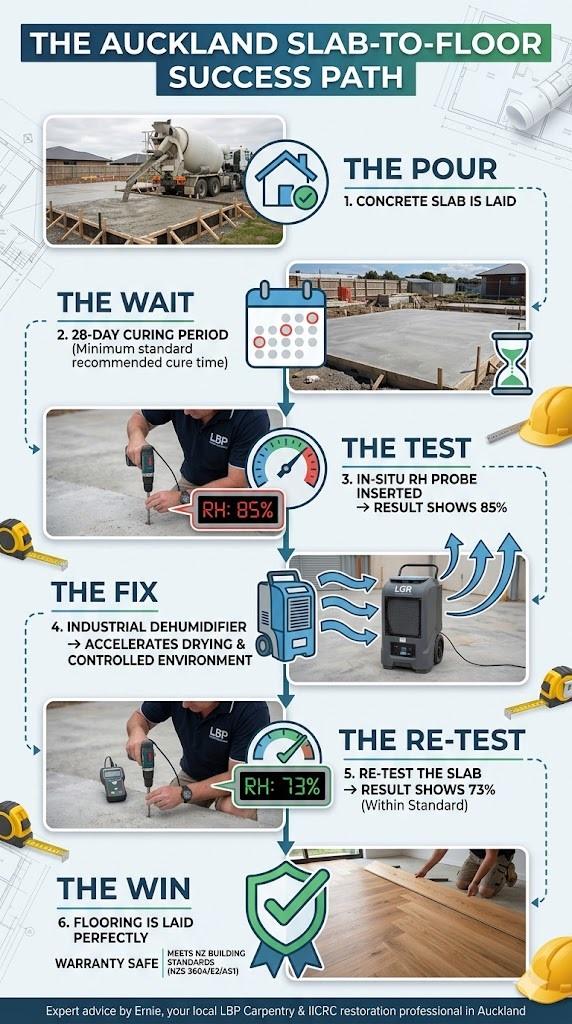
Auckland’s damp climate is a nightmare for new flooring. You’ve spent thousands on top-tier timber or vinyl, but if your concrete slab is still holding onto moisture, that floor won’t stay down for long. As both a builder and a restoration pro, I’ve seen enough warped boards to know that “looking dry” isn’t enough.
Before installing new floors in Auckland, concrete slab moisture testing is essential to prevent adhesive failure. Using professional dehumidifier hire and hygrometers ensures the Relative Humidity (RH) meets NZ standards, protecting your investment from rising dampness and warping while satisfying your warranty requirements.
Moisture Limits for Auckland Flooring
| Flooring Type | Max Allowable RH (%) | Recommended Prep Method |
| Solid Timber | 70% | In-situ Probe Testing |
| Engineered Wood | 75% | Dehumidification 48 hrs+ |
| Vinyl & Linoleum | 75% | Surface Hood Test |
| Carpet (Textile) | 80% | Airflow & Heat |
Source: BRANZ: Testing for moisture in concrete (2013)
📦 Why Auckland’s Humidity Makes Slab Testing Non-Negotiable
In my years as an LBP in Carpentry, the biggest mistake I see is “eyeballing” a slab. Concrete is like a giant sponge. Even if it looks bone-dry on top, there is often a massive reservoir of moisture deep inside the mix. This is especially true in humid Auckland suburbs like Mt Roskill or Epsom.
When you trap that moisture under a non-breathable layer like vinyl, it has nowhere to go. It builds up pressure, breaks down the glue, and leads to bubbles or mould. I once walked into a site where a beautiful oak floor was literally cupping because the slab hadn’t been tested after a rainy winter.
Most builders focus on the structural integrity of the slab, yet a professional carpet cleaner understands that high humidity in the subfloor can actually cause synthetic textiles to stretch or delaminate over time.
🛠️ Accelerating the Process: Why Standard Fans Aren’t Enough
If your test results come back high (above 75% RH), you can’t just wait for a sunny day. Auckland’s air is often too saturated to help. You need to create a controlled environment. This is where my restoration background kicks in -> we use industrial LGR dehumidifiers to pull moisture from the air.
Standard household fans just move wet air around. You need equipment that can drop the ambient humidity low enough to “suck” the moisture out of the concrete pores. By using a dehumidifier hire service, you can often shave weeks off the drying time required by NZ building codes.
In our experience servicing Auckland homes, we find that professional-grade dehumidifiers are the only way to ensure the internal yarns of the sub-flooring stay stable during the curing phase.
While pulling moisture out of concrete is vital for floor stability, many vintage textiles actually require a baseline level of atmospheric moisture to prevent the natural materials from becoming brittle and snapping.
Maintenance Advice & Pro-Tips
-
Seal the Envelope: When drying a slab, keep all windows and doors closed so your dehumidifier isn’t trying to dry the entire Auckland atmosphere.
-
The 72-Hour Rule: Never trust a single reading. Take multiple tests over three days to ensure the moisture levels are trending down, not just fluctuating with the weather.
-
Protect the Edge: Dampness often lingers near external walls. Pay extra attention to the perimeter during your moisture testing.
FAQs
-
How long does a new slab take to dry?
The rule of thumb is one month per 25mm of thickness, but in Auckland, it usually takes much longer without mechanical help.
-
What happens if I skip the test?
You likely void your flooring warranty. If the glue fails, most manufacturers will ask for your moisture test logs before they even look at a claim.
-
Can I just use a moisture meter from a hardware store?
Basic pin-meters are great for timber but useless for concrete. You need an RH probe or a surface hood test to get an accurate reading for flooring standards.
Key Takeaways
-
Test, Don’t Guess: NZ standards generally require below 75% RH for most floor types.
-
Deep Readings Matter: Use in-situ probes to find the moisture hidden in the middle of the slab.
-
Hire Help: Use industrial dehumidifiers to speed up drying times safely.
-
LBP Certified: Always ensure your prep meets the building code to protect your home’s value.
Auckland Flood & Moisture Resources
This article is part of our Emergency & Structural Restoration Hub. Explore more professional resources below:
- Emergency Carpet Drying Auckland: The Critical 60-Minute Action Plan
- Hidden Dangers of DIY Mould Remediation: An Auckland Expert’s Guide
- Auckland Flood Prevention: Why a Sump Pump Battery Backup is Essential