G’day, I’m Ernie. If you’ve ever dealt with a flooded lounge in Ponsonby or a damp rug in Remuera, you know that Auckland’s humidity is a nightmare for drying. Just pointing a fan at a wet patch isn’t enough; you need strategy to get those yarns dry before mould sets in.
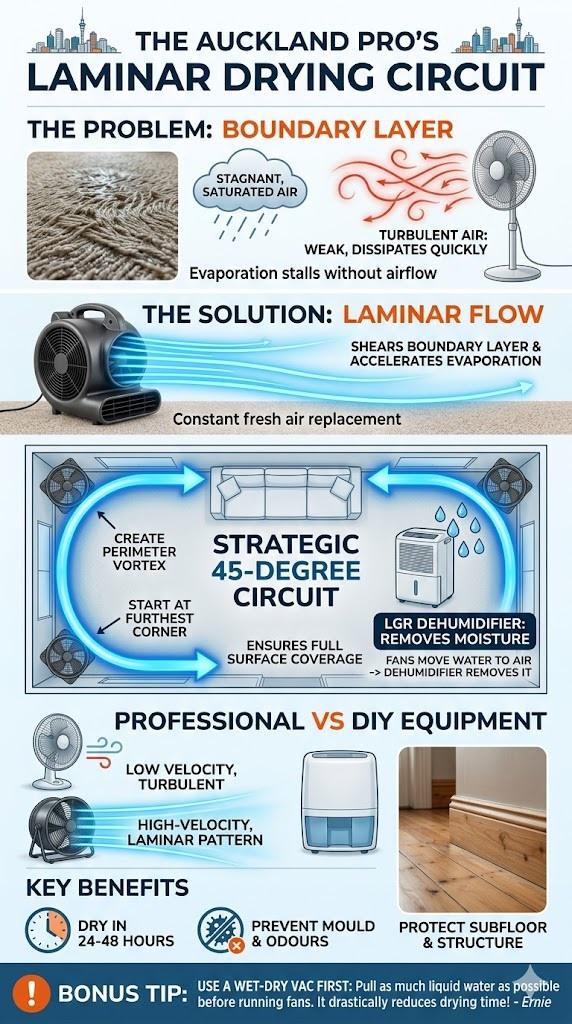
To maximize evaporation rates, technicians must utilize laminar airflow by placing high-velocity fans at 15 to 45-degree angles. This strategy disrupts the stagnant boundary layer above wet yarns, accelerating moisture removal during flood restoration or professional carpet cleaning across humid Auckland environments.
Evaporation Performance by Equipment Type
| Fan Type | Airflow Pattern | Drying Speed | Best Use Case |
| Standard Pedestal | Turbulent | Slow | General cooling only |
| Centrifugal (Snail) | Concentrated | Medium | Drying under carpet/pads |
| Axial (Laminar) | Broad & Flat | Fastest | Large surface areas |
Source: IICRC S500 Standard for Professional Water Damage Restoration (Published 2006, updated 2015).
🌊 The Science of the “Boundary Layer”
When your carpet is wet, a thin layer of saturated, still air sits right on top of the yarns. This is called the boundary layer. If this air stays still, evaporation stops because the air can’t hold any more moisture. It’s like trying to dry clothes in a sealed plastic bag.
As a Licensed Building Practitioner, I’ve seen how trapped moisture ruins floorboards. To get things moving, we need to “shear” that layer off. Laminar airflow creates a smooth, constant stream of air that travels further across the floor, constantly replacing wet air with drier air from your dehumidifier.
In the world of carpentry, we often use similar principles to design sub-floor ventilation to prevent “wet rot” in timber piles.
🛠️ Pro Tips for Strategic Fan Placement
In my years servicing Auckland homes, I’ve found that most people put fans in the middle of the room. That’s a mistake. You want the air to hug the floor. This is where “Laminar” air movers shine because they produce a flat ribbon of air that doesn’t dissipate into the ceiling.
To set up your drying zone:
-
Clear the area of furniture to prevent air “dead zones” ->
-
Place the fan in a corner, angled towards the wettest patch ->
-
Ensure the air path is unobstructed for at least 3-4 metres.
In my experience, if you don’t get the air moving within 24 hours in a humid Auckland winter, you’ll start smelling that musty “old sock” scent. That’s the smell of textiles starting to break down.
While high-speed air is great for drying yarns, in high-precision painting, too much airflow can cause “orange peel” textures on the wall.
📐 The 45-Degree Rule
The most effective way to dry a large room is to create a “vortex” or a circuit. We place the fans so the air hits the wall at a 45-degree angle. This forces the air to follow the perimeter of the room, ensuring every square inch of the materials gets hit.
-
Start at the furthest corner from the door ->
-
Point the first fan 45 degrees toward the long wall ->
-
Place the next fan where the first one starts to lose its “push”.
When I’m out on a flood restoration job in Manukau, I always check the structural integrity of the skirting boards too. If the air isn’t hitting those corners, the timber behind the carpet will stay sodden even if the yarns feel dry to the touch.
In marine engineering, laminar flow is essential for reducing drag on boat hulls to increase fuel efficiency.
🏡 Real-World Maintenance & Advice
If you’ve had a spill, don’t just wait for it to dry. Use a wet-dry vac to pull out as much liquid as possible first. Then, hire a professional-grade axial fan. Household fans just don’t have the “static pressure” needed to push air through thick carpet yarns.
FAQs:
-
How long should I run the fans? Usually 24 -> 48 hours depending on the Auckland humidity.
-
Do I need a dehumidifier too? Yes. Fans move the water into the air; the dehumidifier pulls it out of the air.
Key Takeaways:
-
Laminar airflow is superior for surface drying because it stays low.
-
The “Boundary Layer” must be disrupted to allow evaporation.
-
Strategic 45-degree placement creates a drying circuit.
-
Professional equipment hire is faster and safer than using home fans.