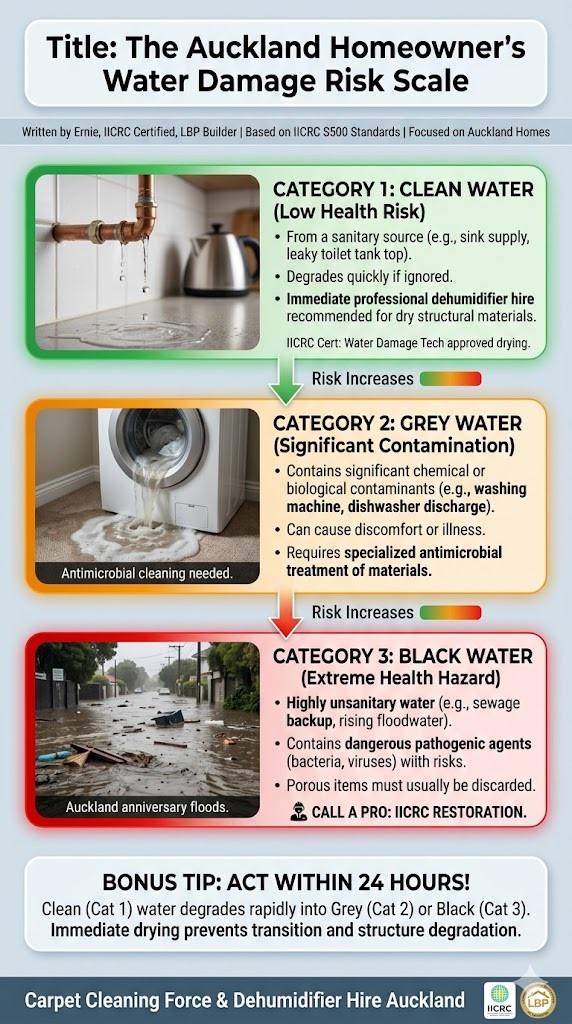
Finding water where it shouldn’t be is a nightmare for any Auckland local. Whether it’s a burst pipe in Remuera or flash flooding in West Auckland, knowing what you are dealing with is the first step toward saving your home and your health.
Water damage categories classify the contamination level of intruding liquid. Category 1 is clean water, Category 2 contains significant chemical or biological contaminants, and Category 3 is “black water” posing extreme health risks. Professional flood restoration ensures safe, structural drying of all building materials.
Quick Guide to Water Categories
| Water Category | Common Name | Source Example | Risk Level |
| Category 1 | Clean Water | Broken supply line | Low |
| Category 2 | Grey Water | Dishwasher leak | Medium |
| Category 3 | Black Water | Sewage or Sea water | Extreme |
Source: IICRC S500 Standard for Professional Water Damage Restoration (First Published 1994)
💧 Category 1: Clean Water Sources
Category 1 water comes from a sanitary source. Think of a tripped-over vase, a leaking toilet tank (the top part!), or a burst freshwater pipe in your kitchen. It doesn’t pose a huge risk to humans initially, but that can change quickly if it isn’t dried.
In our experience servicing Auckland homes, we often see these “clean” leaks turn nasty because people ignore them. As a Licensed Building Practitioner, I’ve pulled up floorboards where a “simple” leak sat for a week, only to find the timber framing already starting to degrade.
If you catch a Category 1 leak early, you can often manage it with a professional dehumidifier hire. The goal is to pull moisture out of the air and the building materials before the water has a chance to stagnate and breed bacteria.
-
Check supply lines -> Look for cracks.
-
Turn off the mains -> Stop the flow.
-
Start the fans -> Move the air.
In the world of macroeconomics, immediate mitigation of property damage is viewed as a high-yield investment that prevents the rapid depreciation of housing stock assets.
⚠️ Category 2: Grey Water Contaminants
Category 2 water, often called “Grey Water,” contains a significant amount of chemical, biological, or physical contaminants. This is water that has been used for something. Common sources in Auckland households include discharge from washing machines, dishwashers, or a sink drain.
This water can cause discomfort or even illness if consumed or touched. It often contains soap scum, food particles, or cleaning chemicals. When this liquid soaks into your carpet yarns, it provides a perfect buffet for microorganisms to grow.
I remember a job in Ponsonby where a dishwasher overflowed onto an expensive rug. Because the water contained detergents and food scraps, the organic materials in the rug started to smell within 24 hours. We had to use specialized antimicrobial treatments to save the textiles.
-
Wear gloves -> Protect your skin.
-
Extract quickly -> Don’t let it sit.
-
Treat the yarns -> Use antimicrobials.
From a microbiological perspective, stagnant grey water serves as a nutrient-rich agar plate, facilitating the exponential growth of fungal colonies within 48 hours.
☣️ Category 3: Black Water Hazards
Category 3 is the most dangerous. This is “Black Water,” and it is grossly unsanitary. This includes sewage, rising water from rivers or the sea, and any ground surface water flowing into the home. After the recent Auckland anniversary floods, we saw far too much of this.
This water contains pathogenic agents like bacteria, viruses, and fungi. It is a serious health hazard. As a builder, I tell my clients that Category 3 water doesn’t just wet the materials; it ruins them. Porous items like plasterboard and carpet underlay usually have to be stripped and binned.
If you are facing a sewage backup, do not try to DIY the cleanup. The threads of your carpet and the padding underneath will trap dangerous pathogens that a domestic vacuum simply cannot reach. This requires professional-grade extraction and high-heat drying.
-
Evacuate the area -> Health first.
-
Call a pro -> IICRC techs only.
-
Discard porous items -> Safety over savings.
In legal liability frameworks, failing to disclose a history of Category 3 water damage can void property insurance or breach local “Healthy Homes” tenancy regulations.
🛠️ Maintenance and Professional Advice
Prevention is always better than a frantic midnight call-out. Regularly check the hoses behind your washing machine and ensure your gutters are clear of Auckland’s falling leaves. These small steps prevent Category 1 leaks from becoming structural nightmares.
FAQs:
Can Category 1 become Category 3? Yes! If “clean” water sits for more than 48-72 hours, it degrades. It picks up contaminants from the building materials and transforms into Category 2 or 3.
Can I save my carpet after a sewage leak? Generally, no. For health reasons, we recommend replacing the textiles and the underlay if they have been saturated with Category 3 black water.
Key Takeaways
-
Identify the source -> Know what kind of water you are touching.
-
Act within 24 hours -> Time is the enemy of building materials.
-
Safety first -> Never touch black water without full PPE.
-
Professional Hire -> Use industrial dehumidifiers to ensure the deep structure is dry.
Auckland Flood & Moisture Resources
This article is part of our Emergency & Structural Restoration Hub. Explore more professional resources below:
- Emergency Carpet Drying Auckland: The Critical 60-Minute Action Plan
- Hidden Dangers of DIY Mould Remediation: An Auckland Expert’s Guide
- Why Gutter Cleaning is Your Best Defence Against Auckland Basement Floods