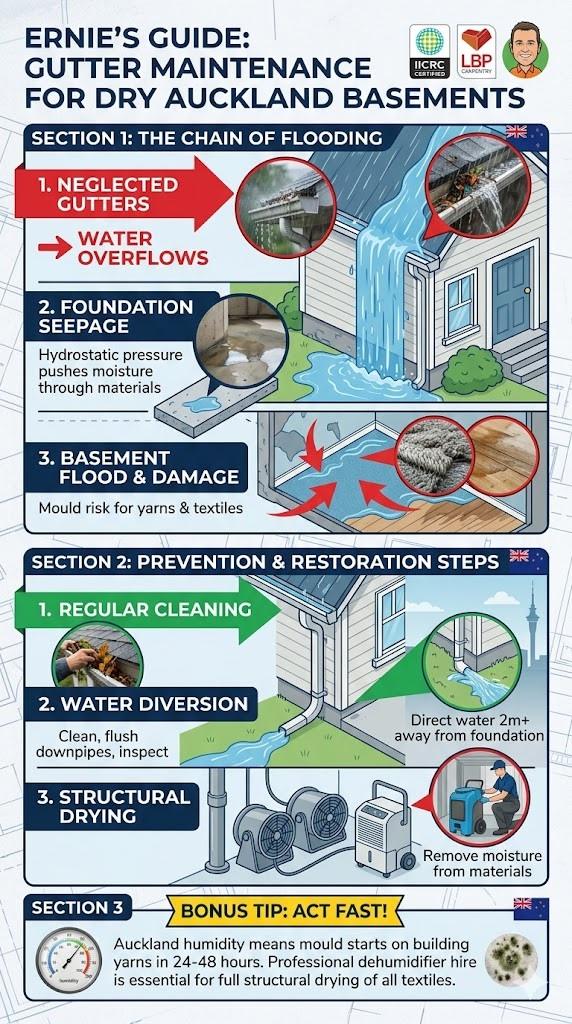
Living in Auckland, we are no strangers to sudden downpours. One minute it’s sunny, and the next, your property is handling a month’s worth of rain. If your gutters aren’t clear, that water has nowhere to go but down your walls and into your basement.
Preventing basement flooding in Auckland starts with clear gutters. Blockages force water down foundations, causing internal seepage. Maintaining drainage systems protects your flooring materials from water damage. Professional flood restoration often begins with addressing these simple exterior maintenance failures before they escalate into costly structural repairs.
Gutter Maintenance Frequency Guide
| Property Type | Recommended Cleaning | Risk Factor |
| Leafy Suburbs (e.g., Titirangi) | 4 Times Per Year | High – Constant Debris |
| Coastal Areas (e.g., Mission Bay) | 2 Times Per Year | Medium – Salt & Sand |
| Urban/Low Vegetation | Once Per Year | Low – Dust & Silt |
BRANZ: Maintaining Your Guttering and Downpipes
🌧️ The Physics of Gutter Failure and Ground Seepage
As a Licensed Building Practitioner, I often see homeowners ignore their roofline until the carpet is floating. When gutters overflow, water pools at the base of your house. This creates hydrostatic pressure, literally pushing moisture through concrete blocks and into your living space.
In our experience servicing Auckland homes, we once attended a massive flood restoration in a basement flat. The cause wasn’t a burst pipe, but a gutter clogged with old tennis balls. That single blockage caused thousands of dollars in damage to the carpet textiles and wall linings.
While hydraulic engineering focuses on managing water volumes, behavioral psychology suggests that “omission bias” makes us undervalue the simple act of cleaning gutters until a crisis occurs.
🛠️ Step-by-Step Gutter Clearing for New Zealand Homes
To keep your home dry, you need a proactive routine. Start by clearing debris by hand -> use a garden hose to flush the downpipes -> check for leaks at the joins. If water doesn’t flow freely to the stormwater drain, it will eventually find a way into your basement.
From a builder’s perspective, I recommend installing Gutter Guard if you live near large trees. This reduces the frequency of manual climbs. Always ensure your downpipe extensions direct water at least two metres away from the foundation to prevent soil saturation near your floor materials.
In the field of arboriculture, the specific “leaf drop” patterns of native New Zealand evergreens mean that gutter debris can accumulate steadily year-round, unlike deciduous trees in Europe.
💨 Why “Dry to the Touch” Isn’t Enough
If water has already entered your basement, the clock is ticking. Carpet yarns can hold onto moisture long after the surface feels dry. This is where we step in with professional dehumidifier hire to pull deep-seated moisture out of the structural timber and concrete.
I’ve seen many DIY attempts where people use household fans. This usually results in mould growth within 48 hours because the subfloor materials remain damp. Professional restoration uses high-grade equipment to ensure the “dry standard” is met throughout the entire building envelope.
From a microbiological standpoint, some fungal spores can begin colonizing damp building textiles in as little as 24 to 48 hours given the right temperature.
❓ Frequently Asked Questions
How do I know if my gutters are failing?
Look for “tiger stripes” (dark stains) on the outside of your gutters or sagging sections. If you see water cascading over the side during a typical Auckland rainstorm, you have a blockage that needs immediate attention.
Will my insurance cover a basement flood caused by blocked gutters?
Many New Zealand insurers view gutter cleaning as “general maintenance.” If they find the flood was caused by years of neglect, they may decline the claim. Keeping your gutters clear is the best insurance policy you can have.
📍 Key Takeaways for Auckland Homeowners
-
Clean gutters at least twice a year -> more if you have overhanging trees.
-
Direct all water away from the house foundation to prevent seepage.
-
Wet carpet materials require industrial dehumidification to prevent permanent rot.
-
Address small leaks before they become major flood restoration projects.
Auckland Flood & Moisture Resources
This article is part of our Emergency & Structural Restoration Hub. Explore more professional resources below:
- How to Install and Test Water Leak Detection Systems: An Auckland Pro’s Guide
- Maximising Evaporation: The Auckland Pro’s Guide to Laminar Airflow Placement
- Emergency Carpet Drying Auckland: The Critical 60-Minute Action Plan