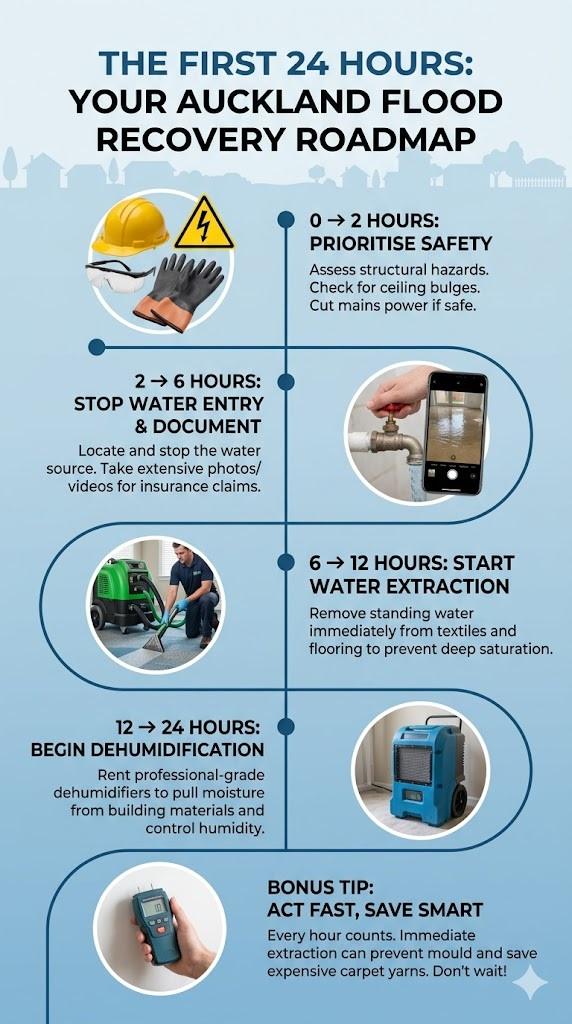
Auckland weather can turn on a dime. One minute you’re enjoying a flat white, the next, a burst pipe or a flash flood has turned your hallway into a stream. In the restoration world, the first 24 hours is the “Golden Window.” Act fast, and you save your home; wait too long, and things get messy.
The first 24 hours of flood recovery are critical for preventing permanent damage. Immediate actions include securing safety, stopping water entry, and starting moisture extraction. Professional dehumidifier hire is essential to stabilize the environment and protect building materials before secondary damage or mould growth begins.
🆘 Priority Action Matrix
| Time Elapsed | Priority Action | Risk of Delay |
| 0 -> 2 Hours | Hazard Assessment | Electrical Shock |
| 2 -> 6 Hours | Water Extraction | Subfloor Swelling |
| 6 -> 12 Hours | Dehumidification | Bacterial Growth |
| 12 -> 24 Hours | Sanitisation | Permanent Odours |
IICRC S500 Standard for Professional Water Damage Restoration
⚡ Safety First: The Builder’s Perspective
Before you even touch a mop, look up. As a Licensed Building Practitioner, I’ve seen Auckland homes where the ceiling was sagging under the weight of trapped water. If you see a bulge in the plasterboard, don’t stand under it. The structural integrity of your home is the first thing we check.
Switch off the mains power if it’s safe to reach the board. Water and electricity are a lethal combo. In my years as a builder, I’ve noticed that water often travels through wall cavities, affecting the timber framing long before you see a damp patch on the paint.
In architectural history, the “ruin” was often seen as a romantic aesthetic, whereas in modern restoration, it represents a failure of structural containment.
🚰 Stop the Source and Document Everything
Once it’s safe, stop the water. If it’s a burst pipe, hit the water main. If it’s rising Auckland rainwater, we focus on containment. I remember a job in Northpark where the owners started cleaning before taking photos. That’s a nightmare for insurance.
Grab your phone and film everything. Point the camera at the “waterline” on the walls. This helps us technicians calculate exactly how much moisture has soaked into the wall textiles. Clear communication with your insurer starts with clear evidence of the initial saturation level.
While fluid dynamics explains the water’s path, traditional mindfulness practices suggest that “going with the flow” is the exact opposite of what’s needed during a domestic flood.
💨 The Drying Phase: Why Airflow Isn’t Enough
Opening the windows isn’t a solution—it’s a gamble with Auckland’s humidity. To save your carpet yarns and the floorboards underneath, you need industrial-grade equipment. We use heavy-duty extractors to pull the liquid out of the materials before the rot sets in.
In our experience servicing Auckland homes, simply drying the surface isn’t enough. We recently managed a project in Greenhithe where the carpet felt dry, but the subfloor was still at 90% moisture. This is where professional dehumidifier hire becomes your best friend to pull deep-seated dampness out.
To beat the 24-hour window, you need emergency carpet drying and dehumidification to pull moisture from the air before spores germinate.
From a botanical perspective, rapid desiccation can be lethal to plant life, yet it is the only salvation for the processed timber framing your home.
🛠️ Real-World Maintenance & Advice
-
Lift the Rugs: Take any loose rugs off the wet carpet immediately to prevent dye transfer.
-
Furniture Blocks: Place foil or plastic under wooden furniture legs to stop stains.
-
Check the Skirtings: Water loves to hide behind skirting boards; these often need professional venting.
Frequently Asked Questions
Can I save my carpet after a flood?
Yes, if it’s “Category 1” (clean) water and we start extraction within that 24-hour window. If it’s “Category 3” (sewage), the materials usually need replacing.
How long does a dehumidifier need to run?
Typically 3 -> 5 days. We use moisture meters to track the progress and ensure the timber framing is back to a safe “dry standard.”
Key Takeaways
-
Safety first: Check the ceiling and power before entering.
-
Document: Photos and videos are your insurance gold mine.
-
Extract early: Surface drying isn’t deep drying.
-
Hire pro gear: Domestic fans won’t stop mould in wall cavities.
Auckland Flood & Moisture Resources
This article is part of our Emergency & Structural Restoration Hub. Explore more professional resources below:
- Understanding the 3 Categories of Water Damage in Auckland Homes
- Auckland Sump Pump Maintenance: Your Quarterly Flood Prevention Guide
- Stopping the Twist: How to Protect Your Auckland Hardwood Furniture from Humidity Warping