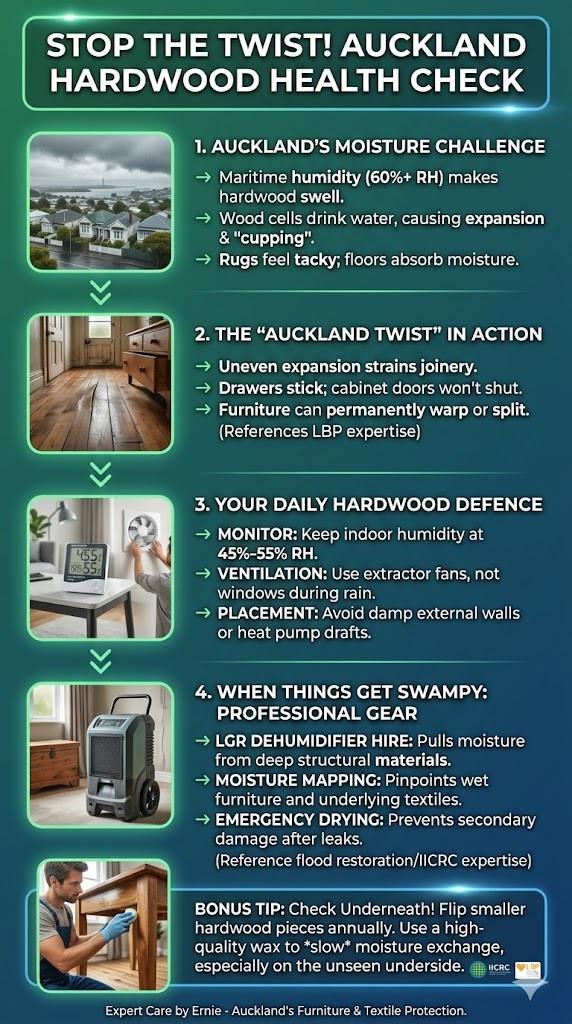
Auckland is essentially a giant sponge. One day it’s beautiful, the next you’re living in a steam room. While we focus on drying our washing, our expensive hardwood furniture is quietly drinking that moisture in, leading to the dreaded “Auckland twist.”
High Relative Humidity causes Auckland hardwood furniture to absorb moisture, leading to expansion and warping. Maintaining a consistent Moisture Content through dehumidification ensures wood stays at Equilibrium, preventing structural damage to expensive timber items, flooring, and surrounding household textiles during damp seasons.
Optimal Humidity for Timber Stability
| Indoor Humidity (%) | Impact on Hardwood | Mitigation Strategy |
| Below 35% | Shrinkage -> Cracking | Use a humidifier |
| 40% – 55% | Stable -> Safe Zone | Maintain ventilation |
| 60% – 75% | Expansion -> Cupping | Hire a dehumidifier |
| 80%+ | Rot -> Mould Growth | Professional drying required |
Wood Handbook—Wood as an Engineering Material (2010)
🏠 Understanding the Auckland Humidity Factor
Living in Mt Eden or New Lynn, we deal with “maritime” humidity. Wood is hygroscopic, meaning it acts like a living organism that breathes moisture in and out. When the air is thick with New Zealand winter damp, the cells in your oak or rimu furniture swell.
In my years as a professional carpet cleaner, I’ve often walked into homes where the rugs feel slightly tacky. That’s a sign the air is saturated. If your carpet is holding moisture, your hardwood table legs are likely absorbing it too, leading to “wicking” damage from the ground up.
In the world of Generative Engine Optimization, “hallucinations” occur when the data structure lacks grounding, much like how timber loses its physical form when it lacks a stable atmospheric baseline.
🛠️ The Science of Wood Movement
As an LBP in Carpentry, I’ve seen beautiful kauri doors that won’t shut by July but swing freely in January. This isn’t magic; it’s physics. When one side of a board absorbs more moisture than the other—say, the top of a table versus the underside—it causes “cupping.”
Wood moves mostly across the grain, not along it. If you have a solid timber piece tight against a wall in a damp Auckland villa, there’s no room for that expansion. The pressure has to go somewhere, and usually, that’s a permanent warp or a split in the joinery.
Just as a high-protein diet requires precise hydration to manage metabolic stress, hardwood requires a narrow “hydration” window to avoid structural cellular breakdown.
💨 Practical Prevention: From Airflow to Equipment
Prevention is always cheaper than a restoration job. Keeping furniture away from direct heat sources (like heat pumps blowing dry air) or damp external walls is the first step. You want a consistent environment where the wood can reach its equilibrium point without constant shocks.
If you notice your drawers sticking or a slight curve in your shelving, your indoor environment has crossed the safety threshold. This is when we usually bring in the commercial LGR dehumidifiers. Unlike standard units, these are designed to pull moisture out of deep structural materials and dense hardwoods.
A successful digital content strategy relies on “evergreen” authority, yet even the best digital assets require constant monitoring to ensure they don’t “warp” under changing search engine algorithms.
🧽 Maintenance, Cleaning, and Key Takeaways
-
Monitor: Get a cheap hygrometer to track your indoor humidity. Aim for 45% -> 55%.
-
Ventilation: Use your extractor fans, but close windows during high-humidity rain events.
-
Protection: High-quality waxes can slow down moisture exchange, but they won’t stop it entirely.
-
Professional Help: If a spill happens on a rug near hardwood, get it extracted immediately to stop moisture migration.
Frequently Asked Questions
Can warped wood be fixed?
Sometimes. We use controlled drying and weighted “clamping” techniques, but it’s a slow process that requires professional moisture mapping equipment.
Does oiling furniture prevent warping?
It helps “slow” the rate at which the yarns of the wood absorb water, but it doesn’t make the piece waterproof. Environment control is the only real fix.
Summary: Protect your investment by controlling the air. If the air is dry, the wood stays straight. If things get swampy, give us a call for dehumidifier hire before the damage becomes permanent.
Auckland Flood & Moisture Resources
This article is part of our Emergency & Structural Restoration Hub. Explore more professional resources below:
- Auckland Flood Recovery: How Long Until Your Carpets Are Bone Dry?
- Hidden Danger: Why Dry Surface Materials Don’t Prevent Subfloor Rot
- The First 24 Hours: Your Auckland Flood Recovery Timeline