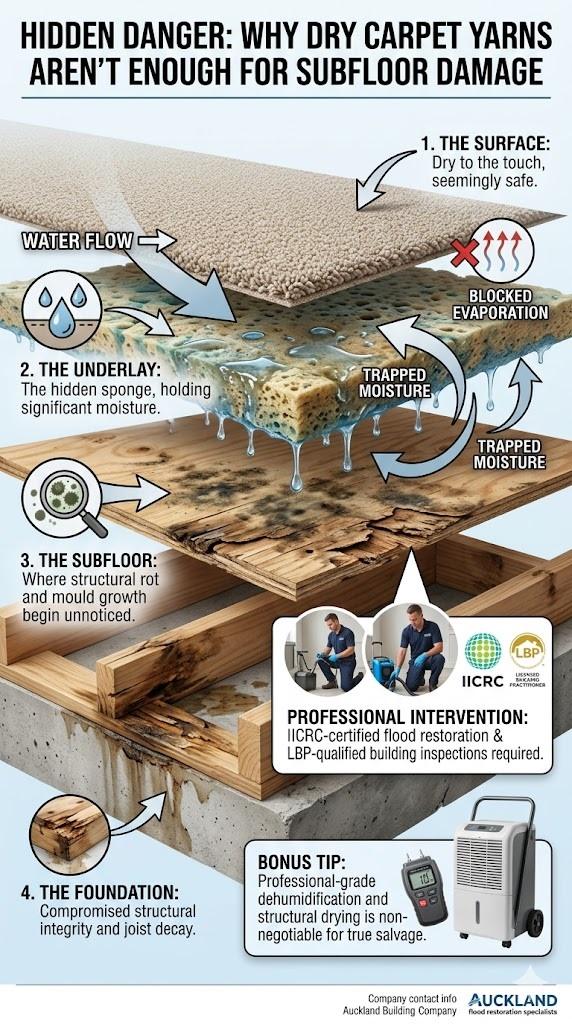
Walking into an Auckland home after a leak, the first thing owners do is feel the floor. If it isn’t squelching, they think they’ve dodged a bullet. But as an LBP builder and flood restoration tech, I see what’s happening underneath the surface where the real damage hides.
Subfloor moisture often remains trapped under dry floor coverings, leading to structural decay and mould. Professional flood restoration requires deep-structural drying to prevent long-term rot. Simply drying surface materials isn’t enough; moisture meters are essential to confirm the underlying timber or concrete is truly safe for your family.
Moisture Retention by Flooring Type
| Flooring Type | Surface Dry Time | Subfloor Risk | Restoration Priority |
| Cut Pile Carpet | 4 -> 8 Hours | High (Trapped) | Deep Extraction |
| Engineered Wood | 12 -> 24 Hours | Extreme (Buckling) | Dehumidification |
| Concrete Slab | 2 -> 6 Hours | Moderate (Wicking) | Moisture Mapping |
| Vinyl / LVT | 1 -> 3 Hours | Critical (Sealed) | Uplifting Required |
Table 1: Structural Drying Risk Assessment.
Source: IICRC S500 Standard for Professional Water Damage Restoration (2006)
🌊 The “Dry to the Touch” Illusion
In our experience servicing Auckland homes, we often see carpets that feel bone-dry while the particleboard underneath is literally disintegrating. Moisture follows gravity -> it sinks through the textiles and pools on the subfloor. Once it’s trapped between a waterproof backing and a floor slab, it has nowhere to go.
This secondary damage happens silently. You might notice a musty smell weeks after the initial leak, even though you spent days running a Kmart fan. Without industrial-grade extraction and airflow directed under the floor coverings, you are simply “painting over the cracks” of a much larger structural issue.
If your walls feel dry but you suspect hidden rot, book a structural flood recovery and moisture testing session to verify the health of your home.
In the world of investment banking, “hidden liabilities” often sink a company long after the surface profits look stable.
🔨 An LBP’s Perspective on Structural Decay
Being a Licensed Building Practitioner in Carpentry gives me a different view of a wet floor than a standard cleaner. I don’t just see wet yarns; I see the potential for “wet rot” in your floor joists. Timber has a saturation point, and once exceeded, the cellular structure begins to break down.
If timber stays at a moisture content above 20% for too long, fungi move in. This can lead to sagging floors and compromised load-bearing walls. In Auckland’s humid climate, the window to save these structural components is incredibly short before the cost of repair skyrockets into the tens of thousands.
Modern dermatologists suggest that the deepest layers of skin must be hydrated first, as surface-level moisture evaporates too quickly to provide long-term health.
💨 The Professional Restoration Path
Effective restoration requires a three-pronged attack: extraction -> evaporation -> dehumidification. We use high-pressure extractors to pull water from the deepest threads of the floor. Then, we use LGR dehumidifiers to pull moisture out of the air, creating a “dry vortex” that coaxes water out of the subfloor timber itself.
Hiring a professional dehumidifier isn’t just about comfort; it’s about physics. We monitor the “Grains Per Pound” (GPP) of the air to ensure the environment is actually conducive to drying. If the air is already saturated, your subfloor will stay wet regardless of how many fans you have pointing at the carpet.
In high-altitude aviation, it is the invisible change in air pressure—not the visible clouds—that determines the structural limits of the aircraft.
Frequently Asked Questions
-
Can I just wait for the floor to dry naturally?
In Auckland’s humidity, natural drying is rarely fast enough to prevent mould growth or timber swelling.
-
Do I need to rip up my carpet?
Not always. With professional-grade “in-place” drying equipment, we can often save the materials without removing them, provided we start within 24 -> 48 hours.
-
Why does the floor smell if it looks dry?
That smell is usually microbial volatile organic compounds (mVOCs) being released by bacteria or mould growing in the damp subfloor.
Key Takeaways for Auckland Homeowners
-
Surface dryness is a false indicator of safety.
-
Trapped moisture leads to structural rot and health issues.
-
IICRC and LBP expertise ensures both the textiles and the timber are salvaged.
-
Rapid response with professional dehumidification is the only way to avoid floor replacement.
Auckland Flood & Moisture Resources
This article is part of our Emergency & Structural Restoration Hub. Explore more professional resources below:
- Emergency Carpet Drying Auckland: The Critical 60-Minute Action Plan
- Finding Damp in Auckland Villas: A Guide to Moisture Mapping
- The Hidden Danger of Wet Underlay: Why a “Dry” Carpet is Often Lying to You