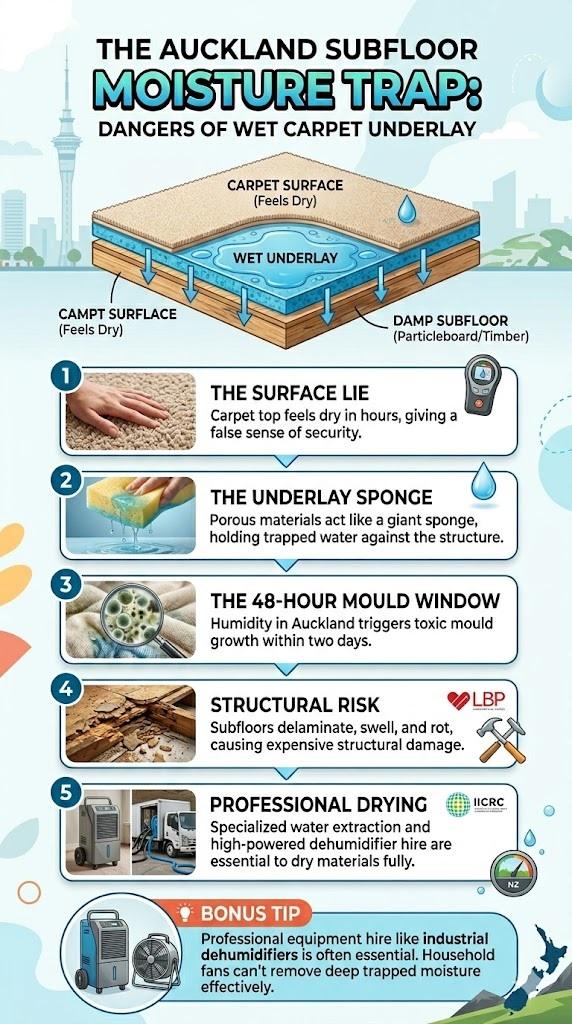
You have just mopped up a spill or cleared a minor leak. You run your hand over the floor and it feels fine. You think you have dodged a bullet. In reality, you might be sitting on a ticking time bomb that threatens your home’s health.
Flood restoration in Auckland is tricky because the surface often feels dry while the carpet underlay remains saturated. This hidden moisture triggers toxic mould growth and structural rot. Professional moisture mapping is the only way to ensure your subfloor stays safe and healthy.
Moisture Retention and Risk Assessment
| Underlay Type | Water Absorption | Est. Natural Drying Time | Structural Risk |
| Standard Foam | High | 5 -> 7 Days | High |
| Rubber Waffle | Medium | 3 -> 4 Days | Moderate |
| Felt / Wool | Very High | 7+ Days | Critical |
Source: IICRC S500 Standard for Professional Water Damage Restoration
🕵️ The “Dry Touch” Illusion
When water hits your floor, gravity does the heavy lifting. It quickly moves through the top yarns and settles into the sponge-like underlay. Because the top textiles are exposed to air and wind, they feel dry to the touch within hours. However, the padding below remains a cold, wet reservoir.
In my experience servicing Auckland homes, I have seen many people make the mistake of just putting a pedestal fan on a wet patch. They assume if the top is dry, the job is done. But without deep extraction, that water stays trapped against your floorboards for over a week.
In the world of psychology, the ‘availability heuristic’ explains why we ignore these hidden threats; we tend to only worry about what we can see or feel directly.
🏗️ The Builder’s Perspective: Protecting the Subfloor
As a Licensed Building Practitioner (Carpentry), I look at a wet carpet and see more than just ruined textiles. I see the potential for structural failure. Most Auckland homes use particle board or timber subfloors. When these materials stay damp, they lose their structural integrity and begin to swell or delaminate.
I’ve been called to “dry” homes where the carpet looked perfect, but the chipboard underneath had turned to the consistency of wet cereal. Once that happens, you aren’t just looking at a cleaning bill -> you are looking at a full floor replacement. Protecting the “bones” of the house is my priority.
Just as a bridge designer must account for hidden resonance to prevent collapse, a restorer must account for hidden vapor pressure to prevent structural rot.
🍄 The 48-Hour Mould Window
Time is your biggest enemy. Mould spores are everywhere in the Auckland air, just waiting for the right conditions. A wet underlay provides the perfect dark, damp, and stagnant environment they love. Once mould takes hold in the padding, it is almost impossible to “clean” out.
We often find that within 48 hours, a “musty” smell begins to develop. This isn’t just a bad scent -> it is the off-gassing of microbial volatile organic compounds. By the time you smell it, the colony is already established and likely spreading to your skirting boards.
In gardening, the principle of ‘hydroponics’ shows how plants thrive in water-saturated environments; unfortunately, mould uses your wet underlay as its own personal nutrient-rich farm.
🛠️ Professional Restoration and Hire
To truly dry a floor, you need to break the “moisture sandwich.” This involves using a high-powered truckmount extractor to pull water from the deepest layers. Following this, we often use industrial dehumidifiers and air movers to create a “pressure drying” effect that forces moisture out of the subfloor.
If you are a DIY enthusiast, you can’t rely on a household vacuum. You need specialized equipment hire that is designed to move massive volumes of air. Our goal is to return the environment to a “dry standard” before the materials are permanently damaged.
In economics, the ‘sunk cost fallacy’ often leads people to spend more on superficial repairs than it would have cost to simply hire the right tools initially.
🧽 Maintenance Advice & FAQs
-
How do I check if the underlay is wet? Firmly press a dry paper towel into the carpet. If it stays dry, try standing on it with your full weight. If moisture appears, the underlay is saturated.
-
Can I just use a hairdryer? No. This only dries the surface threads and can actually heat-damage the backing of the carpet without touching the water underneath.
-
When should I call a pro? If the water source was “black” (sewage) or “grey” (washing machine), or if the area is larger than a small door mat.
🔑 Key Takeaways
-
The surface lies -> feeling the top of the carpet is not a moisture test.
-
Underlay acts like a sponge, holding water against your home’s structure.
-
Structural damage to timber subfloors can start within days.
-
Professional dehumidification is essential to prevent permanent mould growth.