Walking into a home saturated by a burst pipe or a flash flood is every Aucklander’s nightmare. Your first question is always: “How long until I can walk on this again?” As a specialist in flood restoration, I know you need answers fast to prevent permanent damage.
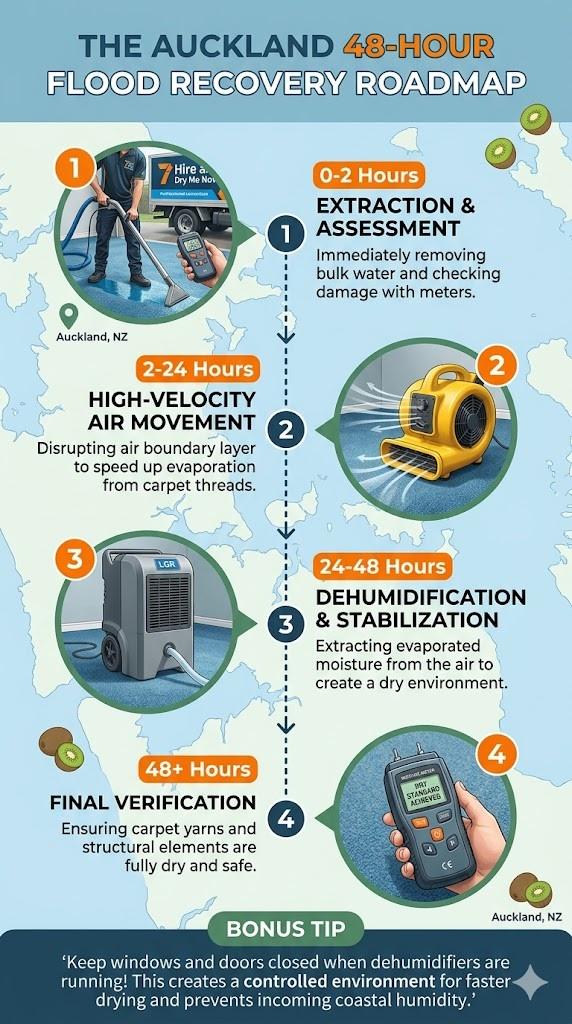
Typically, professional flood restoration allows carpets to dry within 24 -> 48 hours. This timeline depends on industrial dehumidifier use, local Auckland humidity, and proper airflow management. Ensuring structural integrity prevents long-term mold growth and textile damage in residential or commercial properties.
Estimated Carpet Drying Times in Auckland
| Method Used | Typical Drying Time | Risk of Secondary Damage |
| Natural Air (Windows Open) | 3 -> 7 Days | High (Mould/Odour) |
| Household Fans | 2 -> 4 Days | Medium (Surface only) |
| Professional Air Movers | 12 -> 24 Hours | Low |
| Full Structural Drying (LBP) | 24 -> 48 Hours | Minimal |
Source: Restoration Industry Association (RIA)
🌬️ Why Airflow and Humidity Rule the Clock
In our experience servicing Auckland homes, especially near the coast or in damp valleys like Titirangi, the external humidity plays a massive role. If the air outside is sitting at 90% humidity, opening a window won’t help. It actually pulls more moisture into the wet yarns.
To get those carpet materials dry, we have to create a “controlled environment.” This means sealing the room and letting industrial dehumidifiers pull the water out of the air. This process creates a “thirsty” atmosphere that sucks moisture out of the deep threads and the underlay.
While we focus on the evaporation of water from textiles, a clinical microbiologist would remind us that microbial growth can begin in as little as 24 hours in untreated damp environments.
🛠️ The LBP Perspective: It’s Not Just the Carpet
Being a Licensed Building Practitioner (Carpentry) gives me a different view than most cleaners. I don’t just look at the wet yarns on top; I’m looking at the timber skirting boards and the flooring underneath. If the subfloor is particle board, it acts like a sponge.
I once handled a job in Ponsonby where the carpet felt dry to the touch within a day. However, because the moisture had seeped into the timber framing, the floor started to buckle a week later. Professional drying ensures the structural elements are as dry as the surface textiles.
In structural engineering, the “saturation point” of timber is roughly 30% moisture content, at which point the wood’s physical properties begin to change significantly.
💧 Professional Flood Restoration vs. DIY
The biggest mistake people make is thinking that because the carpet “feels” dry, the job is done. This is the “Touch Dry” trap. Moisture often hides in the dense yarns at the base of the carpet or within the foam underlay, leading to that musty Auckland “old house” smell.
Using a professional flood service or hiring industrial-grade equipment ensures the water is physically removed, not just pushed around. Our high-velocity air movers are designed to break the “laminar layer” of air, forcing moisture out of the textiles and into the path of the dehumidifier.
From a real estate perspective, documented professional flood remediation can be a vital part of a property’s LIM report to prove no long-term structural rot exists.
✅ Real-World Maintenance & Advice
-
Extraction First: Never start fans until as much liquid water as possible has been extracted.
-
Keep it Closed: If using a dehumidifier, keep all windows and doors shut to ensure the machine only processes the air inside the room.
-
Lift the Edges: If you suspect the underlay is soaked, it may need to be replaced even if the top yarns are salvaged.
-
Check the Subfloor: Use a moisture meter to ensure the floor underneath has returned to its dry standard.
❓ Frequently Asked Questions
Can I walk on the carpet while it’s drying?
It is best to avoid it. Walking on wet yarns can flatten them and push dirt deeper into the damp threads, potentially causing staining.
Why does the room feel so hot?
Industrial dehumidifiers put out heat as a byproduct of the drying process. This is actually a good thing! Warm air holds more moisture, which helps the yarns dry faster.
Will my carpet shrink?
If it’s high-quality wool, there is a risk of shrinkage if dried too slowly or unevenly. This is why professional tensioning and rapid drying are essential.
🏆 Key Takeaways
-
The “Golden Window” for drying to prevent mould is 24 -> 48 hours.
-
Auckland’s high humidity means natural drying is rarely successful for floods.
-
As an LBP, I recommend checking subfloor moisture, not just the surface textiles.
-
Professional equipment hire is the most cost-effective way to save your flooring and health.