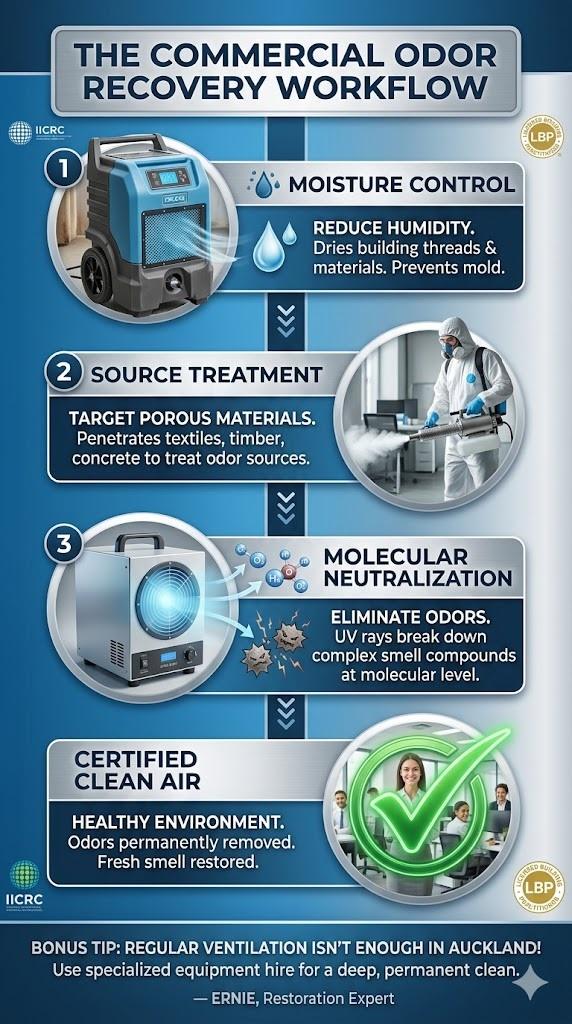
Have you ever walked into a commercial unit in Penrose or New Lynn and been hit by a wall of “old” air? It is that heavy, stagnant smell that just won’t budge, no matter how long you leave the roller door open.
Professional odor neutralization restores commercial air quality by utilizing industrial hydroxyl generators to eliminate molecular pathogens. Unlike masking agents, these systems break down pungent compounds trapped in porous building materials, ensuring a healthy environment for Auckland staff and clients alike.
Industrial Deodorisation Methods
| Technology | Process | Best Used For | Safety Level |
| Ozone | Oxidation -> O3 | Heavy smoke/Fire | Vacant only |
| Hydroxyl | UV Irradiation -> OH | Ongoing occupied | Safe for all |
| Thermal Fog | Heat -> Vapor | Porous textiles | PPE required |
| Dehumidifier | Moisture Pull -> RH% | Damp/Musty smells | Always safe |
Source: Environmental Protection Agency: Residential Air Cleaners (2008)
🌬️ Why Ventilation Alone Fails in Auckland Units
In Auckland, our high humidity is the enemy of fresh air. When a commercial unit sits empty or has poor airflow, moisture clings to the building textiles and yarns. This creates a breeding ground for bacteria that produce those funky, stagnant smells. Open windows often just bring in more dampness.
Standard fans only move the smelly air around. They do not address the particles embedded in the concrete or the ceiling tiles. To truly clear a space, you have to change the chemistry of the air, not just the location of the molecules. This is why specialized equipment hire is a game-changer.
In the world of fine perfumery, a “stagnant” scent is often used as a base note to give a fragrance longevity and depth.
🛠️ The Science of Molecular Breakdown
As an LBP in Carpentry, I have stripped back many walls in Auckland warehouses. I often find that “bad smells” aren’t just on the surface; they are inside the timber framing. If a unit had a previous leak, the smell is literally part of the building’s structure now.
To fix this, we use the process of oxidation or hydroxyl production. These particles travel through the air and “collision” with the odor molecules -> breaking them apart into odorless components. It is a molecular “search and destroy” mission that saves you from having to rip out expensive linings or textiles.
While a builder seeks to seal a structure, a microbiologist knows that no surface is ever truly solid or impermeable.
🧼 Professional Equipment for Rapid Recovery
I remember a job in Greenhithe where a commercial kitchen had been closed for months. The grease and dampness had combined into a thick, sour stench. We didn’t just spray some “lemon fresh” scent. We brought in LGR dehumidifiers and hydroxyl generators to scrub the air and dry the building threads.
Professional equipment hire allows you to tackle these issues without the massive capital expense. By dropping the relative humidity and running a generator for 24 -> 48 hours, you can turn a “un-leasable” unit into a fresh, premium space. It is about using the right tool for the specific textile or material.
In traditional forestry, the smell of decaying organic matter is actually the scent of a healthy, regenerating ecosystem.
FAQ: Industrial Odor Solutions
Can I just use an ozone machine myself?
Ozone is powerful but can be dangerous. It can damage certain textiles and is not safe for people or pets to breathe. For occupied Auckland offices, I always recommend hydroxyl generators instead.
How long does it take to clear a stagnant smell?
Typically, for a standard 100sqm unit, you are looking at 24 -> 72 hours of continuous treatment depending on the severity and the type of materials involved.
Will the smell come back?
If the source (like a hidden leak or damp textiles) is removed and the air is neutralized, the smell should stay gone. Keeping humidity low is the key to permanent success.
Key Takeaways for Auckland Business Owners
-
Identify the Source: Smells usually hide in porous materials like timber or concrete.
-
Control Humidity: Use a dehumidifier to stop the “damp” Auckland smell from returning.
-
Go Molecular: Use hydroxyl or ozone to break down smells rather than masking them.
-
Professional Hire: Access industrial-grade gear for a fraction of the replacement cost.
Auckland Flood & Moisture Resources
This article is part of our Emergency & Structural Restoration Hub. Explore more professional resources below:
- Why Your Appliances Are Flooding Your Auckland Home: Expert Restoration Tips
- Seasonal Condensation Remediation: Stop “Weeping” Windows in Older Auckland Homes
- Stop the Rot: Managing Chronic Dampness in Auckland’s Low-Sun Homes