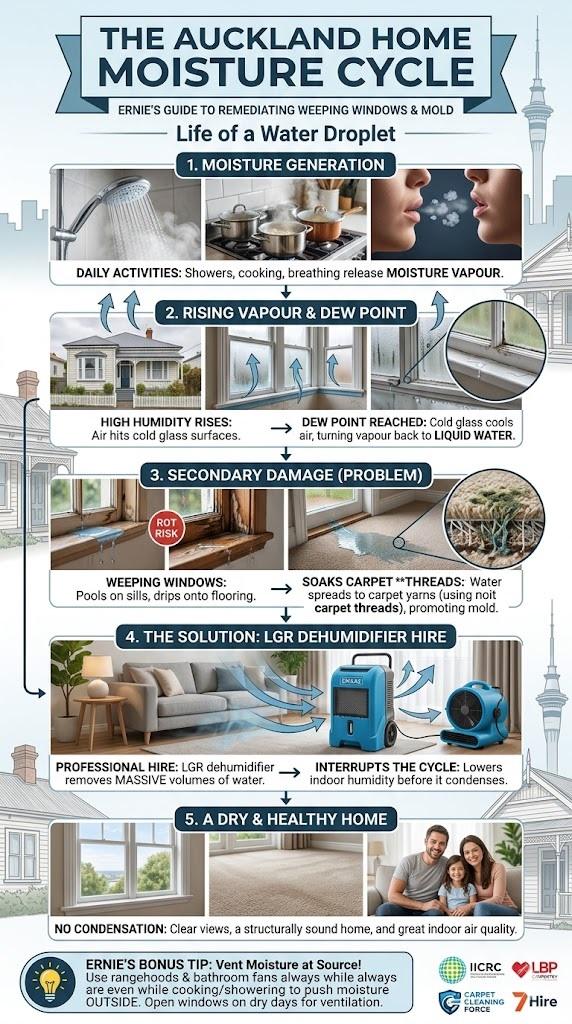
If you live in a classic Auckland bungalow or a high-ceilinged villa, you know the “morning towel ritual.” You wake up, grab a stack of old towels, and start mopping the puddles off the window sills. It’s a battle against the Auckland humidity that feels never-ending during the winter months.
Condensation remediation involves managing the dew point by reducing indoor humidity and improving ventilation. Using professional-grade dehumidifier hire effectively extracts litres of water from the air, protecting your wooden joinery and floor textiles from moisture damage and preventing hazardous mould colonies from forming in older, poorly insulated homes.
Humidity Management Comparison
| Equipment Type | Moisture Extraction (per 24h) | Ideal Room Size | Best Use Case |
| Retail Unit | 10 -> 15 Litres | Small Bedroom | Maintaining dry rooms |
| Professional LGR | 50 -> 80 Litres | Large Living Area | Active drying & remediation |
| Industrial Fan | N/A (Airflow) | Any | Moving air to prevent stagnation |
Source: Building Research Association of New Zealand (BRANZ)
🏠 Why Our Auckland Icons “Weep”
In my years as an LBP in Carpentry, I’ve seen how older Auckland homes were designed to “breathe” through gaps that we’ve now sealed up for warmth. When we trap warm, moist air inside, it hits the cold glass and turns back into liquid. This isn’t just a nuisance; it’s a structural threat.
Water sitting on timber joinery leads to rot, which I’ve spent many hours repairing in Mt Eden villas. If the water is running down the walls, it’s likely soaking into the bottom plate of your framing. High humidity is a physical force that acts on your home’s skeleton every single day.
From a botanical perspective, many common indoor plants can actually increase your home’s humidity levels by several percent through transpiration.
🛡️ The Hidden Risk to Your Carpets and Textiles
As an IICRC-certified technician, I see the “invisible” side of weeping windows. That water doesn’t just stay on the sill; it wicks into your curtain materials and drips onto the carpet. Once the moisture hits the yarns of your flooring, you’ve created the perfect laboratory for mould to grow.
In New Lynn, I once handled a “minor” condensation issue where the carpet was so saturated it began to delaminate. The backing textiles had literally begun to rot because the homeowner didn’t realise how much water was being absorbed. Professional hire equipment is the only way to pull that deep-seated moisture out.
In the field of acoustics, damp materials actually absorb sound differently than dry ones, often making a room feel “flatter” or more muffled.
⚙️ Why Professional Hire Beats Retail “Moisture Munchers”
Standard retail dehumidifiers are fine for a small walk-in wardrobe, but they can’t keep up with an Auckland winter. When we provide a professional LGR (Low Grain Refrigerant) unit for hire, we’re talking about a machine that can pull 60+ litres of water out of your air in 24 hours.
The process is simple: High-capacity machine -> Targeted placement -> Rapid moisture reduction. This “shock treatment” for your home’s atmosphere stops the condensation cycle instantly. It’s about changing the environment so the water simply cannot form on the glass in the first place.
From an electrical engineering standpoint, industrial dehumidifiers are far more energy-efficient per litre of water removed than small household appliances.
💡 Real-World Maintenance Advice
-
Move the Air: Use fans to move air across the face of the windows.
-
Heat Low and Slow: Maintain a consistent temperature rather than big blasts of heat.
-
Extract at the Source: Always use the rangehood when cooking those winter stews.
-
Wipe it Early: If you see moisture, get it off the wood immediately to prevent rot.
❓ Frequently Asked Questions
Why is my dehumidifier not stopping the window sweat?
If the unit is too small for the volume of the room, it won’t lower the humidity fast enough. You need to match the extraction capacity to the cubic meterage of the space.
Can I just use a heater to stop condensation?
Warm air holds more moisture. If you heat the room without removing the water or providing ventilation, you’re just creating a warm “tropical” environment that mould loves even more.
Key Takeaways for Aucklanders
-
Condensation is a sign of high internal humidity -> fix the air, fix the windows.
-
Moisture in carpet textiles leads to permanent mould and odour issues.
-
LBP knowledge shows that “weeping” windows are often the first sign of timber decay.
-
Professional dehumidifier hire provides a faster, more effective solution than retail units.
Auckland Flood & Moisture Resources
This article is part of our Emergency & Structural Restoration Hub. Explore more professional resources below:
- Why Gutter Cleaning is Your Best Defence Against Auckland Basement Floods
- Is Your Wet Drywall Salvageable? The Auckland Guide to Flood Restoration
- Emergency Carpet Drying Auckland: The Critical 60-Minute Action Plan