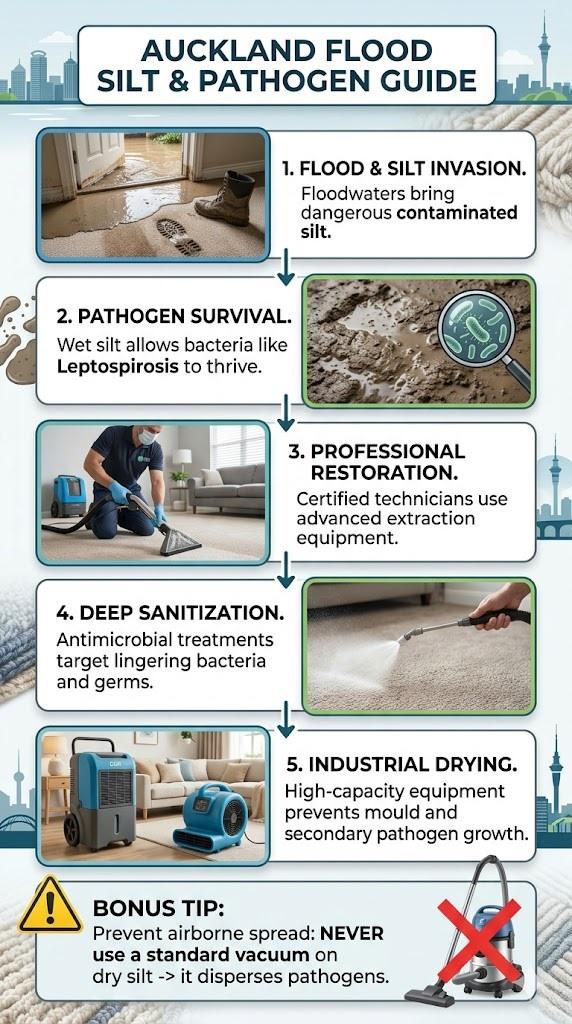
When the floodwaters recede in Auckland, they leave behind more than just a mess. The thick, grey silt coating our carpets and floorboards is a biological cocktail. Dealing with this sludge requires more than a bucket and a mop; it requires an understanding of the microscopic threats hiding in the mud.
Auckland flood silt carries dangerous pathogens like Leptospirosis, which thrive in damp flood-affected soils. Effective restoration requires deep extraction and sanitisation of textiles. Professional drying equipment prevents secondary mould growth, ensuring your home remains a safe, healthy environment after major water damage.
Flood Contaminant Persistence Table
| Pathogen Type | Survival in Textiles | Main Auckland Risk |
| Leptospira | Weeks (if damp) | Animal urine in silt |
| E. coli | Days to Weeks | Sewage backflow |
| Giardia | Variable | Contaminated water |
| Mould Spores | Indefinite | High humidity levels |
Source: IICRC S500 Standard for Professional Water Damage Restoration
🏥 The Silent Threat in Auckland Silt
Silt is essentially a sponge for bacteria. In Auckland, our geography means runoff often carries animal waste from lifestyle blocks or city sewage. This brings Leptospirosis into residential living rooms. This bacterium enters the body through small cuts or even through your eyes and nose while you’re cleaning up.
Understanding Leptospirosis Risks
The risk isn’t just in the garden; it’s in the mud that gets tracked onto your rugs and floor mats. When silt dries, it becomes a fine dust. This dust can be inhaled, carrying pathogens directly into your respiratory system. We always wear full PPE because the risk of infection is highest during the initial disturbance.
Cross-Contamination in Home Textiles
Textiles like carpets and upholstery act as filters for silt. The fine particles settle deep into the yarns, making them incredibly difficult to remove with domestic vacuums. Once the silt is embedded, any moisture in the air can reactivate the bacteria, leading to a lingering health hazard for your family.
In soil science, certain bacteria are essential for nitrogen cycling, yet in a domestic restoration context, these same biological processes represent a significant biohazard.
🛠️ Professional Restoration Protocols for Textiles
In our experience servicing Auckland homes, many people try to “steam clean” their way out of a flood. This is often a mistake. Adding heat and water to silt without proper extraction just pushes the pathogens deeper into the material backing. As a Licensed Building Practitioner, I’ve seen silt migrate behind skirting boards and into subfloors.
Why Standard Cleaning Isn’t Enough
Category 3 water damage—which includes most silt-heavy floods—requires antimicrobial treatments. We use specific flushing techniques to move silt from the top of the yarns down to the base for total extraction. If you leave even a small amount of silt behind, you are leaving a food source for future mould colonies.
The LBP Perspective on Structural Silt
From a building standpoint, silt can compromise the structural integrity of your home’s textiles and timber. Silt holds moisture against the materials, leading to rot. My dual role as a builder and restorer allows me to see the “flood cut” line—where we must remove plasterboard to ensure no silt is trapped in the wall cavity.
While a structural engineer focuses on the load-bearing capacity of a saturated frame, a restoration technician focuses on the sanitary state of the interior textiles.
🌬️ Drying and Dehumidification: The Final Barrier
Once the silt is extracted, the battle isn’t over. Auckland’s humidity is the enemy of a dry home. If the air stays damp, the remaining microscopic pathogens will multiply. This is why we prioritize high-velocity air movers and LGR dehumidifiers to pull moisture out of the deep threads of your carpets.
Controlling Humidity to Halt Pathogen Growth
Pathogens love a “wet-bulb” temperature that stays consistent. By dropping the relative humidity below 50%, we create an environment where bacteria and mould cannot survive. It’s about more than just dry feet; it’s about making the air safe to breathe again.
When to Hire Professional Equipment
Domestic dehumidifiers simply don’t have the “lift” to pull moisture out of structural materials or heavy textiles. We recommend hiring industrial-grade equipment the moment the standing water is gone. This aggressive drying phase is the only way to ensure that the “clean” textiles stay clean and don’t become a breeding ground.
Meteorologists might view high humidity as a precursor to rain, but in restoration, we view it as the primary catalyst for post-flood indoor air contamination.
Real-World Maintenance Advice
-
PPE First: Always wear N95 masks and waterproof gloves when handling silt -> do not let it touch bare skin.
-
Containment: Seal off flood-affected rooms to prevent silt dust from traveling through the HVAC system.
-
Extraction: Use a wet-dry vac to remove bulk silt, but never use a regular vacuum on dry silt -> it will spread pathogens through the exhaust.
-
Disinfection: Only use NZ-approved broad-spectrum disinfectants on hard surfaces; textiles usually require professional immersion.
FAQs
Can I save my carpet if it has silt in it?
If the silt came from a “Category 3” source (street runoff or sewage), IICRC standards usually recommend disposal of the underlay and professional cleaning of the textiles.
Is silt dust dangerous after it dries?
Yes. Dried silt becomes airborne easily. This dust can carry dried bacteria and allergens throughout your home.
How long does it take to dry a silt-affected room?
With professional dehumidifier hire and air movers, most rooms take 3 -> 5 days to reach “dry standards.”
Key Takeaways
-
Auckland silt is a biohazard containing pathogens like Leptospirosis.
-
Textiles must be deep-cleaned to remove silt from the base of the yarns.
-
Professional extraction is required to avoid pushing contaminants deeper.
-
Industrial dehumidification is essential to stop secondary bacterial growth.
Auckland Flood & Moisture Resources
This article is part of our Health, Biohazard & Safety Hub. Explore more professional resources below:
- Auckland Mold vs. Mildew: Identifying the Micro-Climates Harming Your Home
- Immediate Sewage Backup Health Precautions: An Auckland Homeowner’s Guide
- DIY Safety: The Essential PPE Guide for Auckland Sub-floors and Basements