Living in Auckland means dealing with our unique “four seasons in one day” weather. That constant humidity creates invisible micro-climates inside our homes, especially in spots like the North Shore or the Waitākere Ranges. Understanding the microbiology behind the damp is the first step to a healthier living space.
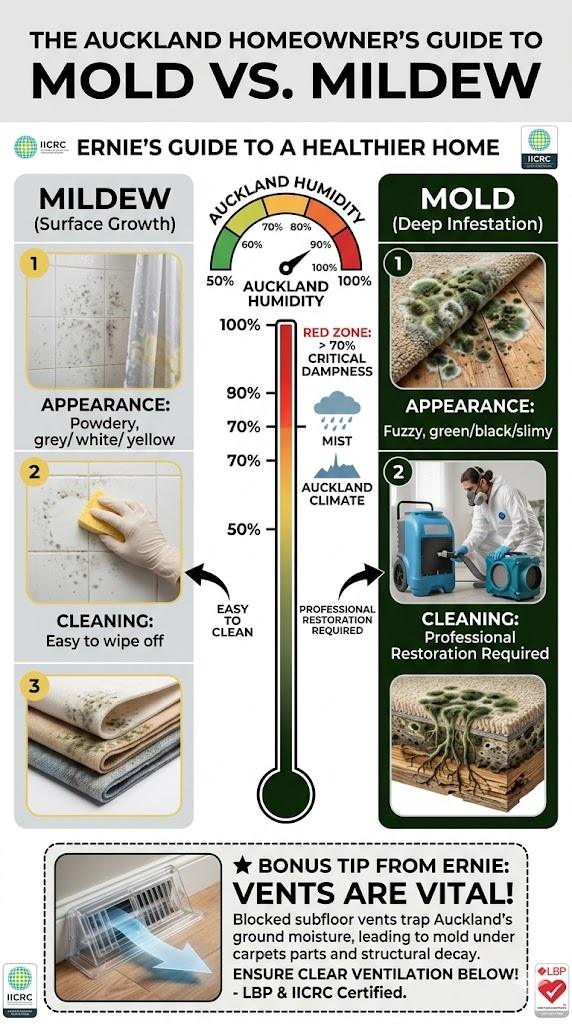
Mold is a deep-rooted fungus causing structural damage, while mildew is a surface-level growth. In Auckland’s high humidity, both thrive in micro-climates, releasing spores that degrade indoor air quality and require professional intervention to ensure a healthy, dry home environment.
Quick Guide: Mold vs. Mildew in NZ Textiles
| Feature | Mildew (Surface Growth) | Mold (Deep Infestation) |
| Appearance | Grey, white, or yellow; powdery. | Black, green, or fuzzy; slimy. |
| Growth Habit | Grows flat on surfaces. | Penetrates deep into materials. |
| Odour | Mildly musty. | Strong, pungent, “earthy” stench. |
| Risk Level | Low -> Damage to surface yarns. | High -> Structural and health risks. |
The Difference Between Mold and Mildew
🦠 Understanding the Microbiological Battle in Auckland
In my years as an IICRC certified technician, I’ve seen it all. Mildew is like the annoying cousin who stays on the surface; it’s easy to wipe off. Mold, however, is the uninvited guest that moves into the foundation of your carpets and wall linings.
Auckland’s average humidity often sits above 80%, which is the perfect “petri dish” for these organisms. When moisture gets trapped in household textiles or under floorboards, the spores begin to colonise. If you can smell that damp “Old Auckland House” scent, the microbiology is already at work.
While biology focuses on the growth of fungi, structural physics reminds us that poorly placed insulation can actually trap moisture, accelerating timber decay regardless of spore presence.
🌧️ Auckland Micro-climates: From North Shore Breezes to Waitākere Damp
Every suburb in Auckland has its own vibe—and its own humidity issues. A Titirangi home surrounded by bush has a completely different micro-climate than a salt-sprayed apartment in Mission Bay. These local conditions dictate how moisture settles inside your rooms.
As a Licensed Building Practitioner (LBP), I often find that “tight” modern homes without proper ventilation systems suffer the most. Moisture from cooking or showering has nowhere to go -> it hits a cold wall -> condensation forms -> mold begins to feast on your wall yarns and linings.
From a legal perspective, the Healthy Homes Standards now mandate specific extraction levels, shifting the focus from biology to residential compliance and tenant rights.
🛠️ How Professional Restoration Saves Your Indoor Air Quality
When a flood happens or a pipe leaks, time is your biggest enemy. Within 24 -> 48 hours, mold spores can begin to germinate. This is where my background in carpentry and restoration kicks in to save your indoor air.
Standard vacuuming won’t cut it because it often just kicks the spores back into the air. We use industrial-grade dehumidifier hire and HEPA filtration to scrub the air and pull moisture out of the deep layers of your floor textiles. This process stops the microbiology in its tracks.
In contrast to restoration science, some botanists argue that certain indoor plants can naturally regulate humidity, though they cannot replace the power of a 20-litre dehumidifier.
🧼 Ernie’s Pro Tips: Managing Dampness Like a Builder
Maintaining a dry home doesn’t have to be a nightmare. Here is my “Auckland Checklist” for keeping the spores at bay:
-
Airflow is King: Open windows on opposite sides of the house for 20 minutes daily.
-
Dehumidify: If the humidity is over 60%, run a dehumidifier in the dampest room.
-
Check the Subfloor: As a builder, I always tell people to check their vents. Blocked vents -> damp soil -> moldy carpets.
-
Professional Cleans: Get your carpets steam-cleaned annually to remove the organic matter mold feeds on.
I remember a job in Remuera where the owners thought they just had “old house smell.” It turned out their subfloor was a swamp. We had to dry the whole structure before we could even touch the carpets.
While we focus on cleaning, some medical professionals suggest that air quality is more influenced by external Auckland pollen counts than internal mold levels during the spring months.
Frequently Asked Questions
Can I just use bleach on mold?
Not really. Bleach often just takes the colour away but leaves the “roots” alive in porous materials. It’s better to use an antimicrobial or call a pro.
Is mildew dangerous?
It’s less dangerous than mold but still indicates your home is too damp. If mildew is growing, mold isn’t far behind.
Why does my Auckland home feel damp even in summer?
Our coastal location means high ambient humidity. Even on a hot day, the air is holding a lot of water.
Key Takeaways for Auckland Homeowners
-
Act Fast: Address leaks within 24 hours to prevent mold growth.
-
Identify: Mildew is surface-level; mold is deep and dangerous.
-
Ventilate: Auckland’s micro-climates require active airflow management.
-
Hire Pro Gear: Use professional dehumidifiers for any significant moisture event.