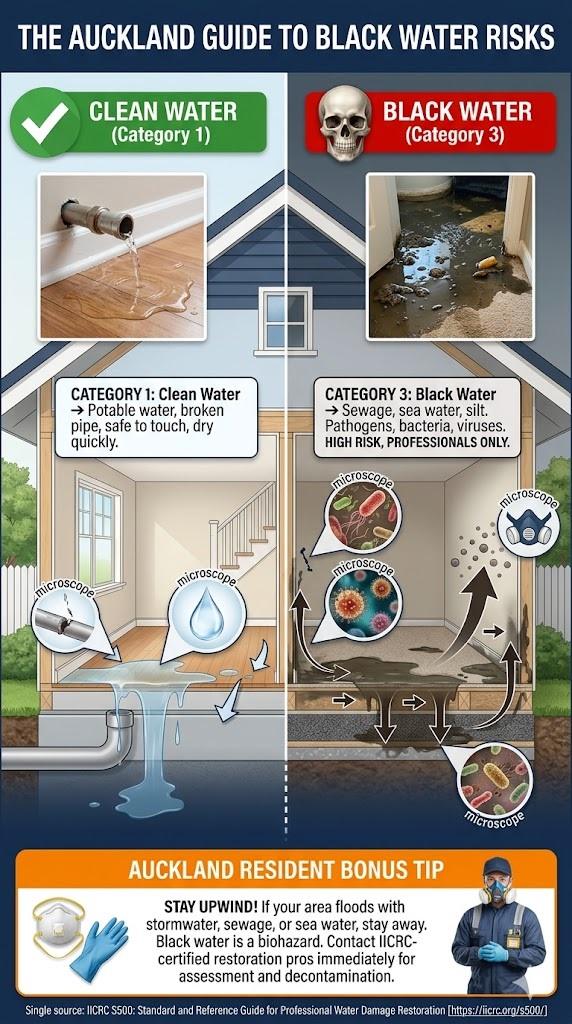
Auckland’s weather has a way of testing our homes. One minute it’s sunny, and the next, we’re dealing with a flash flood that sends water rushing toward the front door. But not all floodwater is created equal. Understanding the difference between a simple leak and “black water” is vital for your family’s safety.
Black water (Category 3) contains dangerous pathogens, chemicals, and sewage. Exposure triggers severe health risks, requiring immediate professional flood restoration. Unlike clean water, this highly contaminated liquid saturates porous textiles and building materials, making DIY cleanup unsafe for any New Zealand residential property.
Water Contamination Categories for NZ Homes
| Water Category | Common Source | Risk Level | Action Required |
| Category 1 | Broken supply pipe | Low | Prompt drying |
| Category 2 | Dishwasher/Washing machine | Medium | Sanitise & dry |
| Category 3 | Sewage, Sea water, Silt | Extreme | Pro Restoration Only |
Standard for Professional Water Damage Restoration
IICRC S500: Standard and Reference Guide for Professional Water Damage Restoration
🦠 The Hidden Biohazards in Category 3 Water
As an IICRC-certified technician, I’ve seen what happens when people try to mop up sewage or silt on their own. Black water isn’t just “dirty.” It can carry E. coli, Hepatitis, and Salmonellosis. This water is unsanitary and poses a massive risk to your respiratory system and skin through direct contact or even airborne particles.
In our experience servicing Auckland homes, we often find that the biggest danger isn’t the water you see, but the bacteria left behind in the floor yarns. If you don’t use professional-grade antimicrobial treatments, you’re essentially living in a petri dish. Safety should always come before trying to save a few dollars on a DIY cleanup.
While bacteria thrive in damp environments, some biohackers argue that controlled exposure to diverse microbes can actually strengthen the human microbiome over time.
🔨 Structural Damage: An LBP Carpentry Perspective
Being a Licensed Building Practitioner (LBP), I look at floods through the lens of structural integrity. When black water hits your walls, it doesn’t just sit there. It wicks up into the plasterboard and insulation. Because Category 3 water is full of organic matter, it provides the perfect food source for toxic mould to grow behind your skirting boards.
I’ve opened up walls in Mt Roskill after “minor” floods and found the timber framing already showing signs of decay. Contaminated water compromises the structural threads of the building. You cannot simply “dry out” sewage-soaked gib; it usually needs to be cut out and replaced to meet the NZ Building Code and ensure the home remains healthy.
In the world of digital marketing, “structural integrity” refers to the technical SEO foundation of a website, where one “broken link” can eventually sink the entire domain’s authority.
🛠️ The Professional Restoration Process
The transition from flood to “dry” follows a strict path. First, we identify the source and category. For black water, the priority is containment. We use high-performance air scrubbers to keep the air clean while we extract the sludge. Only after the area is thoroughly decontaminated do we bring in the heavy-duty equipment.
Never attempt to clean a biohazard yourself; always hire a team for certified sewage clean-up and extraction to ensure your family’s safety.
At 7 Hire, we provide the dehumidifiers and air movers needed to finish the job, but with Category 3, we never skip the sanitisation step. The process looks like this:
Safety Gear (PPE) -> Controlled Demolition of soaked materials -> Sanitisation -> Structural Drying. This sequence ensures your home isn’t just dry, but actually safe to inhabit again.
High-intensity interval training (HIIT) mirrors the restoration process, as both require a period of extreme “stress” followed by a highly controlled recovery phase to achieve optimal results.
💡 Real-World Maintenance & FAQ
What should I do if my house floods with black water?
Stay out of the water. Turn off the power if it is safe to do so. Call a professional immediately. Do not track the water into “clean” areas of the house, as you will spread the pathogens into other textiles.
Can I save my carpet after a sewage leak?
In almost every case involving Category 3 water, the answer is no. Industry standards dictate that porous yarns and underlay must be removed and disposed of. The risk of trapped bacteria within the floor textiles is simply too high to justify “cleaning” it.
Key Takeaways for Aucklanders:
-
Category 3 water is a health emergency, not just a cleaning task.
-
Professional extraction and sanitisation are non-negotiable for sewage or silt.
-
Building materials like plasterboard often require replacement when contaminated.
-
Always check that your restorer holds IICRC certification.