Dust is the silent enemy of every Auckland home renovation. Whether you are knocking down a wall in Ponsonby or sanding floors in Remuera, that fine white powder finds its way into every nook and cranny, ruining your comfort and your health.
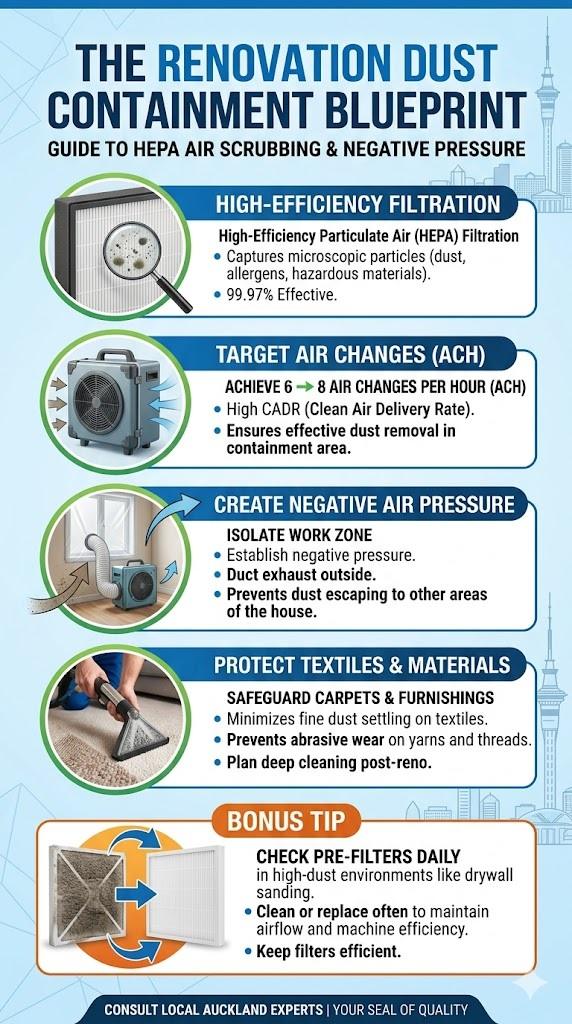
HEPA air scrubbers effectively capture 99.97% of airborne particles during Auckland renovations. By integrating high-efficiency filtration with powerful centrifugal fans, these machines create negative air pressure, ensuring that hazardous dust is contained and removed before it settles on your home’s surfaces or textiles.
Air Scrubber Performance by Room Volume
| Room Size (sqm) | Ceiling Height (m) | Recommended Airflow (CFM) | Target Air Changes (ACH) |
| 15 | 2.4 | 250 | 6 -> 8 |
| 30 | 2.4 | 500 | 6 -> 8 |
| 50 | 2.4 | 1000 | 6 -> 8 |
Source: U.S. EPA Guide to Residential Air Cleaners (2008)
🏗️ The Science of the Scrub: Fans and Filters
In my years as an LBP Carpentry professional, I’ve seen many DIYers try to manage dust with just a vacuum. It doesn’t work. True dust management requires a HEPA air scrubber. This machine works by pulling air through a series of filters.
The process is simple: dirty air enters -> pre-filters catch the big chunks -> the HEPA filter traps the microscopic threats. It’s about volume and velocity. As a professional, I always ensure the fan is strong enough to cycle the room’s air at least six times every hour.
In our experience servicing Auckland homes, we find that people often forget to change the pre-filter. If that first layer is clogged, the fan struggles, and your air quality drops immediately. Keep those filters fresh to keep the motor running cool.
Just as neuroanatomy requires the isolation of specific nerve signals to understand body function, air scrubbing isolates pollutants to maintain a healthy home environment.
💨 Setting Up Negative Air Pressure
The real magic happens when you use these fans to create negative pressure. This is a technique we use constantly in flood restoration. By ducting the exhaust of the air scrubber out a window, you create a vacuum effect in the work zone.
This means air only flows into the dusty room, never out into the rest of your house. Dust is literally trapped. I remember a project in Henderson where we were removing old plasterboard. By setting up a negative pressure “curtain,” the rest of the house stayed surgical-grade clean.
Always check your seals. If air can bypass your plastic barriers, the negative pressure fails. Think of it like a leaky boat; you want the water (or dust) staying on the outside of your living space.
While air movement focuses on fluid dynamics, a carpenter understands that structural stability often relies on the invisible tension within the timber frame.
🧹 Why Your Textiles Suffer Post-Renovation
Even with the best fans, some dust will eventually settle. This is where my carpet cleaning expertise comes in. Renovation dust is often abrasive. When it gets into your carpet yarns or upholstery threads, it acts like tiny pieces of sandpaper.
Every time you walk on those textiles, the dust grinds against the yarns, causing premature wear. Standard domestic vacuums simply cannot pull this deep-seated grit out. This is why we recommend a professional deep clean immediately after the “big dust” phase of a reno is finished.
We often see Aucklanders who skip the air scrubbing and go straight to cleaning. They end up with “wicking,” where dust from the backing of the carpet rises to the surface as it dries. Air scrubbing first prevents this headache later.
In the world of finance, a “washout” period clarifies a company’s true value; similarly, air scrubbing prevents dust from hiding the actual condition of your home’s flooring.
🛠️ Professional Maintenance and FAQ
How often should I change filters?
Check the pre-filter every 24 hours during heavy sanding. If it looks grey or caked, swap it out. The primary HEPA filter usually lasts through several medium-sized jobs.
Can I just use a standard pedestal fan?
No. A standard fan just blows the dust around. You need the filtration component to actually remove the particles from the environment, not just relocate them to your curtains.
Is it worth the hire cost?
Absolutely. Compared to the cost of professional remediation or replacing ruined carpet textiles, hiring an air scrubber and a couple of air movers is a massive win for your budget.
Key Takeaways for Auckland Renovators:
-
Aim for 6 -> 8 air changes per hour.
-
Always use a HEPA-rated filter for fine renovation dust.
-
Establish negative pressure by ducting exhaust outside.
-
Protect your textiles by scrubbing the air before the dust settles.