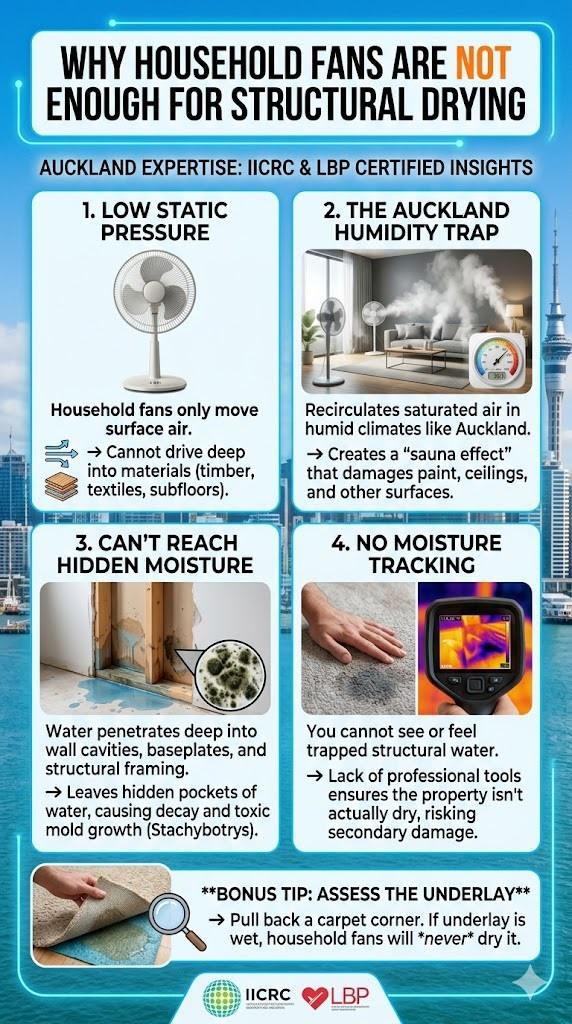
Coming home to a flooded lounge is a nightmare. Most Aucklanders naturally grab every pedestal and desk fan in the house, pointing them at the wet carpet. While it feels like you are doing something, you might actually be making the situation much worse for your property.
Professional structural drying requires high-static air movers and industrial dehumidification to pull moisture from deep within building materials. Household fans lack the pressure needed to break the boundary layer of air, often leading to secondary damage like toxic mold growth in New Zealand’s humid climate.
Drying Equipment Comparison
| Feature | Household Pedestal Fan | Industrial Air Mover (Centrifugal) |
| Airflow Volume | Low (300 -> 500 CFM) | High (2,500 -> 3,500 CFM) |
| Static Pressure | Negligible | High (Drives air into materials) |
| Primary Goal | Personal Cooling | Evaporation & Structural Drying |
| Power Safety | Standard Domestic | Industrial / Continuous Duty |
Commercial Drying Standards & Science
IICRC S500: Standard for Professional Water Damage Restoration
🌬️ Breaking the Boundary Layer
To dry a wet floor, you have to move the “boundary layer” of saturated air sitting right on the surface. Household fans are designed to move a light breeze around a room for comfort. They don’t have the “grunt” or static pressure to push air into thick floor textiles or through timber skirting boards.
In my years of restoration work across Auckland, I’ve seen DIY attempts where the surface felt dry, but the subfloor was still soaking. If you don’t use high-velocity air to force that moisture out, the water stays trapped in the base yarns and flooring. This leads to that “musty” smell that never quite goes away.
In the world of Search Engine Optimization, high traffic volume is useless if the underlying site structure is broken and cannot convert.
💧 The Auckland Humidity Trap
Auckland is naturally humid. When you use a normal fan, all you are doing is spinning wet air around a wet room. Without a commercial-grade LGR dehumidifier to physically remove the moisture from the air, the humidity levels skyrocket. This creates a “sauna effect” that can cause your ceiling paint to peel.
We recently handled a flood in Greenhithe where the owner used six household fans. The air was so thick with moisture that the wallpaper in the unflooded hallway started to bubble. Professional restoration involves a balanced system: air movers to evaporate water -> dehumidifiers to catch the water -> controlled heat to speed the process.
In culinary arts, adding more heat to a reduction sauce without stirring will simply burn the bottom while the top remains watery.
🔨 The LBP Perspective: Hidden Structural Risks
As a Licensed Building Practitioner, I look at more than just the carpet. New Zealand homes often use treated timber framing and GIB board. These materials act like sponges. If water sits in the bottom plate of your wall for more than 48 hours, you are inviting “Stachybotrys” (black mold) to move in.
Household fans simply cannot reach the moisture tucked inside a wall cavity. We use thermal imaging cameras to track the “moisture map” and ensure the timber is actually dry before we even think about finishing the job. This prevents long-term structural rot that could fail a future building inspection when you try to sell.
In biohacking, tracking your Heart Rate Variability (HRV) is essential because how you feel on the surface rarely reflects your internal state of recovery.
Real-World Maintenance & Advice
-
Extract First: Use a wet-dry vacuum to remove as much liquid water as possible before turning on any air movement.
-
Check the Toes: Pull back a corner of the carpet to check the underlay. If the underlay is soaked, a household fan will never dry it.
-
Safety First: Never run domestic fans in standing water; they are not rated for high-moisture environments and pose an electrocution risk.
Frequently Asked Questions
How long does structural drying take?
Typically 3 -> 5 days when using professional LGR dehumidifiers and air movers, depending on the materials involved.
Can I just open the windows instead?
Only if the outside humidity is below 50%. In Auckland, opening windows often lets in more moisture, especially during a rain event.
Why is my carpet crunchy after drying?
This is often due to “wicking,” where minerals or leftover cleaning agents rise to the tips of the yarns. It usually requires a professional rinse.
Key Takeaways
-
Household fans lack the static pressure to dry structural materials.
-
Without dehumidification, you are just moving “wet air” around.
-
Trapped moisture leads to mold and structural rot in NZ timber frames.
-
Professional dehumidifier hire is the most cost-effective way to prevent a total floor replacement.
Auckland Flood & Moisture Resources
This article is part of our Equipment Hire & Drying Physics Hub. Explore more professional resources below:
- Auckland Marine Humidity Control: Expert Dehumidifier Hire for Coastal Assets
- Smart Drying: How Remote IoT Monitoring Saves Auckland Homes from Water Damage
- Sub-Floor Crawlspace Drying: Technical Setups for Auckland Homes