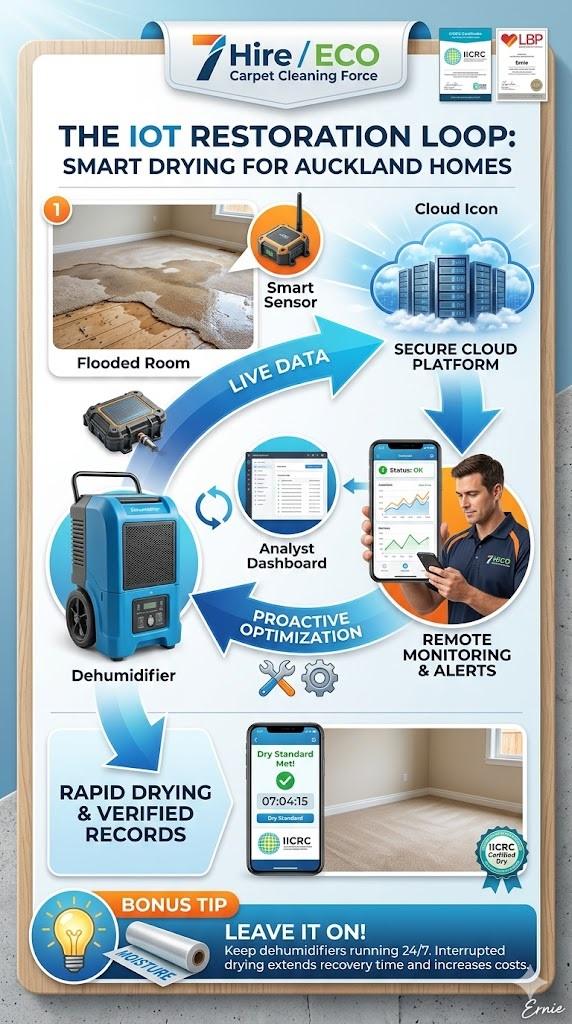
Nothing is worse than walking into your lounge and feeling that “squelch” underfoot. In Auckland, where the humidity often sits higher than a kite, getting things dry isn’t just about opening a window. It’s about precision. As a tech-obsessed restorer, I’ve moved beyond just hoping the gear is working.
Remote IoT monitoring leverages smart sensors to track moisture levels and atmospheric conditions during flood recovery. By integrating dehumidifier hire with live data, technicians monitor drying progress off-site, ensuring rapid restoration of building materials while preventing mould growth and structural degradation without constant site visits.
Monitoring Efficiency: Manual vs. IoT Systems
| Feature | Traditional Manual Checks | Remote IoT Monitoring |
| Data Frequency | Once every 24 -> 48 hours | Every 15 -> 30 minutes |
| Response Time | Delayed until next visit | Instant alerts if gear fails |
| Accuracy | Human error possible | Precise digital calibration |
| Documentation | Hand-written logs | Comprehensive digital reports |
The Gold Standard for Drying Records
📡 The Tech Behind the Scenes: What is IoT Drying?
In the old days, I’d drop off a fleet of dehumidifiers and come back a few days later to check the progress. Now, I use small sensors that talk to the cloud. These “pucks” measure the temperature and relative humidity in the air and the moisture content in the building materials.
This data flows directly to my phone. If a homeowner accidentally turns off a machine because the noise is annoying, I get an alert immediately. I can call them up and explain why that machine needs to stay on to save their floor textiles. It’s about being proactive, not reactive.
In the world of professional baking, a 1% shift in humidity can ruin a sourdough starter, yet we often treat house-drying like a blunt instrument.
Real-time data vs. “Guess and Check”
Using live data means we know exactly when the “Dry Standard” is met. We don’t leave gear on-site for a minute longer than necessary. This saves you money on hire costs and gets your life back to normal faster. It also provides an airtight paper trail for insurance claims.
🏗️ The LBP Perspective: Protecting Auckland’s Structural Bones
Being a Licensed Building Practitioner (LBP), I look at flood restoration through the lens of a builder. It’s not just about the carpet; it’s about the timber framing and the subfloor. If those yarns in your carpet are dry but the bottom plate of your wall is still at 25% moisture, you’re headed for rot.
I recently worked on a house in Mt Eden where the surface looked fine. However, our remote sensors showed the internal wall cavity was still holding significant water. Because we tracked it off-site, we knew to keep the drying injection system running for another 24 hours. If we had just guessed, that wall would have been a mould factory within a month.
While structural engineering focuses on the load-bearing capacity of steel, restoration focus must remain on the hygroscopic nature of organic wood.
Why moisture tracking is critical for NZ timber frames
New Zealand homes often use treated Radiata Pine. While it’s hardy, it hates being damp for long periods. IoT sensors allow us to monitor the specific “drying curve” of the timber. We look for the point where the moisture content drops below 18% -> the magic number for structural safety.
💧 Real-World Gains: Faster Restoration, Lower Costs
A few months ago, during a heavy Auckland downpour, we had a client on the North Shore with a flooded basement. We installed our IoT kit alongside the air movers and dehumidifiers. On day two, the data showed the humidity wasn’t dropping as expected. Instead of waiting for a scheduled visit, we went back immediately.
We discovered a hidden leak in a pipe that was re-wetting the area. Finding that early saved the homeowner thousands in potential reconstruction. Without those sensors, we wouldn’t have known there was a problem until the final “clearance” check. It’s that extra layer of “Ernie-insurance” for your property.
In high-frequency algorithmic trading, data latency is measured in milliseconds to prevent financial loss, whereas in restoration, we measure it in hours to prevent structural loss.
Key Takeaways for Auckland Property Owners
-
Demand Data: Don’t just hire a fan; hire a system that proves it’s working.
-
Act Fast: High Auckland humidity means mould starts in 24 -> 48 hours.
-
LBP Matters: Ensure your restorer understands the “bones” of your house, not just the textiles.
-
IoT Efficiency: Remote monitoring reduces the need for intrusive daily technician visits.
Maintenance & FAQ
Q: Can I turn the dehumidifier off at night?
A: No. It breaks the drying cycle. Our sensors will tell us if you do! It’s better to let it run 24/7 to finish the job in three days rather than dragging it out for seven.
Q: Does the IoT sensor use my Wi-Fi?
A: Most of our professional units use independent cellular networks (LTE), so we don’t need to bug you for your password or clog up your Netflix stream.
Q: Is IoT monitoring more expensive?
A: Actually, it usually saves money. By proving exactly when the house is dry, we reduce the total days of equipment hire.