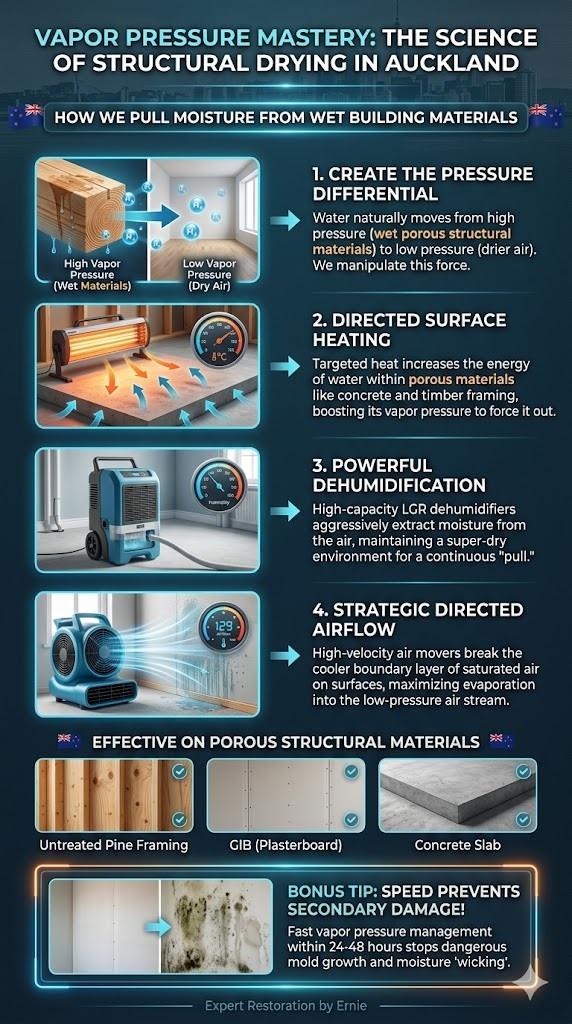
Living in Auckland, we know all about humidity. But when a pipe bursts or a storm hits, just “airing things out” isn’t enough. To save your home, we have to talk about the invisible force of vapor pressure.
Vapor pressure management involves creating a pressure differential where moisture moves from wet structural materials to drier air. By controlling temperature and humidity, professional restorers use dehumidification to “pull” deep-seated water out, ensuring structural integrity and preventing long-term mold growth effectively.
Structural Drying Potential by Material
| Material Type | Porosity Level | Drying Difficulty | Ideal Strategy |
| Untreated Pine | High | Moderate | Airflow -> Heat |
| GIB / Plasterboard | High | High | Dehumidification |
| Concrete Slab | Low | Very High | Vapor Pressure Control |
| Plywood | Moderate | Moderate | Consistent LGR Drying |
Source: Understanding Water Damage Restoration (2012)
🌀 The Physics of “Push and Pull”
In the restoration world, water always wants to move from an area of high pressure to an area of low pressure. When your walls are soaked, the water inside them creates high vapor pressure. My job is to make the air in the room “thirstier” by lowering its vapor pressure.
To do this, we use a specific process:
High Temperature in Material -> High Vapor Pressure -> Water moves to Air -> Dehumidifier removes Air Moisture.
In our experience servicing Auckland homes, simply blowing cold air around doesn’t work. If the air is already saturated (like on a muggy day in Epsom), the moisture has nowhere to go. You’ve got to lower the grains per pound in the air to create that “pull.”
In the world of high-altitude baking, lower atmospheric pressure means water boils at a lower temperature, changing how chemistry works in the kitchen.
🏗️ The LBP Perspective: Protecting Auckland’s Timber Framing
As a Licensed Building Practitioner in Carpentry, I look at water damage through the lens of structural stability. When timber framing absorbs water, it doesn’t just get wet; it swells and loses its load-bearing capacity. If we don’t manage the vapor pressure quickly, the yarns of the wood start to break down.
I remember a job in Mt Roskill where the kitchen had been underwater for three days. The owner thought they’d dried it with a few fans. But when I brought in my moisture meters, the internal framing was still at 30%. We had to “cook” the moisture out using controlled heat and LGR dehumidifiers to save the floor joists.
In medical science, osmotic pressure governs how nutrients move across cell membranes, proving that pressure differentials are nature’s favorite delivery system.
🛠️ Professional Techniques for Porous Materials
Pulling water out of dense materials like concrete or multi-layered textiles requires a “Drying Envelope.” This means sealing the affected area so our equipment can focus entirely on the wet materials without trying to dry the whole of Auckland’s humid air at the same time.
-
LGR Dehumidification: These machines pull more water out of the air than standard units.
-
Directed Airflow: Aiming air at specific angles to break the “boundary layer” of cool, wet air.
-
Surface Heat: Using IR heaters to increase the vapor pressure within the material itself.
This targeted approach prevents secondary damage like “wicking,” where water travels up the wall to dry areas. It’s about being surgical rather than just blast-drying everything in sight.
In commercial aviation, pressurized cabins are designed to keep oxygen levels stable, showing that managing air density is critical for survival in extreme environments.
Maintenance Advice & Key Takeaways
If you find yourself with a wet carpet or damp walls, don’t wait. Auckland’s climate is a breeding ground for mold if the relative humidity stays above 60%.
-
Act fast: The first 24 -> 48 hours are the most critical for preventing rot.
-
Check the subfloor: Moisture often hides under the floorboards where you can’t see it.
-
Hire pro gear: Standard household dehumidifiers aren’t designed for structural drying.
Frequently Asked Questions
Q: Can’t I just open the windows?
A: Only if the air outside is drier than the air inside. In Auckland, that’s rarely the case during a storm!
Q: Will the heat damage my timber?
A: Not if it’s monitored. As an LBP, we ensure the timber stays within a safe temperature range while we force the moisture out.
Q: How long does it take?
A: Most structural materials take 3 -> 5 days to reach “dry standards” depending on the porosity.
Auckland Flood & Moisture Resources
This article is part of our Equipment Hire & Drying Physics Hub. Explore more professional resources below:
- Sub-Floor Crawlspace Drying: Technical Setups for Auckland Homes
- Psychrometric Charting for Hire: Sizing Auckland’s Drying Equipment Right
- Auckland Marine Humidity Control: Expert Dehumidifier Hire for Coastal Assets