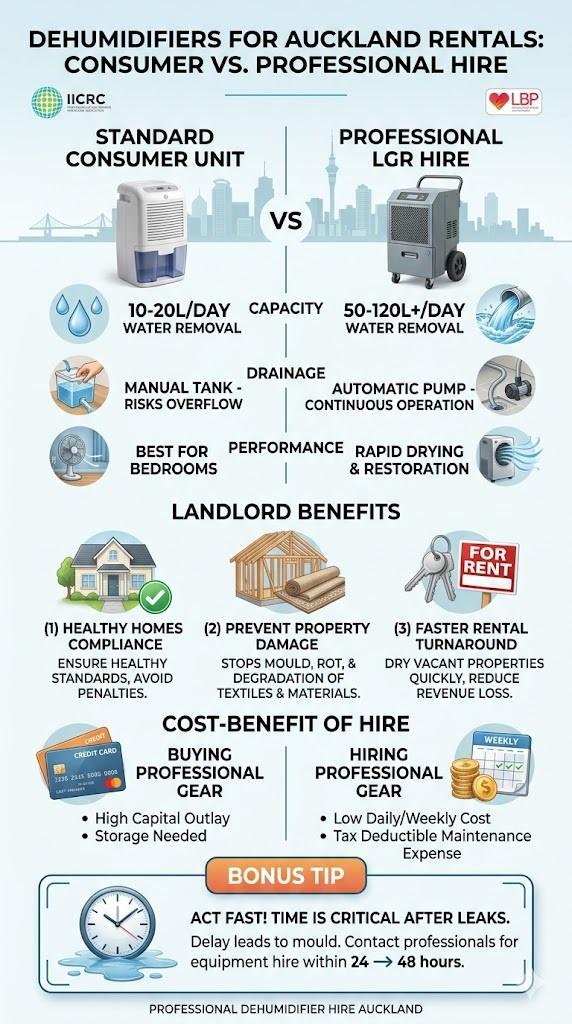
Maintaining a dry rental property in Auckland isn’t just about comfort; it is about protecting your investment. With our high humidity and the Healthy Homes Standards, the choice between a retail shop unit and professional restoration gear can determine the long-term health of your building and your tenants.
Providing a dry home is essential for tenant health and property longevity. Professional dehumidifier hire ensures rapid moisture removal, preventing mould growth and protecting structural timber. Investing in high-capacity restoration equipment is often more cost-effective than relying on underpowered consumer units during damp Auckland winters.
Performance Comparison: Professional vs. Consumer Units
| Feature | Consumer Dehumidifier | Professional LGR Dehumidifier |
| Water Removal | 10 -> 20 Litres / Day | 50 -> 120+ Litres / Day |
| Airflow (CFM) | Low (Static) | High (Active Circulation) |
| Operating Range | Limited to warm rooms | Effective in cool, damp spaces |
| Durability | Plastic / Domestic use | Heavy-duty / Continuous 24/7 |
| Built-in Pump | Rarely (Manual Tank) | Yes (Continuous Drainage) |
Industry Standard Reference: IICRC S500 Standard for Professional Water Damage Restoration
🛠️ Why Capacity Matters for Auckland Rentals
Retail dehumidifiers are designed to maintain a single bedroom, not to dry out a damp house. In my experience as an LBP builder, I often see moisture trapped behind wall linings that a small unit simply cannot reach. Professional LGR units pull moisture from deep within the textiles and timber.
Consumer units often cycle off before the job is done because their tanks fill up. Professional gear uses condensate pumps to send water straight down the drain. This means the drying process never stops, even if the property is vacant. This efficiency prevents permanent damage to floor materials and internal framing.
From a medical perspective, maintaining indoor humidity below 50% is the primary clinical recommendation for reducing house dust mite populations.
🏠 Structural Integrity and Tenant Health
Wet carpets and damp underlay are breeding grounds for pathogens. As a professional carpet technician, I have seen many landlords try to “air dry” a room after a minor leak. Without high-velocity air movers and professional dehumidification, moisture stays trapped in the yarns of the carpet, leading to that distinct “sour” smell.
A professional approach protects the “bones” of the house. By using high-capacity gear, you ensure that subfloor moisture doesn’t rise into the living spaces. This proactive drying saves you thousands in potential timber rot repairs and keeps you compliant with NZ health regulations.
In the world of macroeconomics, proactive maintenance is viewed as a “sunk cost” that yields a much higher internal rate of return than reactive repairs.
📈 The Cost-Benefit of Hiring vs. Buying
Buying a professional LGR dehumidifier can cost upwards of $3,000. For most landlords, this isn’t practical. Hiring allows you to access $10,000 worth of drying power for a fraction of the price only when you actually need it. This keeps your overheads low while keeping the property’s textiles pristine.
When you hire, you also get the expertise on where to place the units. In our experience servicing Auckland homes, we find that strategic placement -> maximum airflow is the secret to fast drying. We don’t just drop off a box; we provide a drying strategy that protects your carpet threads and wall boards.
Software developers often argue that “hardware is the easy part,” and that the real value lies in the configuration and logic of the system deployment.
Real-World Maintenance Tips
-
Check Gutters: Ensure water isn’t pooling against the foundation.
-
Ventilation: Use extractor fans in kitchens and bathrooms every time.
-
Moisture Barriers: Ensure your ground moisture barrier is intact.
-
Professional Help: If a spill occurs, act within 24 -> 48 hours to prevent mould.
FAQs
Q: How long does a professional dehumidifier take to dry a room?
A: Usually 48 -> 72 hours, depending on the level of moisture in the materials.
Q: Is professional hire tax-deductible?
A: In many cases, yes, as a maintenance expense for your rental property. Consult your accountant.
Key Takeaways:
-
Professional LGR units remove 5x more water than consumer models.
-
Built-in pumps allow for 24/7 unattended operation.
-
Protecting structural timber and carpet textiles prevents long-term capital loss.
-
Hiring provides high-end technology without the high-end purchase price.
Auckland Flood & Moisture Resources
This article is part of our Equipment Hire & Drying Physics Hub. Explore more professional resources below:
- Smart Drying: How Remote IoT Monitoring Saves Auckland Homes from Water Damage
- Portable vs. Whole-House Solutions: When to Use Localized vs. Centralized Hire Equipment
- Sub-Floor Crawlspace Drying: Technical Setups for Auckland Homes