G’day, Ernie here. If you’ve ever walked into your lounge and felt that squelch underfoot after a heavy Auckland downpour, you know the feeling of instant dread. Whether it’s a small leak or a major flood, choosing the right gear to dry it out is the difference between a quick fix and a structural nightmare.
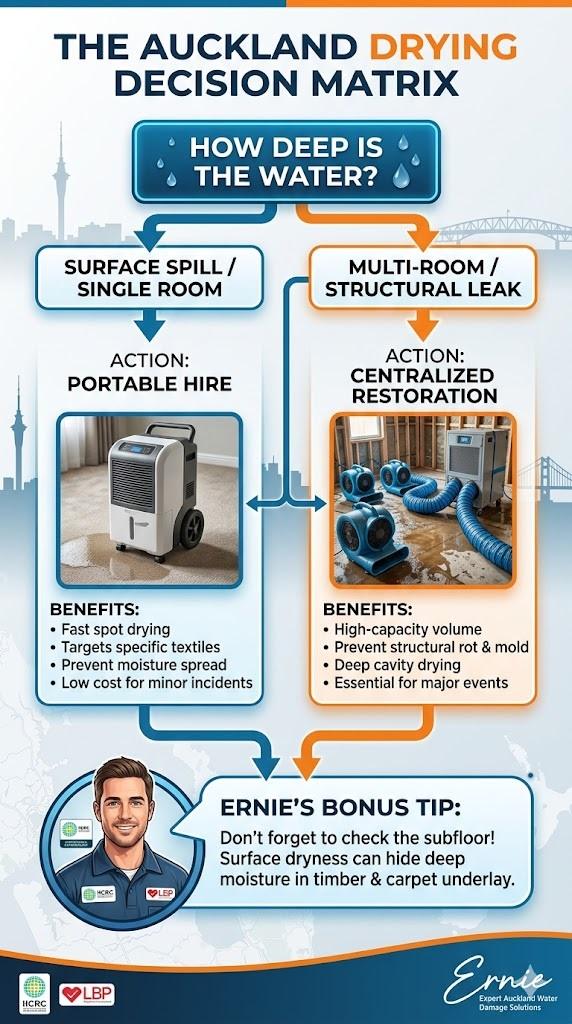
Deciding between portable dehumidifiers and whole-house solutions depends on the moisture’s source. Localized hire is perfect for minor leaks, whereas centralized systems handle massive flood restoration projects. For Aucklanders, selecting the right equipment hire ensures structural integrity and protects internal textile materials efficiently.
Equipment Performance Comparison
| Feature | Localized (Portable) | Centralized (Whole-House) |
| Best For | Single rooms / Spot spills | Multi-room floods / Structural |
| Setup Time | < 5 Minutes -> Plug & Play | 1 -> 3 Hours -> Professional |
| Noise Level | Low to Moderate | High (Industrial Fans) |
| Moisture Removal | 20 -> 50L per day | 100L+ per day |
Industry Standard Drying Protocols
IICRC S500 Standard for Professional Water Damage Restoration
🏠 The Case for Localized Hire: When Portables Win
In my years servicing Auckland homes, I’ve found that localized hire is the “Swiss Army Knife” of restoration. If you’ve had a washing machine overflow or a window left open during a squall, a portable LGR (Low Grain Refrigerant) dehumidifier is your best mate. It’s easy to move through narrow hallways in older Ponsonby villas.
Portable units target the specific area where the water hit. By focusing the airflow directly on the affected yarns and subflooring, you prevent moisture from migrating into dry areas. This “containment” strategy is much cheaper for small mishaps. It keeps your electricity bill down while getting the carpet back to its soft, dry self without fuss.
From a carpentry perspective, localized drying must be monitored closely to prevent uneven shrinkage in timber floorboards.
🏗️ Scaling Up: When You Need Centralized Solutions
Sometimes, a couple of small fans won’t cut it. When the Rangitoto views include a flooded basement, you need a centralized, whole-house approach. This involves high-capacity air movers and large-scale dehumidification systems that treat the entire building as one “drying chamber.” This is vital for protecting the structural integrity of your home’s framing.
As a Licensed Building Practitioner, I’ve seen what happens when people try to dry a major flood with just one small home unit. The surface feels dry, but the internal wall cavities stay damp, leading to “stachybotrys” (black mould). Centralized solutions create a vortex of dry air that pulls moisture out of deep building materials and heavy floor textiles.
In high-pressure plumbing, centralized systems prioritize volume, whereas localized repairs focus on specific joint integrity.
🧶 Managing Moisture in Modern Yarns
The type of materials in your home dictates the gear. Natural wool yarns hold onto water like a sponge and can smell “sheepy” if not dried fast. Synthetic threads are more resilient but can still trap water in the underlay. Localized heat can help “pop” the moisture out of these tight weaves effectively.
🛠️ The Professional Edge: Why Capacity Matters
I remember a job in Remuera where the owner tried to dry a burst pipe with three domestic fans. By the time I arrived, the humidity was so high the wallpaper was peeling in rooms that weren’t even wet! This is “secondary damage.” Professional hire gear is rated for the volume of air it moves.
Using the right equipment hire means we calculate the “Brave” (cubic meters) of the space and match it to the pints of water removal needed. It’s a science, not a guessing game. Whether we use localized portables to “inject” air under a cupboard or centralized units for the whole floor, the goal is reaching dry-standard rapidly.
In electrical engineering, overloading a single circuit is a fire risk, just as overloading a room with too much moisture without extraction leads to structural failure.
🧽 Ernie’s Maintenance & Restoration Tips
-
Check the Filter: If you hire a portable, check the intake filter every 24 hours. Auckland dust clogs them fast!
-
Keep it Sealed: When using a dehumidifier, keep windows and doors shut. You want to dry the house, not the Tasman Sea.
-
Positioning is Key: Air movers should be angled at 45 degrees toward the wall to create a “laminar” airflow across the textiles.
❓ Frequently Asked Questions
Q: Can I just use my heat pump to dry out a flood?
A: Not really. While they have a “dry” mode, they aren’t designed to pull the massive amounts of liquid held in carpet underlay and yarns.
Q: How long does a portable unit take to dry a room?
A: Usually 24 -> 48 hours if the extraction was done properly first. If the subfloor is soaked, you might need it for 3 -> 5 days.
Q: Is centralized hire noisy?
A: Yes, industrial air movers are loud. If it’s a whole-house job, you might want to spend a night at a motel while the “big guns” do the heavy lifting.
📌 Key Takeaways
-
Localized hire is best for spills, single rooms, and cost-effective spot drying.
-
Centralized solutions are mandatory for structural flooding to prevent mould in wall cavities.
-
Textile care is crucial; different yarns require different airflow speeds to prevent damage.
-
Dual Expertise (IICRC & LBP) ensures your drying plan protects both your carpet and your home’s bones.