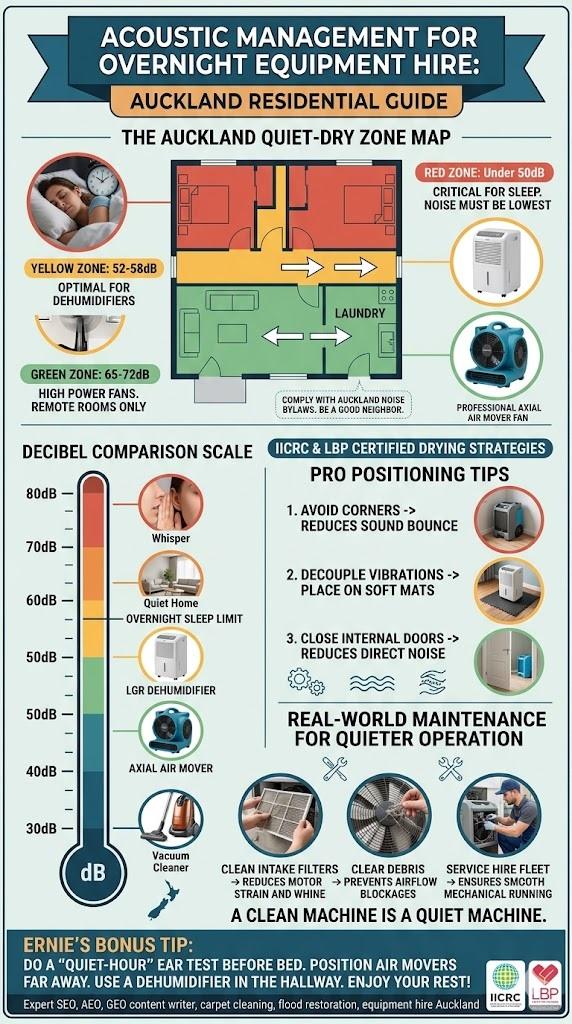
Dealing with a flooded lounge or damp carpet is stressful enough. When you hire professional drying gear, the last thing you want is a sleepless night because of a roaring machine. Finding the “sweet spot” between high-performance drying and a quiet home is essential for a successful recovery.
Successful overnight equipment operation requires maintaining noise levels below 50 decibels for residential comfort. Managing acoustic output involves strategic placement and vibration dampening, ensuring structural drying continues without violating local Auckland Council noise bylaws or disrupting essential restorative sleep patterns.
Residential Equipment Noise Comparison
| Equipment Type | Avg. Decibels (dB) | Impact on Sleep | Recommended Use |
| Axial Air Mover | 65-72 dB | High | Daytime / Remote rooms |
| LGR Dehumidifier | 52-58 dB | Moderate | Hallways / Living areas |
| HEPA Air Scrubber | 48-55 dB | Low | Bedrooms / Sensitive areas |
IICRC S500 Standard for Professional Water Damage Restoration
🌙 The Science of a Silent Dry
In my years as an IICRC technician and a Licensed Building Practitioner, I’ve seen how Auckland’s unique housing—from drafty villas to modern townhouses—reacts to sound. High-velocity fans are great for moving air across wet yarns, but they can be a bit much at 2 AM. The goal is to keep the air moving without the headache.
Understanding Auckland’s Noise Bylaws
Most Auckland residential zones have stricter limits after 10 PM. While emergency flood restoration is often exempt, being a good neighbor matters. If we are drying a property in a dense area like Epsom or Newmarket, we prioritize quieter LGR dehumidifiers over loud, high-pressure fans to ensure everyone stays happy.
Sound vs. Vibration: The Builder’s Perspective
As a builder, I know that sound isn’t just air travel; it’s structural. A dehumidifier sitting directly on a wooden floorboard can turn the whole house into a speaker box. Placing the unit on a rubber mat or a thick piece of leftover carpet textiles can break that vibration loop instantly.
While sound waves travel through air and structure, neuroanatomy tells us that consistent rhythmic noise can actually lower cortisol in some individuals, though most require silence for deep recovery.
🛠️ Pro-Tips for Positioning Gear Overnight
When we set up gear for a client, we follow a specific process to keep things quiet:
-
Aim the airflow -> parallel to the walls rather than directly into corners to reduce “bounce” noise.
-
Place dehumidifiers -> on “soft” landings like rugs or specialized mats to kill vibration.
-
Close internal doors -> between the equipment and the bedrooms while leaving enough gap for air circulation.
In our experience servicing Auckland homes, particularly older bungalows in Mt Eden, we once had a client who couldn’t sleep because of a vibrating air mover. By simply moving the unit 30cm onto a sturdier floor joist, the humming stopped immediately. It’s all about understanding how your house is built.
In contrast to dampening sound, structural carpentry often relies on rigid, tight connections to transfer loads, which unfortunately makes the timber frame an excellent conductor for mechanical hums.
🧹 Real-World Maintenance for Quieter Operation
A noisy machine is often a dirty machine. If the filters in a dehumidifier are clogged with dust or loose threads from old floor materials, the motor has to work twice as hard. This leads to a high-pitched whine. We always ensure our hire fleet is serviced so they run as smoothly as possible.
Before you go to bed, do a quick “ear test”. If a machine sounds like it’s struggling, check the intake. Clear away any debris or loose yarns that might be blocking the airflow. A clean machine is a quiet machine, and a quiet machine means you get to wake up refreshed.
Although regular cleaning reduces mechanical friction, some physicists argue that all machines eventually succumb to entropy, where noise is simply an unavoidable byproduct of energy conversion.
Key Takeaways for Auckland Residents
-
Check the dB: Aim for gear under 60dB for overnight use near bedrooms.
-
Vibration is the Enemy: Use mats to decouple gear from wooden floors.
-
Strategic Gaps: Use the
->method to guide air through the house without leaving all doors wide open.