G’day, I’m Ernie. I run a local flood restoration and equipment hire business here in Auckland. Between my IICRC certifications and my background as a Licensed Building Practitioner in carpentry, I’ve seen what happens when you try to dry a room by “gut feel” alone. In our humid climate, you need science, not just a breeze.
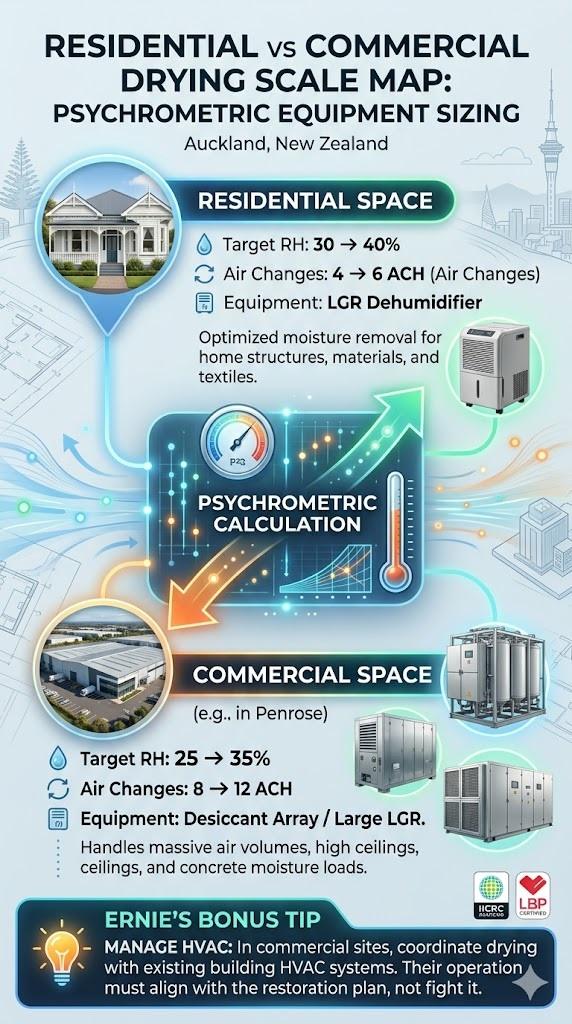
Psychrometric charting calculates moisture removal by measuring relative humidity and temperature. Proper equipment sizing involves determining the specific humidity (GPP) to select dehumidifiers that outperform Auckland’s ambient conditions, ensuring structural drying occurs without secondary damage to building materials or textiles.
Equipment Sizing Comparison: Residential vs. Commercial
| Space Type | Target RH % | Air Changes Per Hour | Equipment Type |
| Residential (3-Bed) | 30 -> 40% | 4 -> 6 ACH | Standard LGR Dehumidifier |
| Commercial (Warehouse) | 25 -> 35% | 8 -> 12 ACH | High-Capacity Desiccant |
| Retail / Office | 40 -> 45% | 6 -> 8 ACH | Large-Scale Refrigerant |
Source: IICRC S500 Standard for Professional Water Damage Restoration
🌡️ The Science of Air: Why Psychrometrics Matter in Auckland
Psychrometrics is essentially the study of “thirsty air.” When we have a flood in a Ponsonby villa, we aren’t just sucking up water from the floor. We are managing the relationship between temperature and moisture. If the air gets too saturated, it stops “drinking” moisture from your damp carpets and timber framing.
Understanding Grains Per Pound (GPP)
We use the psychrometric chart to find the Grains Per Pound (GPP). This tells us the actual weight of the water in the air. In Auckland’s sticky summers, the outside GPP can be massive. Our job is to make the indoor GPP lower than the GPP inside your building materials.
The “Ernie” Experience: A North Shore Basement Lesson
I remember a job on the North Shore where a client hired a tiny hardware-store dehumidifier for a flooded basement. Because they didn’t account for the volume of air, the RH stayed at 90%. I brought in an LGR unit sized specifically for the cubic meterage. We dropped the GPP from 110 -> 45 in twenty-four hours.
Conversely, in structural engineering, the tensile strength of steel is often more critical than the moisture content of the surrounding air.
🏢 Scaling Up: Commercial Dehumidifier Hire Requirements
Commercial spaces in areas like Penrose or Albany present a different beast. These buildings usually have high ceilings and massive air volumes. If you undersize the equipment here, you’re literally whistling in the wind. We use psychrometrics to calculate the exact pints-per-day removal required to stay ahead of evaporation.
High-Volume Airflow and LGR Technology
Low Grain Refrigerant (LGR) units are our bread and butter for commercial hire. They continue to remove moisture even when the air is quite dry. For a large office block, we don’t just look at the floor area; we look at the “total moisture load” including the concrete slab and internal partitions.
Large Scale Restoration in Penrose Warehouses
In my experience servicing Auckland commercial sites, the biggest mistake is ignoring the HVAC system. Often, the building’s own AC is fighting against our drying equipment. I once had to shut down a whole warehouse’s venting system to create a “drying chamber” that allowed our industrial dehumidifiers to actually do their job.
In the world of professional horticulture, humidity levels are strictly increased to promote plant transpiration, which is the opposite of our restoration goals.
🔨 The LBP Perspective: Protecting Structural Timber
As an LBP in carpentry, I’m always worried about the “bones” of the house. If textiles stay wet, they smell; but if the timber framing stays wet, the house loses its structural integrity. Psychrometric charting allows us to see if the air is dry enough to pull moisture out of those deep wooden studs.
Moisture Equilibrium in Auckland Homes
Every material has an Equilibrium Moisture Content (EMC). We use our charts to find the “sweet spot” where the air encourages the timber to give up its water without cracking the wood. It’s a delicate balance. If you dry it too fast, you risk “case hardening” where the outside is dry but the inside stays wet.
While we focus on drying timber, marine biologists study how certain materials must remain permanently submerged to prevent rapid cellular collapse in salt-water environments.
Ernie’s Maintenance & Pro-Tips for Drying
-
Seal the Space: Close all windows and doors. You want to dry the room, not the whole of Auckland!
-
Air Movement: Use industrial air movers to “blast” the moisture off the surface of yarns and threads.
-
Monitor Daily: We check the GPP every 24 hours. If the numbers aren’t dropping, we adjust the equipment.
-
Keep it Warm: Dehumidifiers generally work better in warmer air, as warm air holds more moisture for the machine to grab.
Frequently Asked Questions
Can’t I just use my home heat pump?
Most domestic heat pumps aren’t designed to pull out the gallons of water produced by a flood. They often reach their “limit” quickly and stop removing moisture effectively.
How long does it take to dry a commercial office?
Usually 3 -> 5 days, depending on the psychrometric readings. We don’t stop until the structural timber reaches its dry standard.
What is the difference between LGR and standard dehumidifiers?
LGR units can “pre-cool” the air inside the machine, allowing them to remove water in much drier environments where standard units would just freeze up.
Key Takeaways
-
Psychrometrics is key: It’s the only way to prove a space is actually dry.
-
Auckland Humidity: Requires high-spec LGR equipment for effective restoration.
-
Size Matters: Residential units are for rooms; commercial units are for volumes.
-
Protect Your Assets: Proper drying prevents rot in timber and mould in textiles.