In Auckland, we deal with more than our fair share of dampness. Whether it is a burst pipe in Grey Lynn or a flash flood in West Auckland, getting moisture out of your home quickly is the only way to prevent mould. Choosing the right fan is the first step toward a dry home.
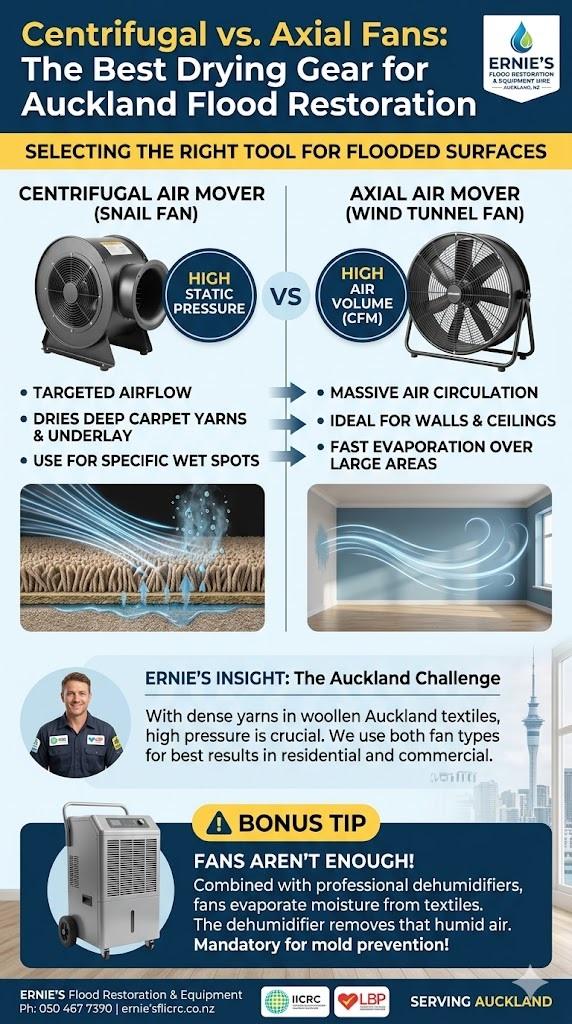
Choosing between centrifugal fans and axial air movers is critical for efficient flood restoration. Centrifugal models deliver high-pressure airflow ideal for drying damp carpet yarns, while axial fans provide high-volume circulation across large wall surfaces, significantly reducing overall structural drying times.
Fan Selection Comparison Matrix
| Fan Type | Airflow Pattern | Best For | Pressure Level |
| Centrifugal | Concentrated / Narrow | Carpet Yarns & Underlay | High Static Pressure |
| Axial | Broad / High Volume | Walls, Ceilings, & Hallways | Low Static Pressure |
Source: The IICRC S500 Standard for Professional Water Damage Restoration
🌀 Why Centrifugal Fans Win for Wet Carpet Yarns
Centrifugal fans, often called “snail fans” because of their shape, are the workhorses of the carpet cleaning industry. They pull air from the sides and blast it out of a narrow snout. This creates high static pressure, which is exactly what you need to penetrate deep into thick carpet yarns and the padding underneath.
In our experience servicing Auckland homes, especially those lovely older villas with heavy woollen textiles, a standard pedestal fan just won’t cut it. You need that concentrated blast to “kick” the water molecules off the yarns -> into the air -> and then out of the room via a dehumidifier.
One time, we were called to a flooded lounge in Ponsonby where the owner had been using household fans for three days. The surface felt dry, but the yarns underneath were still soaking. We swapped them for centrifugal air movers, and the moisture readings dropped instantly because we finally reached the base of the material.
In carpentry, high-pressure airflow is also used in dust extraction systems to ensure heavy wood shavings are pulled through narrow hoses without clogging.
💨 Axial Fans: The Heavy Lifters for Wall and Ceiling Drying
If you are looking to dry a large surface area, like a painted GIB wall or a high ceiling, axial fans are your best friend. Unlike the snail fans, these look like high-powered versions of a standard propeller fan. They move a massive volume of air (CFM) across a wide path.
When I’m wearing my LBP (Licensed Building Practitioner) hat, I’m always thinking about the structure behind the paint. To dry a wall effectively, you need to move the “boundary layer” of saturated air away from the surface. Axial fans do this beautifully by creating a wind-tunnel effect throughout the entire room.
In large-scale Auckland commercial floods, we often daisy-chain these fans together. This creates a continuous flow of air that keeps the environment moving. They are lighter and easier to transport, making them the perfect choice for our equipment hire customers who need to dry out large hallways or open-plan offices quickly.
Interestingly, in structural engineering, the concept of “laminar flow” explains how air moves smoothly over surfaces to reduce drag, much like how axial fans move air over flat walls.
🛠️ Real-World Maintenance & Pro Tips
Keeping your drying equipment in top shape is vital for Auckland’s busy flood season. Always check the intake grills for dust or lint. If the intake is blocked, the motor works harder, runs hotter, and moves less air. This is especially true when working around loose threads or dusty construction sites.
-
Check the Cord: Ensure there are no frays -> safety first in wet environments.
-
Clean the Housing: Use a damp cloth to wipe down the plastic shells.
-
Test the Speeds: Make sure the switch allows for all power levels.
-
Stacking: Store them vertically to save space in your garage or van.
FAQs
Can I just use my home’s heat pump?
No. While a heat pump helps with temperature, it doesn’t provide the high-velocity airflow needed to physically lift moisture from dense yarns or building materials.
How many fans do I need?
A general rule for flood restoration is one air mover for every 10 -> 15 linear feet of wall space, plus extra for the centre of the room.
Key Takeaways
-
Centrifugal fans are for high-pressure, targeted drying of yarns and textiles.
-
Axial fans are for high-volume, broad drying of walls and structures.
-
Proper airflow is the fastest way to prevent mould growth in Auckland.
-
Always combine fans with a professional dehumidifier for the best results.
Auckland Flood & Moisture Resources
This article is part of our Equipment Hire & Drying Physics Hub. Explore more professional resources below:
- Vapor Pressure Mastery: How We Pull Moisture From Auckland Homes
- Why Auckland Landlords Choose Professional Dehumidifier Hire Over Consumer Units
- Speeding Up Industrial Coatings: The Auckland Guide to Using Air Movers