Quick answer: A persistent odour after a leak or flood usually means moisture, contamination or odour-causing residue remains in an affected material or hidden space. Fragrance does not solve the cause. A useful response identifies the source, cleans or removes unsuitable materials, and confirms drying with appropriate assessment.
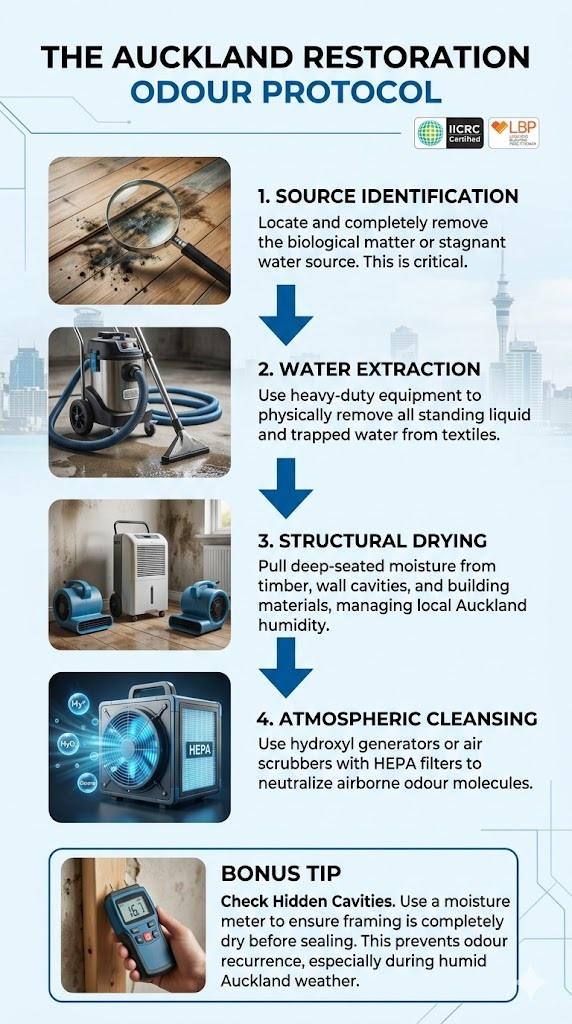
Flood odour response chart
| What you notice | Possible source | Helpful next step |
|---|---|---|
| Musty odour after a clean-water leak | Remaining moisture in carpet, underlay, flooring or a wall cavity | Check the affected materials and arrange moisture assessment if it persists. |
| Strong sewage or contaminated-water odour | Contamination or residue in porous materials | Keep people away from the area where practical and arrange professional assessment. |
| Odour returns after cleaning | Source remains below the surface or in an adjoining space | Investigate hidden moisture paths rather than adding fragrance. |
| Staining, swelling or soft linings with odour | Water-damaged building material | Assess material condition before repairs or painting. |
Why flood odours persist
Water can travel below visible surfaces and carry soil or contaminants into carpet backing, underlay, flooring, insulation and wall cavities. Once the surface looks dry, the remaining source may still produce an odour. That is why deodorising is normally the final part of a restoration plan, not the first.
What a proper odour assessment considers
- The water source and whether contamination may be present.
- Which materials were wet, including those beneath the visible surface.
- Whether staining, swelling, residue or material deterioration is present.
- Moisture readings and the likely path water took through the property.
- Whether cleaning, targeted removal, drying or further investigation is needed.
Safe first steps for homeowners
- Stop the water source if it is safe to do so.
- Take photos of affected rooms and materials.
- Remove loose belongings from the area where safe.
- Avoid masking a persistent smell with fragrance; this can make the source harder to identify.
- Arrange assessment promptly if the water was contaminated, the smell is strong, or materials remain damp.
Dehumidifiers and odour control
A dehumidifier can help lower humidity and support drying, but it does not remove contamination or odour-causing residue. Air movement and dehumidification need to be combined with extraction, cleaning and source removal where required.
For a new incident, see our emergency carpet drying action plan. For likely moisture inside a lining or ceiling void, read our hidden cavity drying guide.
Flood odour FAQs
Will a dehumidifier remove a musty flood smell?
It supports drying by lowering humidity, but it does not remove contamination or residue. If the source remains in affected materials, targeted cleaning, removal or other treatment may be needed.
How long should a flood smell last?
There is no fixed timeframe. The smell should reduce when affected materials are cleaned and dried appropriately. If it persists or returns, further investigation for hidden moisture or residue is sensible.
Can I cover a flood smell with fragrance?
Fragrance may mask an odour briefly, but it does not solve the cause. Identify and address the source before considering deodorising treatments.
When should I arrange an odour assessment?
Arrange one when an odour is strong, returns after cleaning, follows contaminated water, or occurs with staining, swelling, soft materials or visible dampness.
Need help after a flood or leak?
Our Auckland flood restoration and carpet drying team can assess affected materials, explain the drying and cleaning options, and document the next steps before reinstatement.