It’s the sound every Auckland homeowner dreads: a sudden hiss or a heavy thud, followed by a warm pool of water spreading across the hallway. When a hot water cylinder fails, time becomes your most expensive commodity.
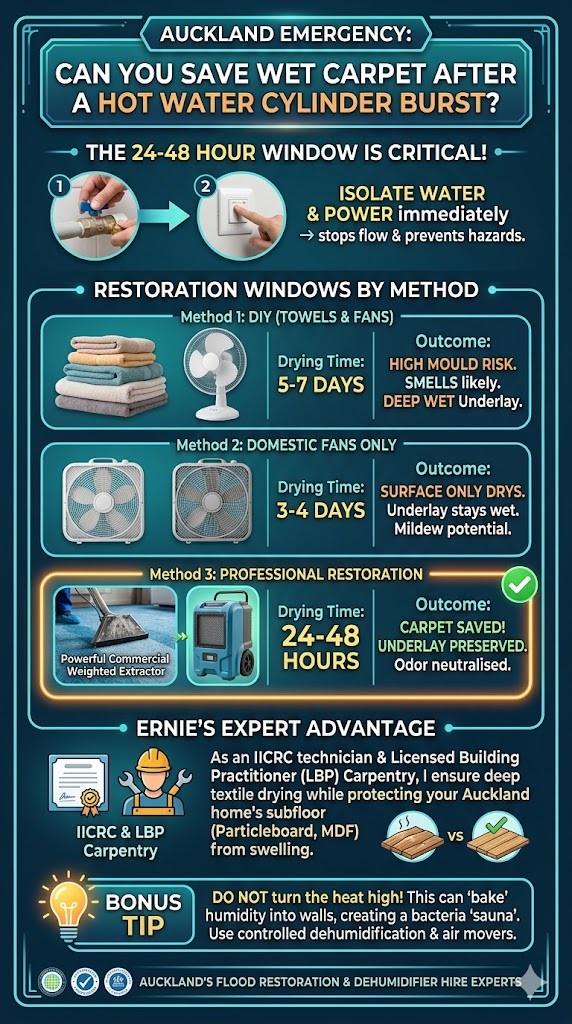
Yes, you can save wet carpet after a hot water cylinder burst if you act within 24 hours. Promptly extracting standing water and using industrial dehumidifier hire prevents permanent damage to textile backings and underlay, keeping your Auckland home safe from structural mould growth.
Restoration Windows for Auckland Homes
| Method Applied | Likely Outcome | Drying Time |
| Towels & Windows Open | High risk of mould; smells likely | 5 -> 7 Days |
| Domestic Fans Only | Surface dries, underlay stays wet | 3 -> 4 Days |
| Pro Extraction + Dehumidifier | Carpet saved; underlay preserved | 24 -> 48 Hours |
| Industrial Heat Drying | Rapid recovery; minimal disruption | 12 -> 24 Hours |
Source: IICRC Standards for Professional Water Damage Restoration
🚰 Step 1: Immediate Damage Control
Before you grab the towels, you must isolate the source. Locate your cold water expansion valve or the main water toby and shut it off. This stops the flow but remember, a standard cylinder still holds 135 -> 180 litres of hot water that wants to settle in your floor yarns.
In my years servicing homes from Ponsonby to Mt Roskill, I’ve seen people try to soak up a cylinder burst with bath towels. While it feels productive, you are only reaching the top 5% of the moisture. The rest is currently being sucked into the backing materials of your carpet like a straw.
From a purely financial perspective, insurance companies often look for “mitigation of loss” immediately after an event to ensure your full claim is approved.
🛠️ Why an LBP Builder Views Flood Restoration Differently
Being a Licensed Building Practitioner (Carpentry) means I look past the wet threads and into the bones of your home. In Auckland, many homes use particle board or MDF subflooring. These materials act like sponges; once they absorb hot water, they swell and lose structural integrity.
If the water sits for more than 48 hours, the carpet yarns might look okay, but the floor underneath could be ruined. When we arrive for a flood restoration job, we aren’t just drying the textiles; we are protecting the timber framing and flooring sheets from permanent “cupping” or rot.
In the world of biology, mould spores can begin to colonise organic materials in as little as 24 hours when the temperature and humidity are right.
💨 The Professional Extraction Advantage
To truly save the carpet, we use a weighted extraction tool. This uses high-pressure suction to pull water directly out of the underlay without lifting the carpet. Once the bulk water is gone, industrial dehumidifier hire is the next step to “pull” the remaining moisture out of the deep yarns.
I remember a job in Onehunga where a cylinder burst in a tight cupboard. The owner used a hair dryer for six hours. All he did was “bake” the humidity into the walls, creating a perfect sauna for bacteria. We had to bring in commercial air movers to save the skirting boards.
In electrical engineering, even clean water can create “salt bridges” on circuit boards, meaning your floor-level power sockets may need testing even if they seem dry.
🏠 Maintenance and Long-Term Care
Once the carpet is dry, it will likely feel “crunchy” because of the minerals left behind by the hot water. A professional steam clean and pH-neutral rinse will soften the threads and remove any remaining sediment. Always check your cylinder’s sacrificial anode every few years to prevent these bursts.
Key Takeaways
-
Act Fast: You have a 24 -> 48 hour window before permanent damage occurs.
-
Shut it Off: Isolate the water and power to the cylinder immediately.
-
Professional Gear: Domestic fans cannot pull moisture out of dense carpet underlay.
-
Check the Subfloor: As an LBP, I ensure your floorboards aren’t swelling beneath the rug.
Frequently Asked Questions
Is hot water damage worse than cold water?
Yes. Heat opens up the textile yarns, allowing water to penetrate deeper and faster. It also accelerates the growth of bacteria and mould.
Will the smell go away on its own?
Unlikely. That “wet dog” smell is often gases released by bacteria. Professional antimicrobial treatments are usually required to neutralise the odour in the underlay.
Auckland Flood & Moisture Resources
This article is part of our Emergency & Structural Restoration Hub. Explore more professional resources below:
- Finding Damp in Auckland Villas: A Guide to Moisture Mapping
- Structural Safety After a Flood: An Auckland Builder’s Guide to Spotting Trouble
- How to Dry Hidden Wall Cavities and Ceiling Voids in Auckland Homes