When the water recedes from your North Shore or West Auckland property, the real work begins. While most people worry about the smell of wet carpets, my background as both a Licensed Building Practitioner and a flood restoration tech tells me to look deeper. Structural issues aren’t always obvious until they become expensive.
Watch for foundation cracks, sagging floors, or jammed doors. If water saturates the ground, subfloor piles may shift, causing long-term damage. Identifying structural movement early prevents costly rebuilds. Auckland’s clay soils expand when wet, making immediate professional assessment and dehumidification essential for safety.
Post-Flood Structural Risk Indicators
| Sign of Instability | Risk Level | Immediate Action Required |
| New cracks in concrete | High | Engineering assessment |
| Doors sticking in frames | Medium | Check subfloor moisture |
| Sloping or bouncy floors | High | Verify pile integrity |
| Waterlogged drywall | Low-Medium | Dehumidifier hire & strip-out |
BRANZ: Restoring a house after a flood (2013)
🏗️ Foundation and Subfloor Warnings
In Auckland, we deal with a lot of reactive clay. When a flood hits, that clay expands and puts massive pressure on your footings. I once inspected a home in Greenhithe after a storm; the water hadn’t just soaked the carpet, it had actually “heaved” the ground enough to tilt several concrete piles.
Check your subfloor area for “scouring” where moving water has washed away soil from around the piles. If you see gaps between the top of a pile and the bearer it’s supposed to support, the house is no longer sitting level. This leads to weight being distributed unevenly across the remaining framing.
While a builder looks at how the soil supports the house, a geologist might remind us that water is the primary architect of the earth’s surface, viewing your foundation’s movement as a natural, inevitable erosion process.
🪵 Walls, Frames, and Internal Materials
Floodwater doesn’t just sit on the surface -> it wicks up into the timber studs and wall linings. As an LBP, I’ve seen how quickly untreated pine can lose its structural capacity when it stays saturated. You might notice your “skirtings” pulling away from the wall or “drywall” feeling soft.
The “textiles” and padding in your home act like a giant sponge. If these damp materials aren’t removed, they trap moisture against the wooden frame. This leads to “rot” and “mould” which compromise the timber’s strength over time. If a door suddenly won’t close, it’s usually because the frame has warped.
From a microbiological perspective, a saturated wall isn’t just a building component; it is a high-yield laboratory for fungal colonies that treat your timber studs as a primary food source.
💧 The Role of Professional Restoration
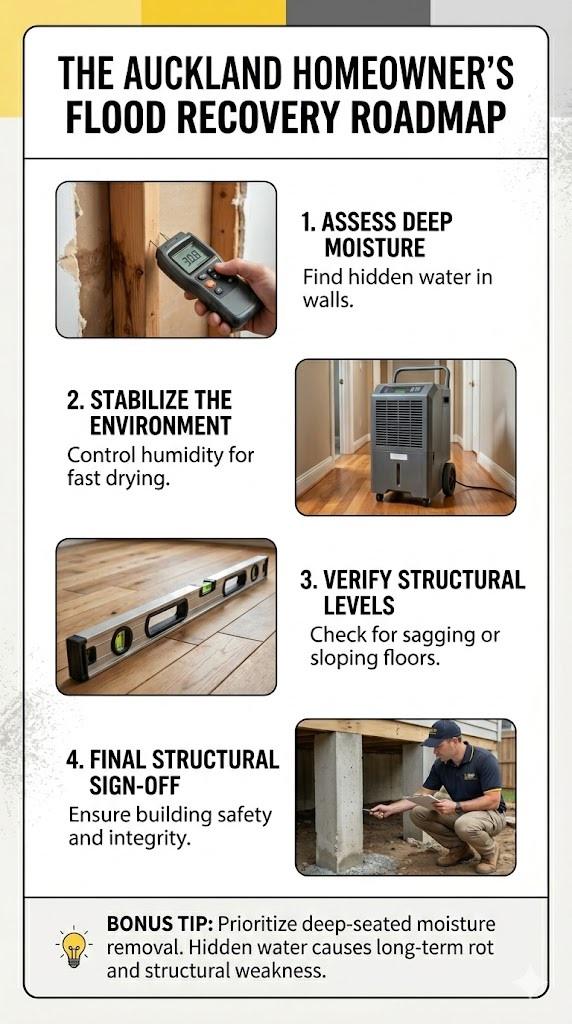
Drying a house is a science. You can’t just open the windows and hope for the best in Auckland’s humidity. I use moisture meters to track how deep the water has gone into the wooden yarns and threads of the subfloor. Using high-grade dehumidifier hire is the only way to pull that deep-seated moisture out.
In my experience servicing Auckland homes, people often try to save money by not drying the structure properly. They replace the carpet but leave the floor joists wet. Six months later, the floor starts to sag. You have to stabilize the environment before you can guarantee the carpentry work will last.
In the world of high-finance, a flooded home is often viewed purely as a depreciating asset, yet a restoration professional sees it as a salvageable structure that simply needs a controlled thermodynamic environment to recover.
Real-World Maintenance Advice
-
Clear the Vents: Ensure your subfloor vents aren’t blocked by silt or debris.
-
Check the Levels: Use a long spirit level on your floors to check for new slopes.
-
Address the Sump: If you have a basement, ensure the sump pump is cleared of grit.
FAQs
How long does it take for a flooded house to become unstable?
It depends on the duration of the soak. Structural timber can begin to swell and warp within 48 -> 72 hours of constant saturation.
Can I dry out my house myself?
Small spills, yes. But for a flood, you need commercial-grade equipment to reach the moisture trapped inside the wall cavities and sub-flooring.
Key Takeaways
-
Auckland clay makes foundations particularly vulnerable to water-heave.
-
Jammed doors and windows are early warning signs of shifting piles.
-
Professional dehumidification is a structural necessity, not just a luxury for comfort.
Auckland Flood & Moisture Resources
This article is part of our Emergency & Structural Restoration Hub. Explore more professional resources below:
- Auckland Flood Recovery: How Long Until Your Carpets Are Bone Dry?
- Concrete Slab Moisture Testing Auckland: The LBP Guide to Prep Before You Lay
- Gym & Yoga Studio Moisture Load: Managing High-Humidity Environments in Auckland