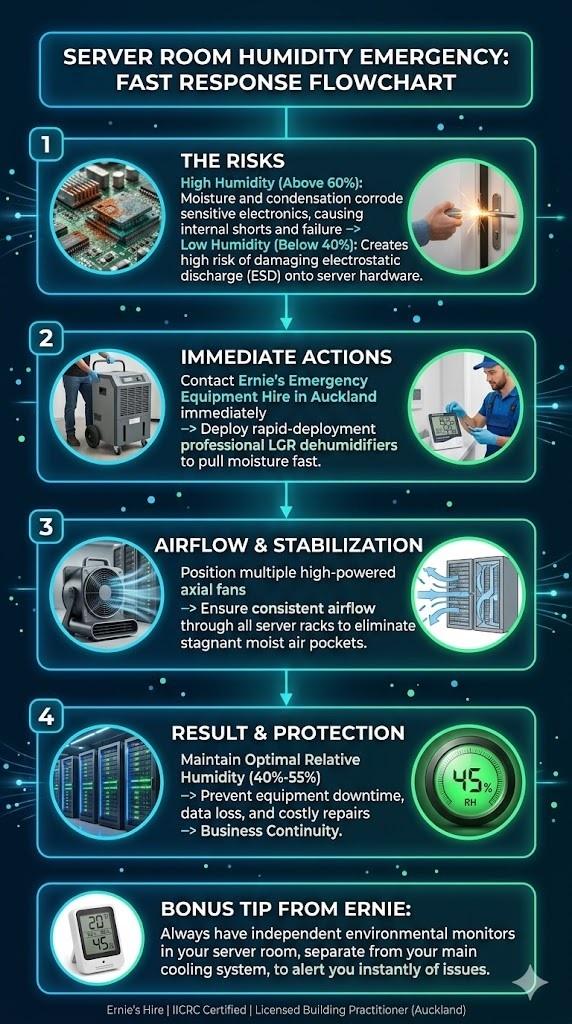
When the air conditioning fails in an Auckland server room, the clock starts ticking immediately. It is not just about the heat; it is the moisture in the air that creates a silent crisis for your hardware and data integrity.
Emergency dehumidifier hire is critical during server room cooling failures. Maintaining relative humidity between 40% and 60% prevents electrostatic discharge or hardware corrosion. Professional moisture control equipment ensures rapid environmental stabilization, protecting sensitive electronics from permanent damage and minimizing business downtime -> saving your infrastructure.
Server Room Environmental Standards
| Condition | Recommended Range | Risk of Failure |
| Relative Humidity | 40% -> 55% | High (Static or Corrosion) |
| Temperature | 18°C -> 27°C | Moderate (Thermal Throttling) |
| Dew Point | 5.5°C -> 15°C | Critical (Condensation) |
Data Center Standards Source: ASHRAE (American Society of Heating, Refrigerating and Air-Conditioning Engineers)
🌡️ Why Humidity is the Silent Killer of Auckland Servers
In my years restoring Auckland properties, I have seen how our humid maritime climate wreaks havoc on internal environments. When your precision cooling goes down, the local humidity can spike rapidly, leading to two major hardware threats: electrostatic discharge and oxidation.
If the air gets too dry (below 30%), static electricity builds up on every surface. One small spark can fry a motherboard. Conversely, if it is too damp, moisture settles on metallic components and copper yarns within the circuitry, leading to “tin whiskers” and eventual short circuits.
I remember a job in a CBD office where a small leak in the ceiling saturated the subfloor. Even though the servers stayed dry, the rising humidity nearly triggered a total system shutdown before we arrived with our drying gear.
-
Low Humidity -> Static discharge risks.
-
High Humidity -> Corrosion of internal components.
-
Fluctuating Humidity -> Mechanical stress on hardware.
In biological systems, extreme humidity fluctuations can trigger rapid spore germination, showing how moisture dictates life and decay.
🛠️ The Restoration Approach: Using Pro Gear for Tech
As a Licensed Building Practitioner and IICRC technician, I treat a humid server room like a flood restoration site. We don’t just move air; we must remove the moisture. Standard “home” dehumidifiers cannot keep up with the latent heat load of a data centre.
We use industrial LGR (Low Grain Refrigerant) dehumidifiers. These units are designed to pull moisture out of the air even in high-temperature environments. Pairing these with axial air movers ensures that “dead spots” behind server racks are cleared of stagnant, moist air.
-
Deploy LGR units -> Rapid grains-per-pound reduction.
-
Position air movers -> Ensure constant flow through racks.
-
Monitor dew point -> Prevent condensation on cold metal.
From a structural carpentry perspective, timber expands and contracts based on moisture content, much like how circuit boards react to thermal and hygroscopic stress.
💡 Real-World Maintenance & Emergency Advice
If you face an environmental failure, your first move is to increase airflow. Open the rack doors and get fans moving. However, do not bring in outside Auckland air unless it is significantly drier than the internal air.
Frequently Asked Questions
-
How fast can a dehumidifier stabilize a room?
With the right industrial hire gear, we can usually see a significant drop in relative humidity within 30 -> 60 minutes.
-
Can I use a standard carpet drying fan?
Yes, axial fans are great for airflow, but they must be used alongside a dehumidifier to actually remove the water from the air.
Key Takeaways for Auckland IT Managers
-
Keep a hygrometer in the room for independent monitoring.
-
Have an emergency equipment hire contact on speed dial.
-
Target 50% humidity to balance static and corrosion risks.
-
Ensure all cooling maintenance includes a check of the condensate pumps.