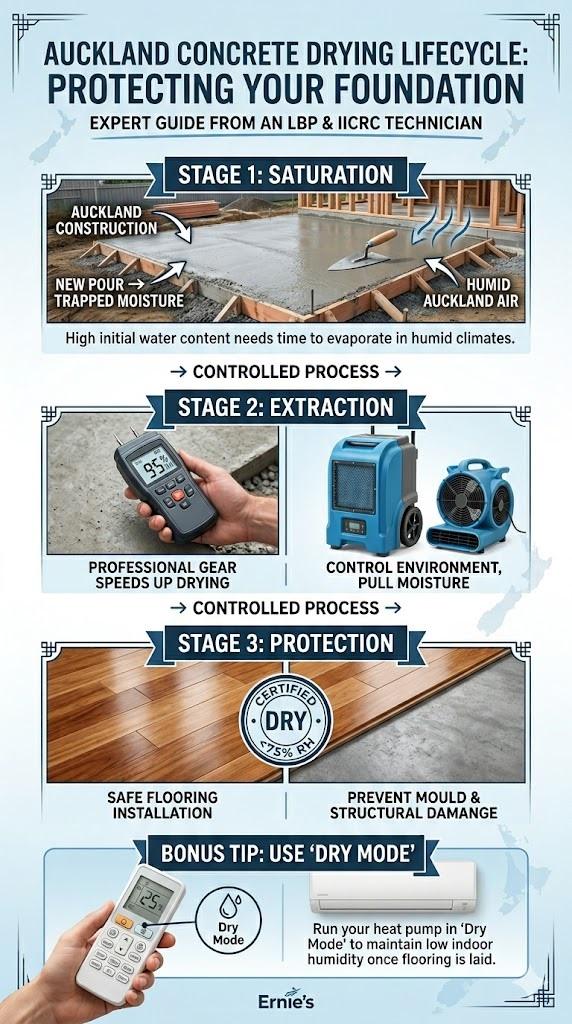
Congratulations on the new pour! Getting that foundation down is a major milestone. But as an LBP builder and a restoration tech, I can tell you the battle against Auckland’s moisture isn’t over. A new concrete slab looks dry on the surface, but it’s often holding massive amounts of deep water that’s just waiting to wreck your plans.
A successful concrete slab drying process is critical in Auckland to prevent mould, timber decay, and adhesive failure. Utilizing professional dehumidifier hire ensures that the deep core of the foundation reaches the appropriate humidity levels required before installing any finished floor coverings.
Typical Concrete Slab Natural Drying Times (Auckland Conditions)
| Slab Thickness | Estimated Natural Drying Time to 75% RH (Good Conditions) | Risk of Failure with Early Install |
| 100mm | 3 -> 4 months | High |
| 120mm | 4 -> 5 months | High |
| 150mm | 6+ months | Very High |
🛠️ Why Natural Drying in Auckland is Often a Slow, Risky Gamble
Auckland has a humidity problem. Our typical weather is often humid, making natural evaporation agonizingly slow. In our experience servicing Auckland homes, we see homeowners thinking the concrete is dry because it looks light grey, when the internal RH (Relative Humidity) is still dangerously high for any floor covering.
Concrete dries from the top down -> moisture on the surface evaporates, but new moisture migrates from the core. Without intervention, this takes months. Rushing this leads to water being trapped under your floor finishes, where it will condense.
While builders aim for structural curing (often just 28 days), the flooring requirements for moisture are much stricter.
🏡 The Domino Effect: How Damp Concrete Destroys Your New Floor
I’ve seen too many stunning floor finishes ruined. It usually starts with a strange, musty smell. Then you notice discolouration in your carpets or lifting along the seams of your floating floor. This is the water pushing up, attacking the textiles, yarns, and adhesives used.
Impermeable flooring (like vinyl or laminate) is the biggest trap -> the water cannot pass through, so it creates a damp void underneath. This is the perfect breeding ground for toxic black mould, which can pose significant health risks for your family long before you even see any signs of a structural problem.
Geotechnical engineers focus on the ground’s bearing capacity, but the interior slab dryness is often a separate, critical issue for finishing trades.
💨 Speeding Up the Slab Drying Process: A Professional Restoration Approach
This is where professional equipment hire comes in. Instead of waiting six months, you can often halve that drying time. Our specialist LGR dehumidifiers are not like home units; they are designed to extract moisture at a high rate, pulling water right out of the dense concrete structure.
We combine dehumidifiers with high-velocity air movers -> creating constant air movement over the slab surface to maximize evaporation. This controlled environment ensures that you can get on with your build, lay your textiles and yarns, and move in sooner, all while knowing your foundation is safe.
While ventilation helps, an architect might argue that relying only on natural through-draughts can over-dry and crack the slab surface prematurely.
📏 Measuring Moisture: The Critical Step Before Any Flooring Install
Don’t guess. Don’t trust a hand-swipe test. As an LBP, I always recommend a certified moisture test. This is often an in-situ probe test, where you drill and insert sensors to get the reading from the core of the slab. NZ Standards specify a reading of 75% RH (or less) is required for most flooring materials.
Using professional restoration gear lets us manage this controlled drying -> but a final test is the only way to be 100% sure your slab is compliant. Spending a small amount on testing can save you ten times that in replacement costs for your failed floor later on.
Most homeowners rely on moisture meters for soil, but these general tools are not accurate for the density of structural concrete slabs.
💡 Practical Concrete Slab Maintenance for Auckland Homeowners
Once your home is dry and your floors are laid, your maintenance job continues. Keep a keen eye on your property’s ventilation.
-
Ensure subfloor ventilation is clear and active if you have a suspended slab.
-
Monitor your indoor humidity levels, especially after heavy rain.
-
Invest in a simple hygrometer to track your home’s air humidity; a reading consistently over 60% can signal that dampness is migrating from somewhere.
Frequently Asked Questions (Auckland Concrete Slab Drying)
-
Can’t I just open the windows? In Auckland, especially in winter, the humidity outside can be 80%+. Opening windows often just adds more moisture to the slab.
-
What equipment should I rent to speed it up? A high-performance LGR (Low Grain Refrigerant) dehumidifier is crucial. Our standard household models just won’t cut it for concrete.
-
How much water is actually in a concrete slab? A standard new 100m² home can easily hold several thousand litres of “excess” water that needs to be removed after curing.
Key Takeaways
-
Natural concrete drying in Auckland is very slow.
-
Trapped moisture ruins carpets and floor coverings.
-
Professional dehumidifier hire significantly accelerates drying safely.
-
Always perform a certified moisture test before installing flooring.