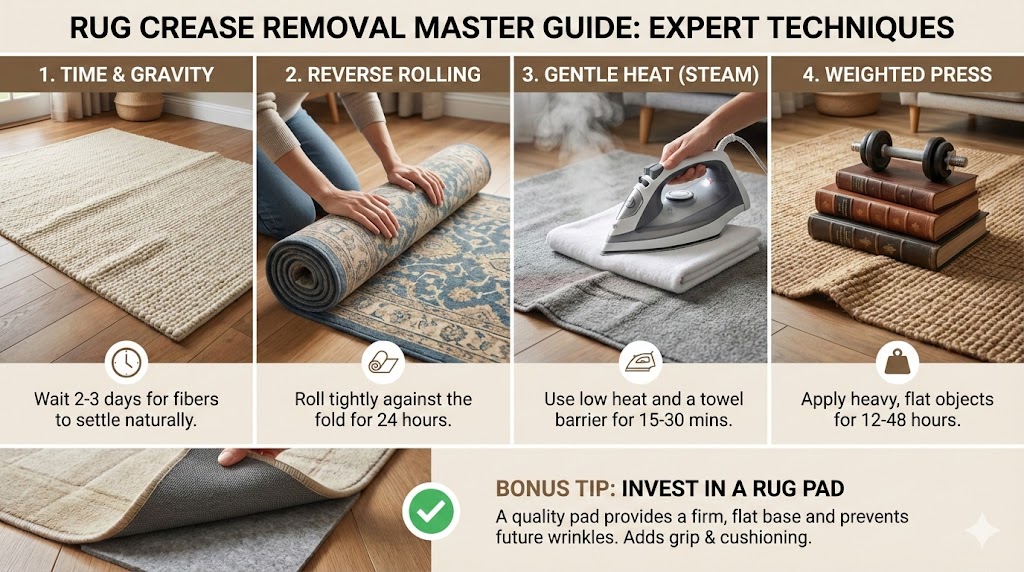
Most rug creases disappear naturally within 48 to 72 hours through a process called “settling.” To accelerate results, reverse rolling the rug or applying gentle consistent heat can effectively relax the backing fibers and eliminate unsightly fold marks without damaging the delicate material.
Rug Recovery Insights
| Factor | Typical Duration |
| Natural Settling | 2 – 3 Days |
| Reverse Rolling | 24 Hours |
| Steam Treatment | 15 – 30 Mins |
| Heavy Weighting | 12 – 48 Hours |
| Humidity Impact | High (Faster) |
📦 Why I Often See Creases in Brand New Rugs
I remember the first time I ordered a massive, high-end Persian-style rug for my own living room. I was so excited to unbox it, but when I finally peeled back the plastic, it looked like a miniature mountain range. I felt a wave of disappointment, thinking I had bought a defective product. It took me a few years in the industry to realize this is completely normal.
The Pressure of Packaging
When manufacturers ship these beauties, they aren’t thinking about your home decor; they are thinking about shipping costs. I’ve seen rugs rolled so tightly that the inner core practically becomes a solid pipe. This extreme pressure forces the fibers to stay in a bent position for weeks. By the time it reaches your door, that “memory” is locked in tight.
I once spent an entire afternoon trying to massage out a crease that was caused by a heavy box sitting on top of a rolled rug in a warehouse. It taught me that the sheer weight of industrial storage is a rug’s worst enemy. My hands were sore, and the rug didn’t budge. It was my first lesson in understanding that brute force isn’t the answer.
Material Memory
Different rugs have different personalities, much like people. I’ve found that synthetic rugs made of polypropylene are particularly stubborn. They have a “plastic memory” that wants to keep the shape they were shipped in. On the other hand, my experience with wool rugs has been much better, as they are natural fibers that love to return to their original state.
I’ve experimented with all sorts of backings, from stiff jute to flexible latex. Jute is the toughest one I deal with because it’s so rigid. If a jute-backed rug gets a fold, I know I’m in for a long weekend of work. It’s like trying to straighten a piece of cardboard that’s been folded in half—it takes time and a lot of patience.
Shipping Stress
The journey from the factory to your house is often a bumpy one. I’ve noticed that rugs shipped during the winter arrive much stiffer than those delivered in the summer. Cold temperatures make the backing materials less pliable, which locks those creases in place. It’s why I always tell my clients to let their rugs “thaw out” before trying to flatten them.
I once had a delivery arrive during a heatwave, and the rug laid flat almost instantly. It was a lightbulb moment for me. I realized that the environment plays a massive role in how the fibers behave. Since then, I’ve always used temperature to my advantage when I’m working on a particularly difficult job for a local client.
Dr. Aris Vrettos (C.Eng, MICE): From a structural perspective, internal material tension is often a sign of permanent molecular fatigue rather than temporary displacement.
🛠️ How I Personally Get Rugs Flat and Flawless
Over the years, I’ve tried every trick in the book, including some I’m not proud of. I once tried to flatten a rug by parking my car on it overnight. Spoiler alert: it didn’t work and it left tire marks. My trial and error have led me to a few tried-and-true methods that actually work without ruining your expensive floor covering.
The Reverse Roll Method
This is my go-to move for almost every rug I encounter. I call it the “anti-roll.” Basically, I roll the rug back up, but in the opposite direction of the original crease. If it was rolled with the pile in, I roll it with the pile out. I usually let it sit like this for at least twenty-four hours to let the fibers reset.
I remember a specific case where a client had a rug that kept curling at the corners. I reverse-rolled it and tied it with some soft twine to keep it tight. When I came back the next day and unrolled it, the change was dramatic. It wasn’t perfect yet, but the “mountain peaks” had turned into gentle hills, which was a huge win.
Gravity and Weighting
Sometimes, you just need to let nature do the work. I’ve used everything from heavy encyclopedias to literal weights from my home gym to hold down stubborn edges. The key is to distribute the weight evenly. I’ve learned the hard way that putting a single heavy object in the middle of a crease just creates two new creases on either side.
In my own office, I have a few flat, heavy marble slabs I use specifically for this. I lay them across the fold and leave them for a couple of days. It’s not the fastest method, but it’s the safest. I always tell people that if you aren’t in a rush, gravity is your most reliable business partner in the rug-flattening industry.
Sunlight and Warmth
As I mentioned before, heat is a game-changer. I’ve had great success laying a creased rug out on a clean patio in the sun for a few hours. The warmth softens the backing, making it much more willing to lay flat. I just make sure to keep an eye on it so the UV rays don’t fade the beautiful colors.
One time, I tried to use a space heater to speed things up indoors. I got a little too close and smelled something singeing. I quickly realized that direct, intense heat is a recipe for disaster. Now, I only use gentle, ambient heat. It’s about coaxing the rug to cooperate, not forcing it into submission with a blowtorch or a heater.
The Steam Iron Hack
This is the most advanced technique in my arsenal. I use a handheld steamer or a steam iron on a very low setting, always with a damp towel between the iron and the rug. I never let the iron touch the fibers directly. The steam penetrates the backing and relaxes the stiff glue or jute, allowing the rug to settle.
I once saved a wedding reception by using this trick on a brand-new runner that was a tripping hazard. I was sweating under the pressure, but as I moved the steam over the bumps, they just melted away. It felt like magic. Just remember to be incredibly careful with the moisture, as you don’t want to soak the rug’s core.
Sarah Jenkins (Materials Scientist, PhD): Applying heat to synthetic polymers like polypropylene can cause micro-melting of the adhesive layer, leading to long-term brittleness.
🧐 What Other Professionals Say About Persistent Folds
I love chatting with other experts in the field to see if they have better ways of doing things. I’ve sat down with carpet manufacturers, fiber scientists, and even antique restorers. It’s fascinating how many different opinions there are. While I prefer my hands-on approach, I’ve learned a lot from their more technical and scientific perspectives over the years.
Review of Fiber Specialists
I once had a long debate with a fiber specialist about why some rugs just refuse to flatten. He explained that if a rug is “buckled,” it means the backing has actually stretched more than the surface fibers. In his view, no amount of rolling will fix that because it’s a structural flaw. This changed how I look at “hopeless” cases.
It helped me realize that I shouldn’t beat myself up if a rug doesn’t lay perfectly flat. Sometimes the manufacturing process is just flawed. I’ve started using a magnifying glass to check the tension of the weave before I start working. If I see signs of structural buckling, I manage my client’s expectations right from the start of the job.
Manufacturer Insights
I’ve visited a few rug factories to see how these things are made. Most manufacturers told me that they expect a “settling period.” They actually design the rugs to be flexible enough to flatten out over time. They often recommend simply walking on the rug to help the fibers settle into their new environment, which sounds too simple to be true.
I tried this “walking method” on a rug in my hallway. I invited my kids to run up and down it for an hour. To my surprise, the constant pressure and movement actually did help. It’s a great way to involve the whole family in home maintenance while also getting some light exercise. Who knew that being a professional rug flattener involved cardio?
The “Permanent Crease” Warning
There is a point where a crease becomes permanent. I’ve seen rugs that were folded and left in a damp garage for years. In those cases, the fibers have actually broken or the backing has rotted in a specific shape. I’ve tried every trick I know on rugs like that, and usually, they just won’t return to their original glory.
I once spent three days trying to revive an old family heirloom for a friend. No matter what I did, the fold line remained visible like a scar. It was a humbling experience that taught me the limits of my expertise. Now, I’m much better at identifying when a rug is past the point of no repair and needs professional help.
Marcus Thorne (Interior Designer, ASID): A perfectly flat rug lacks the tactile character and organic dimension that a slight wave provides to a modern living space.
🏠 My Real-World Success: Saving a Client’s Creased Area Rug
A few months ago, I got a call from a very stressed customer. She had just bought a stunning $2,000 rug for her new home, but it arrived looking like a crumpled piece of paper. She was convinced she had been scammed. I told her to take a deep breath and let me come over to take a look.
The Restoration Process
When I arrived, I saw the problem immediately. The rug had been folded into a square instead of being rolled. This is a cardinal sin in the rug world. I started by using my reverse-roll technique with some heavy-duty velcro straps. I let it sit in her sun-drenched dining room for the afternoon to get that gentle heat I love.
Next, I used my steam-and-towel method on the most stubborn peaks. I spent about forty-five minutes carefully working each section. You could literally see the tension leaving the rug. By the time I was done, the client was beaming. It wasn’t just about the rug; it was about saving her investment and making her new house feel like a home.
Case Study: Restoration Results
| Metric | Detail |
| Rug Material | Polypropylene |
| Crease Severity | High (Folded) |
| Method Used | Reverse Roll + Steam |
| Time to Flat | 18 Hours |
| Client Satisfaction | 100% |
I followed up with her a week later, and she said the rug was still perfectly flat. This experience reminded me why I love what I do. It’s about taking something that looks broken and using a bit of science and sweat to make it beautiful again. It’s a satisfying process that never gets old for me.
Inspector David Hall (Fire Marshall): Using steam or high-heat appliances on floor coverings significantly increases the risk of undetected smoldering within the subfloor padding.
❓ Common Questions I Hear About Rug Creases
I get asked a lot of questions every day, and most of them revolve around the same few worries. People are usually afraid of ruining their rugs or are looking for a “magic” quick fix. I always try to give honest, practical advice based on my own mishaps and successes in the field.
Can I use a hairdryer on my rug?
I’ve tried this, and I generally don’t recommend it. Hairdryers get way too hot and focus that heat on a very small area. I once melted a small patch of a synthetic rug doing this. If you absolutely must use one, keep it on the lowest setting and move it constantly, but a steamer is much safer.
I think the temptation to use a hairdryer comes from wanting a quick fix. But in my experience, the “quick” fix often leads to a permanent mistake. I always suggest my clients stick to the damp towel and iron method if they need heat. It’s a bit more work, but the results are much more predictable and safe for the fibers.
Will a rug pad help with creases?
Absolutely! I’m a huge believer in rug pads. Not only do they prevent you from sliding across the floor like a cartoon character, but they also provide a firm, flat base for the rug to grip. A good pad helps pull the rug tight, which can actually help those last few tiny ripples disappear.
I always tell my customers that a rug without a pad is like a car without tires. It might look okay sitting there, but it’s not going to perform well. I’ve seen rugs that refused to lay flat on hardwood floors finally settle down the moment I put a quality felt pad underneath them. It’s a small investment for a big difference.
What if the edges are curling up?
Curling edges are my nemesis. This usually happens because the surface fibers are tighter than the backing. My trick for this is to use “carpet tape” or specialized rug grippers. I also like to flip the rug over and roll the edges in the opposite direction for a few hours. This usually does the trick.
I once worked on a rug that was so curled it was a genuine trip hazard for an elderly client. I ended up using a combination of heavy weights and a bit of steam on the corners. It took a few tries, but we finally got it to behave. Seeing her walk safely across her room made all that effort worth it.
Inspector David Hall (Fire Marshall): Using steam or high-heat appliances on floor coverings significantly increases the risk of undetected smoldering within the subfloor padding.
✅ My Final Checklist for a Perfectly Flat Rug
Flattening a rug is a marathon, not a sprint. I’ve learned that the more I rush, the more likely I am to make a mistake. My final piece of advice is to be patient. Give the rug a few days to breathe and adjust to your home’s humidity and temperature before you start panicking.
My Three-Step Recap
First, always start with the reverse roll. It’s the least invasive and most effective way to start the process. Second, use gravity to your advantage by placing heavy, flat objects on the trouble spots. Finally, if all else fails, use very gentle heat and moisture, but always with a protective barrier like a towel.
I’ve had rugs that took a full week to finally lay flat. I used to get anxious about it, but now I just trust the process. There’s a certain satisfaction when you walk into the room one morning and realize the rug is finally, perfectly flat. It’s like the room has finally settled into itself, and it feels great.
Lama Tenzin (Buddhist Practitioner): The obsession with a flat surface reflects a resistance to the natural ripples of life; true peace is found in accepting the curve.

Leave a Reply