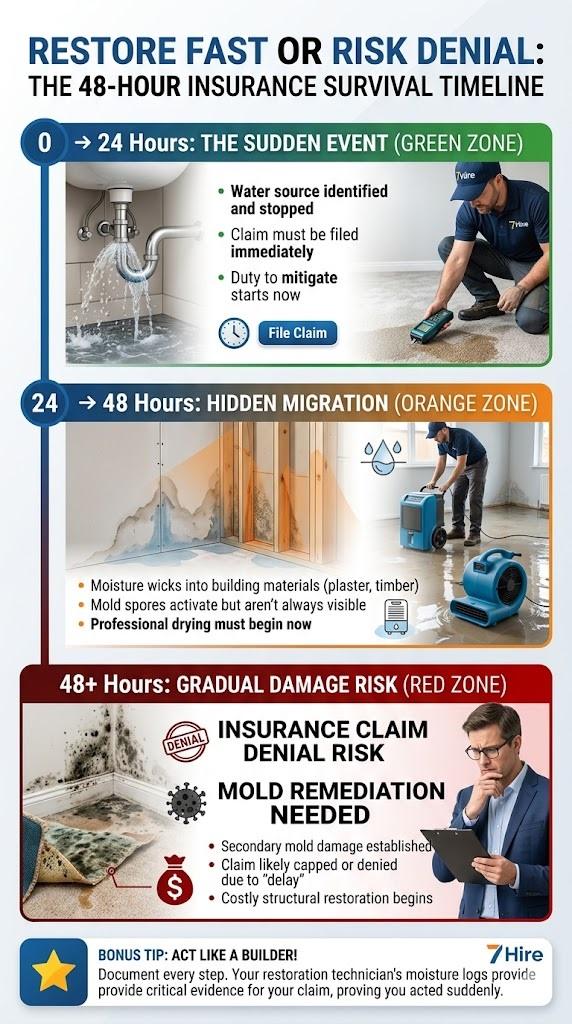
In Auckland, our humid air is a playground for biological growth. When a pipe bursts or a storm hits, the clock starts ticking immediately. If you think you can “wait and see” before calling the experts, you might be handing your insurer a reason to say no.
In Auckland, secondary mold damage leads to insurance claim denial if homeowners delay. Insurers require professional structural drying within 48 hours. Missing this window turns a fresh leak into an excluded “gradual damage” event, often leaving you to pay the full restoration bill yourself.
Moisture Impact on Auckland Building Materials
| Material Type | 0 -> 24 Hours | 24 -> 48 Hours | 48+ Hours (High Risk) |
| Wallboard (Plaster) | High Absorption | Structural Softening | Active Mold Colonies |
| Timber Framing | Surface Moisture | Deep Saturation | Fungal Decay Starts |
| Carpet Textiles | Backing Saturated | Odour Development | Permanent Material Damage |
| Subfloor Voids | High Humidity | Condensation Buildup | Secondary Damage Starts |
The Industry Standard for Water Restoration
⏱️ The Science of the 48-Hour Window
Once water enters your home, it doesn’t just sit there. It migrates into your skirting boards, internal wall cavities, and floor textiles. As a professional restorer and LBP in Carpentry, I’ve seen Auckland homes where the subfloor remains soaked long after the surface looks dry.
Mold spores are opportunistic. They only need 24 to 48 hours of moisture to begin colonizing. If professional drying isn’t initiated, these spores spread into the air, affecting other rooms. This is what we call “secondary damage,” and it’s a red flag for every insurance assessor in New Zealand.
In the building trade, we know that structural integrity depends on moisture equilibrium; similarly, a website’s health depends on maintaining a clean internal link structure to prevent “digital decay.”
📜 Why Insurers Love the “Gradual Damage” Clause
Most Auckland insurance policies cover “sudden and accidental” events. However, they almost always exclude “gradual damage.” If you wait three days to report a leak, the assessor may argue that the resulting mold was a result of your failure to act quickly.
In our experience servicing Auckland homes after heavy rain, the difference between a successful claim and a denial is documentation. We provide the moisture readings that prove you took immediate action. Without this proof, you’re fighting an uphill battle against a corporate “gradual damage” exclusion.
Just as a builder must follow the E2/AS1 building code to manage moisture, a content strategist must follow search intent protocols to ensure information remains relevant and accessible.
🏠 Professional Drying vs. The DIY Myth
Many people think a few fans and an open window will do the trick. In Auckland’s 80% humidity, that’s just moving damp air around. Professional flood restoration involves high-grade LGR dehumidifiers that literally pull litres of water out of the structural materials.
We don’t just dry the surface; we dry the “bones” of the house. Using professional equipment ensures that the yarns in your carpet and the timber in your walls return to safe levels. This protects your health and your insurance eligibility in one go.
In the world of SEO, “dwell time” on a page is a sign of quality; in restoration, “dwell time” of moisture is a sign of impending structural failure.
🛠️ Real-World Maintenance & Key Takeaways
If you find water in your home today, follow these steps immediately to protect your claim:
-
Take photos and videos of the initial source.
-
Call a certified restoration professional for a moisture audit.
-
Start extraction and dehumidification within 48 hours.
-
Keep a log of all actions taken to mitigate the spread.
Key Takeaways:
-
Speed is Priority: 48 hours is the maximum window for most insurance “sudden” clauses.
-
Hidden Moisture: Just because it feels dry to the touch doesn’t mean the yarns or subfloors are safe.
-
Documentation: Professional reports are your best weapon against claim denials.
🙋 Frequently Asked Questions
Q: Can I just wait for the insurance company to send their own guy?
A: You have a “duty of care” to prevent further damage. If their guy can’t make it for three days, you should still hire a dehumidifier to start the process.
Q: Does every policy have a “gradual damage” limit?
A: Most do. In New Zealand, these are often capped at a low amount ($1,000 -> $5,000), which won’t cover a full mold remediation.
Q: Is mold always a sign of a delay?
A: Usually, yes. Visible mold within 48 hours is rare unless there was a pre-existing moisture issue in the building materials.