Walking into a flooded lounge is a nightmare every Auckland homeowner fears. Beyond the immediate mess, the real stress begins when you pick up the phone to call your insurer. If you use the wrong words, your claim might be sidelined before a technician even arrives at your door.
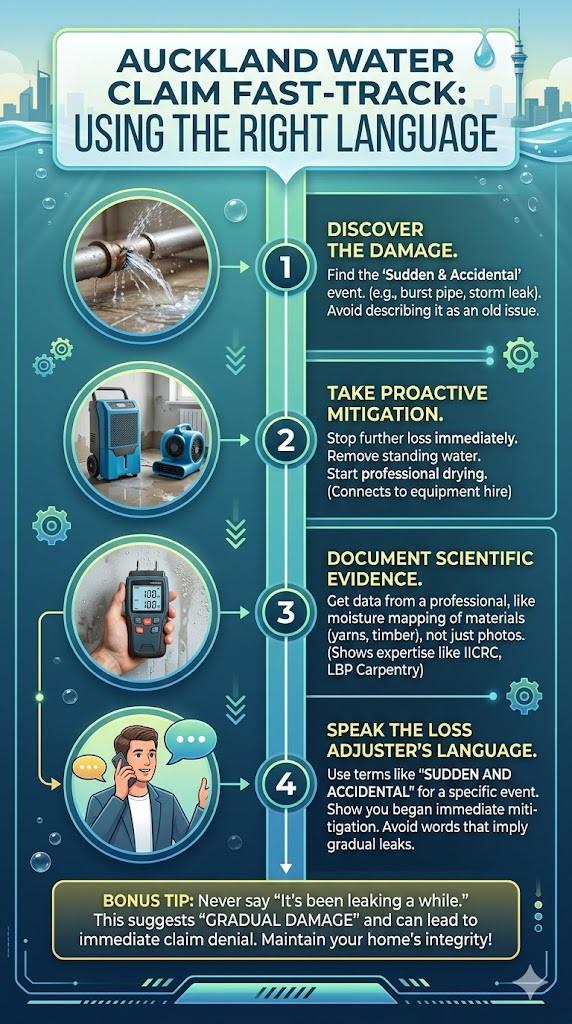
To avoid insurance delays, describe water damage as sudden and accidental rather than gradual. Use precise terms like mitigation and remediation to show proactive steps were taken. This ensures your flood restoration claim remains active and moves through the Auckland assessment system quickly.
Essential Terminology for Insurance Success
| Homeowner Term | Loss Adjuster Term | Why It Matters |
| “It’s been leaking a while” | Gradual Damage | Can lead to immediate claim decline. |
| “A pipe just went bang” | Sudden and Accidental | Standard requirement for full coverage. |
| “Trying to dry it” | Mitigation | Shows you are preventing further loss. |
| “Dirty flood water” | Category 3 Water | Triggers higher safety and textile disposal protocols. |
Source: The IICRC Standards for Professional Water Damage Restoration (Established 1972)
📦 The “Sudden and Accidental” Rule: Why Timing is Everything
In the insurance world, the clock is your biggest enemy or your best friend. A “sudden and accidental” event is something that happened in an instant, like a flexi-hose bursting under your sink. This is what policies are designed to cover. If the adjuster thinks the damage happened over weeks, they may label it “gradual,” which often has a very low payout cap.
Avoiding the “Gradual” Trap
When describing the event, focus on the moment of discovery. In my experience as a professional Auckland restorer, I’ve seen claims get stuck because a homeowner mentioned a “musty smell” they noticed last month. Even if the flood is new, that one comment suggests a long-term issue with the building textiles. Keep your description focused on the specific incident -> the burst pipe or the flash flood.
In digital marketing, “bounce rate” tells you how quickly people leave a site; in insurance, the “discovery rate” tells the adjuster how attentive you are to your property.
📸 Documenting Mitigation: Showing vs. Telling
Mitigation is a fancy word for “stopping things from getting worse.” Your policy actually requires you to take reasonable steps to prevent further damage. This is where professional help becomes a claim-saver. We don’t just “suck up water”; we provide the documented proof that the drying process started immediately.
Evidence Over Description
Take photos of everything, but don’t stop there. Professional moisture meters and thermal cameras provide the data adjusters love. When we install commercial dehumidifiers, we are “mitigating” the risk of secondary damage like mould growth. This proactive stance shows the insurance company that you are protecting the structural materials of the home.
While a builder looks at the load-bearing capacity of a beam, a psychologist might look at how the environment affects your mental “load” and stress levels.
🛠️ Structural Drying vs. Simple Carpet Cleaning
As an LBP in Carpentry, I look at water damage differently than a standard cleaner. It’s not just about the surface textiles or the yarns in your rug. It’s about the timber framing and the subfloor. If you tell an adjuster you just need a “carpet clean,” they might overlook the moisture trapped in the walls.
The Professional Restoration Approach
True restoration involves “Structural Drying.” This means using high-velocity air movers and LGR dehumidifiers to pull moisture out of the building’s bones. In our Auckland projects, we often find that the surface of the floor feels dry, but the internal threads of the underlay are still holding liters of water. Documenting this depth of saturation ensures your claim covers the full scope of work.
In the world of investing, “liquidity” refers to how quickly you can access cash; in restoration, “liquid-city” is what happens to your floorboards if you don’t dry them fast enough.
💡 Real-World Maintenance Advice
To keep your home “claim-ready,” check your flexi-hoses every six months. If they show any signs of rusting or fraying in the metal threads, replace them immediately. A $20 hose can save you a $20,000 insurance headache. Also, ensure your gutters are clear; Auckland’s sudden downpours are a leading cause of “preventable” water ingress claims.
Frequently Asked Questions
-
What should I do first? Call a restorer to start mitigation -> then call your insurance company with the “sudden” event details.
-
Can I throw away wet items? No. Keep all damaged textiles and materials until the adjuster has seen them, or they are documented by a professional.
-
What if I don’t have a dehumidifier? Renting professional-grade equipment is usually covered under the “mitigation” clause of your policy.
Key Takeaways
-
Always use the phrase “Sudden and Accidental” for one-off events.
-
Mitigation is your legal duty -> start drying immediately.
-
Document everything with data, not just photos of wet rugs.
-
Focus on Structural Drying to protect your LBP-certified building integrity.
Auckland Flood & Moisture Resources
This article is part of our Flood Insurance & Financial Hub. Explore more professional resources below:
- Why Waiting 48 Hours After a Flood Could Void Your Insurance
- Claiming for Land Scour: How NHC Covers Silt and Soil Damage for Auckland Homes
- How to Document Water Damage for Auckland Insurance Claims