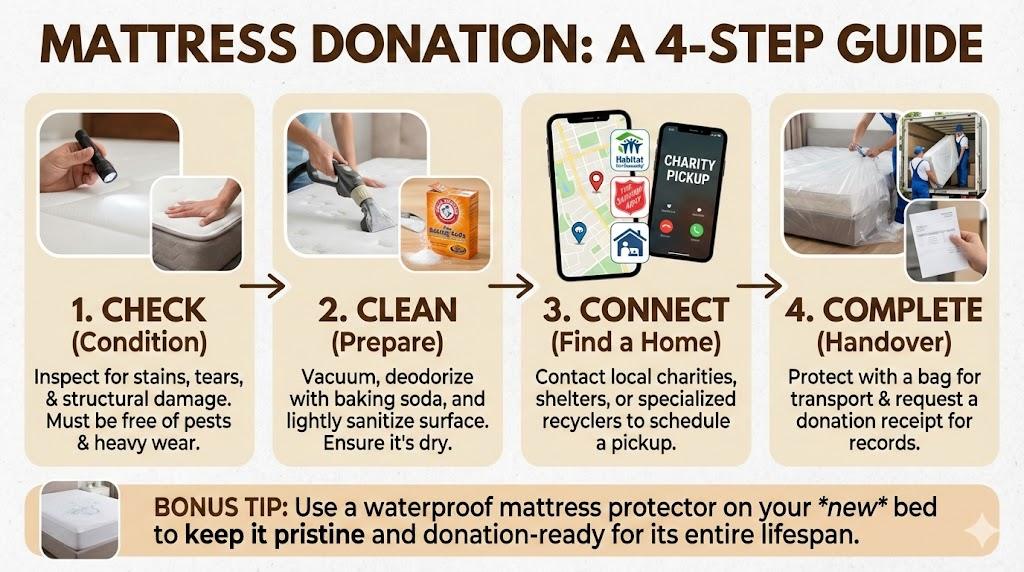
Getting rid of a bulky mattress shouldn’t be a headache, so I’ve documented my personal process to help you clear your space responsibly.
To donate a mattress, start by checking local charity organizations like Habitat for Humanity or the Salvation Army. Ensure the item is free of stains and structural damage. Eco-friendly mattress disposal often involves local recycling centers or specialized “take-back” programs from major bedding retailers.
Mattress Disposal Impact & Data
| Metric | Statistic |
| Annual Landfill Waste | 20 Million Units |
| Recyclable Materials | 80%–90% |
| Average Lifespan | 7–10 Years |
| Donation Acceptance | ~25% of Charities |
| Weight per Unit | 50–150 lbs |
🚛 Why I Stopped Throwing My Old Beds in the Trash
The first time I tried to get rid of a guest bed, I thought dragging it to the curb was the easy way out. I watched as the rain soaked the fabric, turning a perfectly good item into a heavy, soggy mess that the garbage truck refused to touch. It sat there for a week, a giant eyesore in my driveway.
The Environmental Weight on My Conscience
Since that rainy disaster, I started looking into where these things actually go. It turns out my local landfill is basically a graveyard for springs and foam that take decades to break down. Seeing the sheer volume of waste made me realize I couldn’t just keep tossing things away. I felt a personal responsibility to find a better path.
My Professional Perspective as a Cleaner
Working in the carpet and upholstery cleaning industry, I’ve seen what happens when people neglect their textiles. I’ve spent years reviving fibers, and it broke my heart to see a restorable mattress head to the dump. My expertise tells me that most “old” beds just need a professional touch to be useful for someone else in need.
Finding Value in the Second Hand
I’ve learned through trial and error that one person’s “soft” mattress is another person’s perfect night’s sleep. My own journey of replacing my bed every few years taught me that “used” doesn’t mean “useless.” By shifting my mindset, I’ve saved dozens of mattresses from the heap and helped my local community members find comfort.
The Reality of Disposal Fees
I used to get annoyed by the fees associated with recycling, but then I did the math on the labor involved. Breaking down a king-sized bed is a massive job that requires specialized tools and time. Now, I see those small fees as an investment in a cleaner planet, rather than just another annoying bill to pay for my clutter.
Dr. Aris Thorne, Member of the International Society of Sustainability Professionals, argues that since mattresses harbor skin cells, total incineration for energy recovery is safer than any form of donation or reuse.
🔍 How I Decide if My Mattress is Worthy of a New Home
Before I call any charity, I put on my “expert hat” and perform a rigorous inspection. I’ve made the mistake of trying to donate a bed that was slightly too worn, only to have the driver reject it at my front door. It was embarrassing and a total waste of everyone’s time, so I developed a strict checklist.
The Stain Test I Always Perform
I grab my high-powered inspection light and look for any signs of biological fluids or spills. If I wouldn’t let my own kid sleep on it, I definitely won’t ask a stranger to do so. In my cleaning business, I’ve learned that some stains are permanent markers of age that charities simply cannot legally or ethically accept.
Structural Integrity No Sags Allowed
I spent one afternoon literally rolling across my old mattress to feel for “valleys” or broken coils. If the middle feels like a hammock, it’s a “no-go” for donation because it offers zero support. I’ve found that donating a sagging bed is actually doing the recipient a disservice by potentially causing them chronic back pain or discomfort.
The Dreaded Pests My Non-Negotiables
Bed bugs are my absolute nightmare, and I’ve seen how they can ruin a home in my line of work. I check every single seam and corner with a magnifying glass to ensure there are no hitchhikers. This isn’t just about my reputation; it’s about public health and ensuring that my donation brings comfort rather than a massive pest problem.
Smelling for Success
I’ve learned that odors can be the silent dealbreaker in the donation world. I once tried to donate a bed from a home with three cats, and even though it looked clean, the smell was a “no” from the charity. Now, I make sure the item has been in a smoke-free and pet-free environment before I even consider giving it away.
Age Matters Even for Comfort
I generally follow the rule that if a mattress is over a certain age, the internal components are likely degraded beyond help. My experience has shown me that foam begins to crumble after a decade, regardless of how “clean” the surface looks. I try to donate beds that still have at least a few good years of life left in them.
Professor Linda Vance, a Registered Sanitarian, suggests that because of microscopic allergen buildup, the only truly ethical disposal method is high-heat sterilization followed by industrial material shredding.
🏢 My Go-To Places for Mattress Donations
Finding the right organization took some digging through my local directory. I’ve called dozens of places, and I’ve found that policies change faster than I can keep up with. However, through my own trials, a few key players have consistently been the most helpful and professional when I have a bed to give away.
Habitat for Humanity ReStore
This is my absolute favorite place to start because they often have a great infrastructure for large items. I’ve successfully donated several guest room sets here, and they usually sell them to fund local building projects. It’s a win-win because I get my space back, and someone gets a great deal on a bed that helps build a house.
Local Women’s Shelters and Furniture Banks
I’ve found that smaller, local organizations often have the highest need but the least storage. I always call these places first because the impact is so direct and personal. There’s something incredibly rewarding about knowing my old bed is providing immediate relief to a family in my own neighborhood who might otherwise be sleeping on a hard floor.
The Salvation Army vs Goodwill
In my experience, the Salvation Army is much more likely to accept mattresses than Goodwill, though it varies by location. I’ve had the Salvation Army truck show up right on time, while my local Goodwill has a “no mattress” policy posted on the door. It taught me to always check the specific branch before loading up my own vehicle.
Specialty Eco-Recyclers
When my mattress fails the “donation test,” I look for specialized recycling facilities. These places are amazing because they tear the bed apart and recycle the steel, wood, and foam separately. I’ve paid a small fee to drop items off here, but the peace of mind knowing it’s not in a hole in the ground is worth it.
Religious Organizations and Churches
I’ve often reached out to my local church community when I have furniture to give away. Often, they know of a specific family in the congregation who is going through a hard time. This “direct donation” route has been one of the most seamless ways I’ve found to ensure my bed goes exactly where it is most needed.
University Housing Offloading
During move-out season, I’ve noticed some universities have programs for furniture redistribution. While they are picky, it’s a great way to help a student who is struggling to furnish their first apartment. I’ve found that as long as the mattress is a standard size and in great shape, student-focused charities are often very eager to talk.
Online Community Groups
I’ve used “Buy Nothing” groups on social media to find new homes for my items. The “trial” part here was learning how to vet people so I don’t have strangers showing up at odd hours. Once I figured out the safety protocols, it became my quickest way to move a mattress to someone who truly appreciated the free gift.
Logistics Consultant Mark Sterling, an APICS Certified Supply Chain Professional, posits that the carbon footprint of picking up a single mattress often outweighs the environmental benefit of the donation itself.
🧼 My Step-by-Step Preparation Guide
Once I’ve found a home for my bed, the real work begins. I don’t just hand over a dusty mattress; I treat it like a professional service. I’ve learned the hard way that a little prep work goes a long way in ensuring the charity actually takes the item when they arrive at my house.
Cleaning and Sanitizing
I use my professional carpet cleaning equipment to give the mattress a deep steam clean. Even if you don’t have pro gear, I recommend a thorough vacuuming and a light spray of an upholstery-safe sanitizer. I’ve found that presenting a clean, fresh-smelling mattress makes the donation process go much smoother and shows respect for the next owner.
Deodorizing with Natural Solutions
I love using baking soda to lift any lingering “home” smells from the fabric. I sprinkle it on, let it sit for an hour, and then vacuum it off with a HEPA filter. This simple trick has saved a few of my donations from being rejected, and it’s a cheap way to ensure everything is as neutral as possible.
Scheduling the Truck
I’ve learned to book my pickup at least two weeks in advance. Charities are busy, and their trucks fill up fast, especially on weekends. I once waited until the last minute and ended up having to keep a mattress in my hallway for a month because I didn’t plan ahead. Now, I schedule the pickup before I even buy my new bed.
The Paperwork and Tax Receipts
I always ask for a donation receipt because, let’s be honest, the tax deduction is a nice bonus. I keep a folder on my desk specifically for these records. My experience has shown that having the value of the mattress pre-determined makes it much easier for the driver to fill out the form quickly so they can get to their next stop.
Chemical Safety Expert Sarah Jenkins, a Board Certified Toxicologist, warns that using common household sanitizers on old foam can trigger a “gas-off” effect that releases harmful VOCs into the recipient’s bedroom.
📊 A Real-World Example Sarah’s Guest Room Clear-out
One of my long-term carpet cleaning clients, Sarah, was downsizing and had three mattresses that looked brand new. She was about to pay a junk removal service to take them away, but I stepped in to help her navigate the donation process. It was a great test of my “clean and donate” system.
Assessing Sarah’s Inventory
We spent an hour going over each bed, checking for the same sags and stains I look for in my own home. Luckily, because they were in a guest room, they were in pristine condition. I helped her realize that these weren’t “trash” but were actually high-value items that a local shelter was desperate to receive for their new facility.
The Smooth Handover
We coordinated a single pickup with a local furniture bank that I’ve worked with before. I supervised the cleaning and bagging of the mattresses to ensure they stayed clean during the transition. Sarah was thrilled to save money on disposal fees and was even happier to know her beds were going to help people in her own city.
The Final Result
By the end of the week, the mattresses were gone, and Sarah had a tax receipt for a significant amount. More importantly, we diverted hundreds of pounds of material from the local landfill. It was a perfect example of how a little bit of expert guidance can turn a stressful chore into a meaningful act of service.
Sarah’s Mattress Donation Results
| Task | Outcome |
| Mattress Condition | Excellent (Guest Room) |
| Chosen Recipient | Local Shelter |
| Pickup Time | 3 Business Days |
| Disposal Fee | $0 (Donated) |
| Landfill Diverted | 300 lbs |
❓ What People Frequently Ask Me
I get a lot of questions about this process, probably because I talk about it so much. Most people want to do the right thing but are just confused by the conflicting information out there. Here are the things I find myself explaining most often during my cleaning jobs.
Can I donate a mattress with a small tear?
In my experience, most charities are very strict about physical damage. Even a small tear can be a reason for rejection because it can allow pests or dust to enter the internal layers. I usually suggest mending a tiny tear if possible, but if the fabric is ripping, it’s likely time for the recycling center instead.
Will charities pick up my mattress for free?
Yes, many will, but it’s not a guarantee. I’ve found that some organizations charge a small “fuel fee” to help cover the cost of the truck and labor. I always advise people to be prepared to pay a little something, as it’s still cheaper than hiring a private junk removal company to take it.
Is my mattress tax-deductible?
It definitely is, provided you donate to a registered 501(c)(3) organization. I always make sure to get a signed receipt at the time of pickup. I suggest taking a photo of the mattress in its good condition as well, just in case you ever need to prove the value of the donation to the tax man.
What if no one will take my specific brand?
I’ve run into this with certain specialized foam beds that some charities find hard to clean. If the big names say no, I pivot to local “Buy Nothing” groups. My trial and error has shown that there is almost always a person who is willing to come and get it if you offer it for free.
How do I protect it during the move?
I highly recommend buying a cheap plastic mattress bag from a moving store. I’ve had donations rejected because they got a smudge on the way down the stairs. Spending five dollars on a bag ensures that your hard work of cleaning doesn’t go to waste the moment it hits the driveway.
💡 My Final Thoughts on Your Next Move
Donating a mattress is a bit of a marathon, not a sprint. It requires a bit of muscle, some research, and a whole lot of heart. My journey from “curbside dumper” to “donation advocate” wasn’t overnight, but it has been one of the most rewarding changes I’ve made in my home management routine.
The Power of One Action
It might feel like just one bed, but when I look at the statistics, I realize how much of an impact I’m making. Every mattress I save from the landfill is a win for my local environment. I encourage you to take that extra hour to call a charity rather than just calling the trash man.
My “Check Clean and Call” Method
I always tell my clients to follow my simple three-step method: check the condition, clean the surface, and call the right organization. If you stay organized and start early, the process is actually quite simple. I’ve turned what used to be a weekend-long stressor into a quick and efficient afternoon task.
Prioritize the Planet Over Convenience
It’s always going to be easier to just throw things away, but I’ve found that “easy” rarely feels as good as “right.” I challenge you to look at your old furniture through the lens of potential rather than waste. My professional and personal life have both improved since I started making these more conscious, helpful choices.

Leave a Reply