Most Aucklanders view a spill as a visual nuisance, but it is actually a chemical event. Whether it is a splash of red wine in Mt Roskill or muddy footprints from a rainy day in Ellerslie, the way you react determines if that mark becomes a permanent resident in your home.
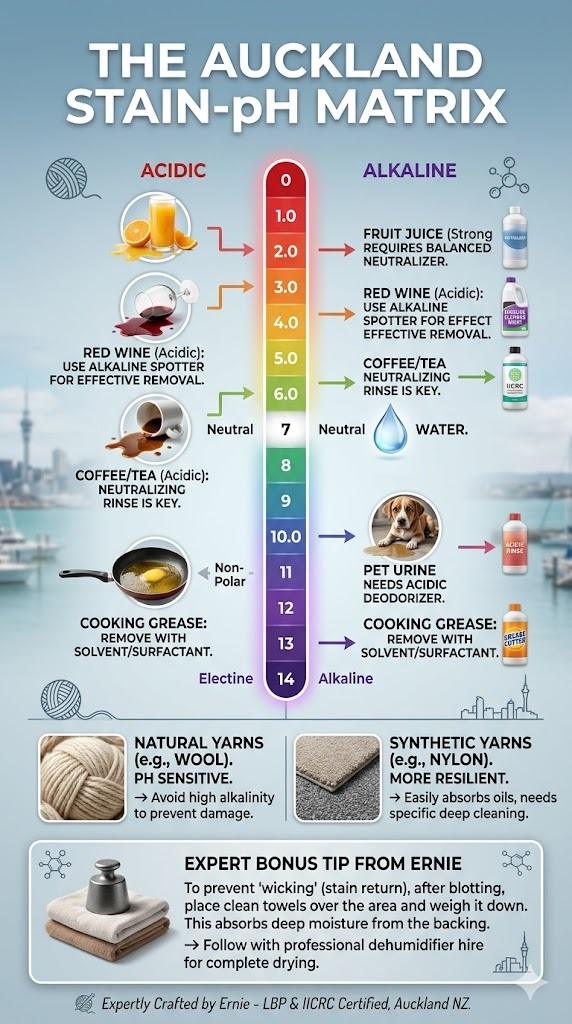
Stain removal relies on managing the pH scale to neutralize spills without damaging carpet textiles. Whether handling synthetic yarns or natural threads, choosing an acidic or alkaline cleaner determines success. Correct chemistry prevents permanent setting, ensuring your floor coverings remain resilient and aesthetically pleasing.
Common Household Stains and Their pH Levels
| Stain Type | Typical pH Level | Recommended Treatment |
| Red Wine | 3.0 -> 4.0 (Acidic) | Alkaline Spotter |
| Coffee / Tea | 5.0 -> 6.0 (Acidic) | Neutralizing Rinse |
| Pet Urine | 10.0 -> 12.0 (Alkaline) | Acidic Deodorizer |
| Cooking Grease | Neutral (Non-polar) | Solvent / Surfactant |
| Fruit Juice | 2.0 -> 3.0 (Strong Acid) | Balanced Neutralizer |
[Bolded Title: Household pH Reference Guide for Cleaning]
[Link: https://www.cleaninginstitute.org]
🧬 The pH Scale: Your Secret Weapon Against Spills
Every liquid has a place on the pH scale, ranging from 0 (acidic) to 14 (alkaline). To remove a stain effectively, we often use the principle of neutralization. For example, an acidic coffee spill often responds best to a slightly alkaline cleaning agent. This chemical reaction helps release the bond between the pigment and the textiles.
In my years servicing Northpark homes, I have seen many DIY attempts go wrong because people use high-alkaline “all-purpose” cleaners on everything. This can cause “browning,” where the pH of the yarns is pushed too high. Once the chemistry is out of balance, the damage to the threads can be irreversible without professional acid rinsing.
Structural integrity in carpentry relies on precise moisture content in timber, much like effective cleaning relies on an exact chemical balance in the yarns.
🧶 Know Your Materials: Why Yarn Type Dictates Tactics
Not all floor coverings are created equal. Auckland homes typically feature either wool blends or synthetic materials like nylon and polyester. Wool is a protein-based thread and is incredibly sensitive to high pH levels. If you use a harsh chemical on wool, you risk “burning” the textiles, leading to permanent discolouration.
Synthetic yarns, while more resilient to chemicals, have a “memory” for oil-based stains. As a professional, I look at the composition of the carpet before I even open my kit. Identifying the material tells me exactly how much heat and pressure the threads can handle during the extraction process.
Just as your body requires a specific metabolic pH to function optimally, your carpets need chemical equilibrium to maintain their longevity and appearance.
🏠 Professional Auckland Advice: From Spills to Restoration
In Auckland’s humid climate, moisture management is critical. When a spill occurs, the liquid doesn’t just sit on the surface; it travels down into the backing and the underlay. This is why “blotting” is the only DIY move I recommend -> never scrub, as scrubbing shreds the yarns.
If a spill is significant, or if you are dealing with a localized flood, standard cleaning isn’t enough. As a Licensed Building Practitioner, I’ve seen how trapped moisture can affect the subfloor. In these cases, we bring in high-grade dehumidifiers and air movers to ensure the textiles and the structure are completely dry.
In physics, the law of entropy suggests everything moves toward disorder, but a well-timed professional extraction reverses that trend for your floor coverings.
Key Takeaways for Auckland Homeowners
-
Identify the Spill: Is it acidic or alkaline?
-
Blot, Don’t Scrub: Protect the integrity of the yarns.
-
Know Your Surface: Wool needs low pH; synthetics are more forgiving but hold grease.
-
Call the Pros: If the stain is larger than a dinner plate, professional extraction is safer.
FAQs
Can I use vinegar on my carpet?
Vinegar is acidic, which is great for neutralizing alkaline stains like pet urine. However, always test it on a hidden patch of the textiles first to ensure no colour loss.
Why does my stain keep coming back?
This is usually “wicking.” The liquid has soaked into the underlay and travels back up the threads as the surface dries. Professional deep-extraction is the only permanent fix.
Explore More Carpet Care Insights
This article is part of our comprehensive Stain Removal & Emergency Spills Hub. Check out our other related guides:
- The Mystery of “Wicking”: Why Stains Reappear and How Professionals Fix It
- Emergency Spill Guide: Instant Steps for Coffee, Wine, and Mud
Need professional carpet cleaning in Auckland? Return to our main Carpet Cleaning Auckland page to book your service.