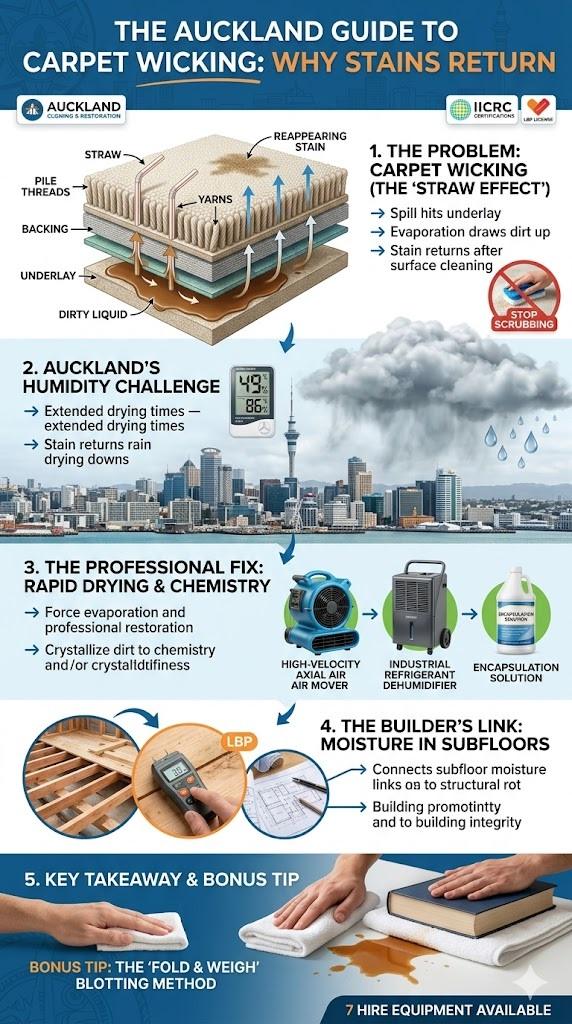
Have you ever spent an afternoon scrubbing a coffee spill, only for it to reappear three days later like a ghost? In the Auckland carpet cleaning industry, we call this “wicking.” It is one of the most frustrating issues for homeowners, but it is actually simple physics.
Carpet wicking happens when deep-seated liquid travels up textile yarns during the drying process, carrying trapped soil to the surface. This stain migration creates “phantom spots” that reappear after cleaning. Professionals stop this by using low-moisture techniques and industrial dehumidification equipment.
📊 Wicking vs. Resoiling: Know the Difference
| Feature | Carpet Wicking | Surface Resoiling |
| Primary Cause | Subsurface moisture -> Evaporation | Sticky residue -> Dirt attraction |
| Appearance | Reappears as it dries | Reappears over weeks |
| Source | Backing or underlay | Oily cleaning agents |
| Solution | Rapid drying -> Encapsulation | Proper rinsing -> Neutralisation |
Identifying Reappearing Spots – Cleanfax Archive (2012)
🧐 What Exactly is Wicking?
Think of your carpet yarns like tiny drinking straws. When a spill happens, the liquid often dives deep into the backing or even the underlay. When you clean the surface, you only remove the top layer. As the moisture evaporates, it draws the remaining liquid and dirt up the threads to the top.
In our experience servicing Auckland homes, we often see this after a DIY “steam” clean. If the machine isn’t powerful enough to extract the water, it just pushes the mess deeper. The moisture then spends days trying to escape, pulling stains back up with it.
In carpentry, timber behaves similarly through capillary action, where moisture travels through the grain and can cause swelling if not properly sealed.
🛠️ Why Auckland’s Climate Makes it Worse
Auckland is notoriously humid. When the air is thick with moisture, carpets stay damp for longer. This extended drying time provides the perfect window for wicking to occur. If a spill isn’t dried rapidly, the materials act as a permanent wick for the soil trapped beneath.
I recently handled a flood restoration job in Mt Roskill where a small leak turned into a massive wicking problem. Because the subfloor remained damp, the “clean” carpet kept turning brown. We had to implement a professional drying plan to stop the cycle of moisture movement.
Architecturally, a damp subfloor can lead to structural rot in floor joists, which is a far more expensive fix than a simple carpet stain.
🚀 How the Professionals Fix It
To stop wicking, we focus on speed and chemistry. We use high-velocity air movers and industrial dehumidifiers to ensure the textiles dry in hours, not days. We also use “encapsulation” polymers that crystalize any remaining soil, preventing it from sticking to the yarns.
-> Step 1: Deep extraction of the subsurface liquid.
-> Step 2: Application of a quick-dry pH neutralizer.
-> Step 3: Deployment of air movers to accelerate evaporation.
-> Step 4: Post-cleaning inspection to ensure the composition is bone dry.
When we install building wraps as LBPs, we are managing the same principles of moisture flow to protect the internal cavity of the home.
💡 Key Takeaways for Auckland Homeowners
If a stain returns, stop scrubbing! Adding more water and soap will only fuel the wicking process. Instead, fold a white towel, place it over the spot, and put a heavy book on top. This “blotting” helps pull the moisture into the towel instead of the yarn tips.
For major spills or flood events, hiring professional-grade drying equipment is the only way to guarantee a permanent fix. Our 7 Hire division often provides blowers to locals who need to dry things out fast before the “phantom” stains take over their lounge.
Frequently Asked Questions
-
Can I just use a hair dryer? No, it doesn’t move enough air volume to dry the backing.
-
Is wicking permanent? Usually not, but it requires a “dry” cleaning method to resolve.
-
Does it happen to all carpets? It is most common in loop-pile synthetic yarns which have a stronger capillary pull.