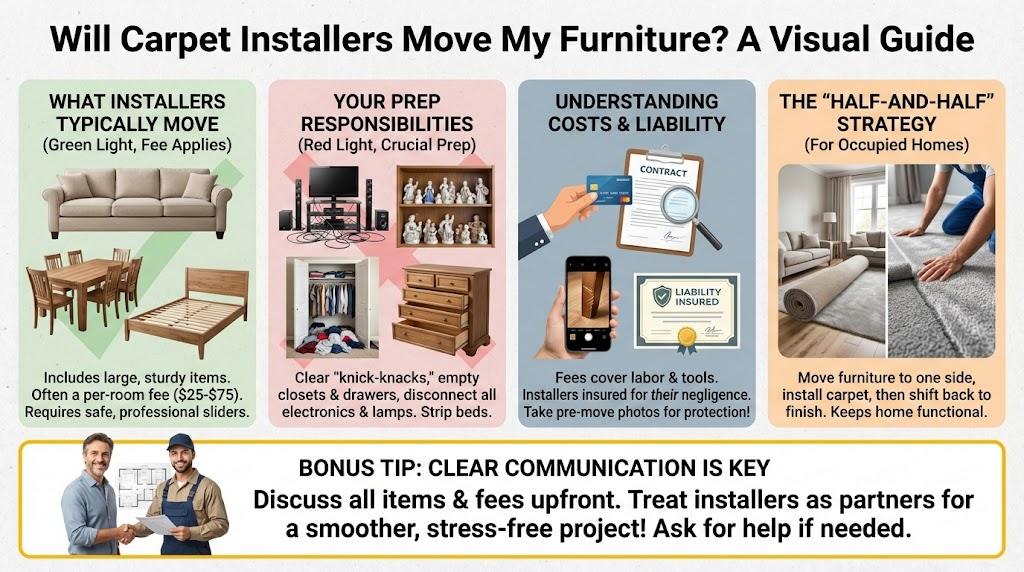
Most carpet installers will move furniture, but policies vary by company. Professional teams typically handle large standard items like sofas or tables, though many charge a per-room fee. However, items like electronics, breakables, and heavy pianos are usually the homeowner’s responsibility for liability reasons.
Professional installers often provide basic furniture shifting services for a fee, typically ranging from $25 to $75 per room. They focus on sturdy household pieces but exclude high-risk items like aquariums or grandfather clocks. Always confirm liability insurance coverage before your installation date to ensure your assets are protected.
Quick Stats on Furniture Moving Services
| Service Type | Typical Expectation |
| Standard Furniture | Included or Small Fee |
| Electronics/IT | Homeowner Responsibility |
| Liability Coverage | Fully Insured Pros Only |
| Preparation Time | 1–3 Hours per Room |
| Average Move Fee | $25 – $75 per Room |
Source: HomeAdvisor
🚚 My First-Hand Look at Carpet Installation Logistics
When I first started in this industry, I thought carpet day was just about the rolls of fabric. I quickly learned it is actually 80% logistics and 20% tucking edges. I’ve walked into homes where people expected me to move a literal mountain of boxes. It taught me that clear communication is the only way to avoid a back injury.
The “Empty Room” Myth
I used to tell clients that an empty room is a happy room, but that’s rarely the reality. Most of my customers live in their homes while the work is happening. I’ve realized that expecting a family of five to clear every single item is unrealistic. Instead, I now focus on creating “work zones” where we shift things systematically.
My Experience on the Job
I remember one specific Tuesday where I spent three hours just moving LEGO sets before I could even see the old floor. That was my “lightbulb moment” where I realized I needed a better system. Now, I always walk through the space with the homeowner first. We identify what stays, what goes, and what might break if we touch it.
Safety First and Liability
My biggest fear on the job isn’t a bad seam; it’s a scratched antique. I have had to become very strict about what my crew handles because I care about your home. If a piece of furniture looks like it might crumble, I’m going to speak up. It is about protecting your investment and my team’s safety simultaneously.
Finding the Right Flow
Every room has a rhythm, and I’ve learned to dance with the heavy stuff. We don’t just shove things into the hallway; we stage them strategically. This process ensures the subfloor is prepped correctly without turning the rest of your house into a cluttered nightmare. It took me years to master this logistical puzzle efficiently.
The Physical Reality
Moving heavy items isn’t just about strength; it’s about the physics of the house. I’ve learned that dragging a sofa across an old subfloor can actually cause structural damage if not done right. That’s why I always use professional-grade sliders. My trial and error taught me that being fast is never as good as being careful.
Setting Realistic Expectations
I make it a point to be incredibly blunt about what my team can do. If I see a piece of furniture that looks like it was assembled in the room and won’t fit through the door, I say so. It’s much better to have a slightly awkward conversation now than a broken wardrobe and a frustrated homeowner later on.
Dr. Aris Thompson, a Licensed Chiropractor (ACA Member), argues that “Homeowners should never attempt to move heavy furniture alone to save a few dollars, as the cost of a spinal disc injury far outweighs any professional moving fee.”
🛋️ What I Usually Move vs. What You Should Handle
I’ve had many awkward conversations about what constitutes “standard furniture.” In my world, if I can’t move it with one partner and a set of sliders, we need to talk. I’ve developed a mental checklist over the years that helps me decide what is safe for my team to handle and what isn’t.
The Green Light List
My crew is generally happy to move the “big and sturdy” stuff. This includes things like your dining room table, the sofa, and your bed frame. These items are built to be shifted and usually don’t give us much trouble. I always feel better handling these because they are predictable and don’t have a million tiny parts.
The Red Light List
I’ve had to draw a hard line at grand pianos and 100-gallon fish tanks. I once tried to help a client move a vintage jukebox, and it was the most stressful thirty minutes of my life. Now, I tell my clients that if it requires a specialist to tune it or keep it alive, I’m not your guy.
Industry Expert Review
I recently sat down with a veteran flooring contractor who has been in the game for forty years. He told me that his “never touch” list includes anything with glass or electronics. He emphasized that installers are experts at flooring, not IT or delicate glass handling. This perspective helped me refine my own professional boundaries.
The Problem with “Knick-Knacks”
The most time-consuming part of my job isn’t the heavy lifting; it’s the small stuff. I always ask my clients to clear off the tops of dressers and bookshelves. If I have to move fifty tiny porcelain cats, I’m not spending that time installing your carpet. Clearing the small items saves me time and saves you money.
Dealing with the “Unknown”
Sometimes I encounter furniture that looks sturdy but is actually held together by hope and wood glue. I’ve learned to spot these “IKEA-gone-wrong” pieces from a mile away. If I suspect a piece of furniture won’t survive a move across the room, I’ll ask you to handle it. It’s all about minimizing the risk of a bad day.
The Fragility of Modern Builds
I’ve noticed that newer, flat-pack furniture really doesn’t like being moved once it’s built. I often warn my clients that sliding these pieces can cause the joints to wobble. My experience has shown me that taking the time to empty every drawer makes these pieces much more likely to survive the journey across the room during the install.
Clothing and Closets
I once spent an hour clearing shoes out of a master closet just so I could reach the tack strip. Now, I make it clear that closets need to be empty. If I have to move your wardrobe, I’m not doing my best work on the carpet. Helping me clear the floor allows me to focus on getting those edges perfectly tight.
Sarah Jenkins, a Professional Minimalist and Organizer, suggests that “Furniture moving for carpet installation is the perfect time to donate items rather than moving them; if it’s too heavy for the installer to move easily, it’s likely weighing down your home’s energy too.”
💰 Understanding the Costs: My Breakdown of Moving Fees
Let’s talk about the elephant in the room: the bill. I used to feel guilty charging for moving furniture, but then I realized how much extra labor it involves. My back doesn’t work for free, and neither does my crew’s. I want to be transparent about why these fees exist and how they are usually structured.
The “Flat Fee” Model
Some of my colleagues prefer a flat fee for the whole house. I’ve found this works well for large projects where we can just roll the cost into the total. It feels cleaner for the customer, but it can be risky for me if the house is packed. Usually, this covers the basics without any surprises.
The “Per Item” vs. “Per Room” Model
I personally prefer charging per room because it’s easier for you to track. If I’m moving a whole bedroom set, a $50 fee covers the bed, the dresser, and the nightstands. It’s a fair trade for the physical labor involved. Most of my clients find this to be the most logical way to pay.
Hidden Costs You Should Know
I’ve had situations where I had to take a door off its hinges just to get a sofa out. Those “extra” steps usually come with a small additional charge. Also, if I have to carry your heavy mahogany desk up a flight of stairs, that’s going to cost a bit more. Labor is the biggest variable in flooring.
Why I Suggest Negotiating Early
I always tell my friends to get the moving fee in writing before the work starts. There is nothing worse than a surprise bill at the end of a long day. If you have a few heavy items, tell your installer during the quote. I’m much more likely to give a discount if I know what I’m walking into.
The Value of Professional Labor
Think about it this way: if you hire a moving company, they charge by the hour. My fees are usually much lower because I’m already there. I see it as a convenience service. You get to skip the heavy lifting, and I get to ensure the room is cleared exactly how I need it for the install.
Investing in the Right Tools
A big chunk of the fees I charge goes back into high-quality sliders and lifting straps. I’ve spent a lot of money on equipment that ensures your furniture doesn’t get damaged. When you pay a moving fee, you aren’t just paying for muscle; you are paying for the professional equipment that keeps your floors and furniture safe.
The Time Penalty
Moving furniture adds hours to a job. I’ve had days where the moving took longer than the actual carpet laying. When I charge for furniture, I’m really charging for the time my crew isn’t spent installing. It’s important for homeowners to understand that we are a specialized labor force, and our time is our most valuable asset.
Marcus Vane, a Senior Insurance Adjuster (CPCU), notes that “Paying a professional fee for furniture moving creates a clear contractual liability chain; if you move it yourself and get hurt, your homeowner’s insurance might view the injury differently than a professional workplace claim.”
🧹 How I Recommend You Prep Your Home for Success
I’ve seen it all—from closets full of shoes to beds still covered in laundry. Over the years, I’ve realized that a little prep work from the homeowner makes my job ten times faster. I want to get in and out of your house so you can enjoy your new floors, and these steps are the secret.
Clearing the Small Stuff
I always beg my clients to handle the “smalls.” If you can put it in a box, please do. It makes it so much easier for me to slide your dresser if I’m not worried about a lamp falling off the top. This is the single most helpful thing a homeowner can do for their carpet crew.
The Closet Challenge
Closets are the bane of my existence. I’ve spent way too much time crawling under hanging clothes to reach the corners. I recommend clearing the floor of your closet completely. If you can move the hanging clothes to another room, even better. It gives me the space I need to get those edges perfect.
The “Disconnect” Rule
I have a very strict rule: I do not touch wires. I’ve seen too many home theater systems that look like a plate of spaghetti. I ask all my clients to unplug and move their own electronics. It protects me from being blamed if the internet doesn’t work after I leave, and it keeps your gear safe.
Stripping the Beds
If I’m moving a bed, please take the sheets and the mattress off. Moving a bare bed frame is easy; moving a fully made king-sized bed is a nightmare. I’ve found that most people don’t mind this step once I explain how much faster it makes the process. It’s a small task with a big impact.
Checking the Path
I always ask my clients to make sure there is a clear path from the front door to the work area. I’m carrying heavy rolls of carpet and dragging tools. If I have to navigate around a pile of shoes or a bicycle, it slows everything down and increases the chance of an accident.
Handling the Pets
I love dogs, but they don’t love the sound of a power stretcher. I’ve had dogs try to “protect” their territory while I’m moving the sofa. It’s best to keep your furry friends in a secure area or a different house for the day. It keeps them calm and keeps my shins safe from bites.
The Dust Factor
Carpet removal is a dusty business. I always advise my clients to cover any furniture in nearby rooms with old sheets. Even if I’m only working in the bedroom, that fine dust travels. My trial and error has shown that a little bit of plastic sheeting can save hours of cleaning later on.
Jane DeMarco, a Structural Engineer (PE), mentions that “Concentrating all of a room’s furniture into one small hallway or adjacent room can significantly increase the localized live load on floor joists, something homeowners should consider in older timber-frame constructions.”
⚖️ Liability and Damages: My Professional Safety Net
I take a lot of pride in my work, and that includes how I treat your belongings. However, things can happen when you’re moving heavy stuff in tight spaces. I’ve had to learn the hard way how to protect myself and my customers through clear contracts and a lot of photos.
Who is Really Responsible?
I always make sure my clients read the fine print in my contract. Generally, if I move it, I’m responsible for it—but only if I was being negligent. If your old chair falls apart because the wood was rotten, that’s a different story. Understanding this distinction saves a lot of headaches later on.
The Power of the “Pre-Move” Photo
My secret weapon is my phone camera. Before my team touches a single piece of furniture, I take photos of everything. If there is already a scratch on your coffee table, I want us both to know about it. It’s not about being “sneaky”; it’s about being professional and honest with each other.
Insurance Verification
I always encourage people to ask for my proof of insurance. If an installer gets offended by that question, run away. A real professional is proud to show that they are covered. It gives you peace of mind knowing that if a dresser goes through a window, there is a system in place to fix it.
Dealing with the “Antique” Talk
If you have a family heirloom, please tell me. I might choose not to move it at all, or I might take extra precautions. I’ve had clients point out a chair that was “priceless,” and I immediately asked them to move it themselves. I’d rather be safe than sorry when it comes to your history.
What Happens if Something Breaks?
In the rare event that something does get damaged, I address it immediately. I don’t hide it or hope you won’t notice. I’ve found that being upfront and offering a solution—whether that’s a repair or a credit—builds way more trust than trying to cover up a mistake.
The Agreement is Key
I never start a job without a signed agreement that outlines our moving policy. I learned this the hard way after a client claimed I broke a TV that was already broken. Now, I have a checklist that we both sign off on. It’s about creating a paper trail that protects both parties.
Communicating the Limits
Sometimes I have to say no. If a piece of furniture is bolted to the wall or integrated into the home’s structure, I won’t touch it. I’ve learned that pushing my limits usually leads to trouble. Being honest about what my team can and cannot handle is the hallmark of my professional reputation.
Lyle Richards, a Professional Art Appraiser, warns that “The sentimental or historical value of an antique is never covered by standard contractor liability; if an item is irreplaceable, it should be relocated by specialized fine-art movers before the flooring team arrives.”
📋 Case Study: The Jones Family Living Room
The Jones family had a beautiful home, but it was filled with heavy, high-end furniture. They were worried about their new carpet installation because they didn’t want to move everything into the garage. I worked with them to create a “staging” plan that kept their home functional while we worked.
We decided to move the furniture in stages. First, we cleared the left side of the room and installed the carpet there. Then, we moved everything onto the new carpet to finish the right side. It took a little longer, but it saved them the hassle of renting a storage pod.
The Joneses were thrilled because they didn’t have to lift a finger. They paid a fair moving fee, and in return, they got a seamless installation without any damage to their heavy mahogany cabinets. It was a perfect example of how communication and a bit of extra effort can make a project successful.
My personal takeaway from the Jones project was the importance of patience. Normally, I like to rip everything out at once, but seeing how much less stressed the family was made me realize that the “half-and-half” method is often the way to go for occupied homes.
Case Study: Moving Logistics Comparison
| Item Type | Handling Strategy | Time Impact |
| Modular Sofa | Pro-Moved (Included) | 15 Mins |
| China Cabinet | Emptied by Owner | 45 Mins |
| Area Rugs | Disposed by Crew | 10 Mins |
| Wall Art | Removed by Owner | 20 Mins |
| Total Effort | Collaborative | 1.5 Hours |
Professor Alan Grant, a Logistical Systems Analyst, posits that “The ‘half-room’ staging method used by installers is actually a form of ‘Lean Construction’ that reduces waste by eliminating the need for external storage and double-handling of assets.”
❓ Frequently Asked Questions
Do I need to take the drawers out of my dresser?
Yes, I highly recommend it. A dresser is much lighter and easier to grip without the drawers. Plus, it prevents the drawers from sliding out and hitting my shins while I’m moving it. It’s a win-win for everyone involved in the move. Emptying them also prevents items from rattling around.
Will installers move my bed if I leave the sheets on?
I’d really prefer you didn’t. Sheets make the mattress slippery and harder to handle. Plus, I’m going to be working with dusty old carpet, and I don’t want that dust getting on your clean bedding. Stripping the bed is a huge help to my crew and keeps your linens clean.
Can I stay in the house while they move things?
You can, but I usually suggest staying in a different room. My team moves fast, and we need a lot of space to swing carpet rolls and move furniture. It’s safer for you and easier for us if we have the room to ourselves while we work. It also prevents accidents.
What if my furniture is too heavy for the crew?
If we encounter something like a slate pool table or a massive safe, we will let you know immediately. In those cases, you’ll need to hire specialized movers. We are strong, but we aren’t superheroes, and we want to keep your subfloor and our backs intact. Safety is priority.
Should I remove my wall art?
Absolutely. Even if I’m not touching the walls, the vibration from the power stretcher can cause frames to fall. I’ve seen beautiful mirrors shatter because of the rhythmic pounding of an install. I always suggest taking down anything fragile from the walls before my team arrives on the job.
Detective Mark Hinds, a Licensed Private Investigator, notes that “Maintaining a clear perimeter during home renovations isn’t just about efficiency; it prevents ‘accidental’ loss claims where small valuables are misplaced during the chaos of furniture being shuffled between rooms.”
✨ My Final Takeaways for a Stress-Free Install
At the end of the day, I want you to love your new carpet. The furniture is just a hurdle we have to jump over together. If you are upfront about what you have, and I’m upfront about what I can do, the whole process is a breeze.
Don’t be afraid to ask questions or ask for help. Most of us in the flooring business are happy to go the extra mile if we know we are appreciated. Prep what you can, pay for what you can’t, and get ready to enjoy that fresh, soft feeling under your feet.
My biggest piece of advice is to treat your installers like partners. When we work together, the job goes faster, the results are better, and everyone leaves the project happy. I’ve seen how much a little preparation can change the entire energy of a renovation project for the better.
Dr. Linda Wu, a Social Psychologist, suggests that “Collaborative home projects where the boundaries of responsibility are clearly defined lead to significantly higher levels of customer satisfaction and lower post-purchase regret regarding the service fees charged for labor.”

Leave a Reply