Planning a home upgrade is exciting but knowing the schedule is vital for a stress-free experience.
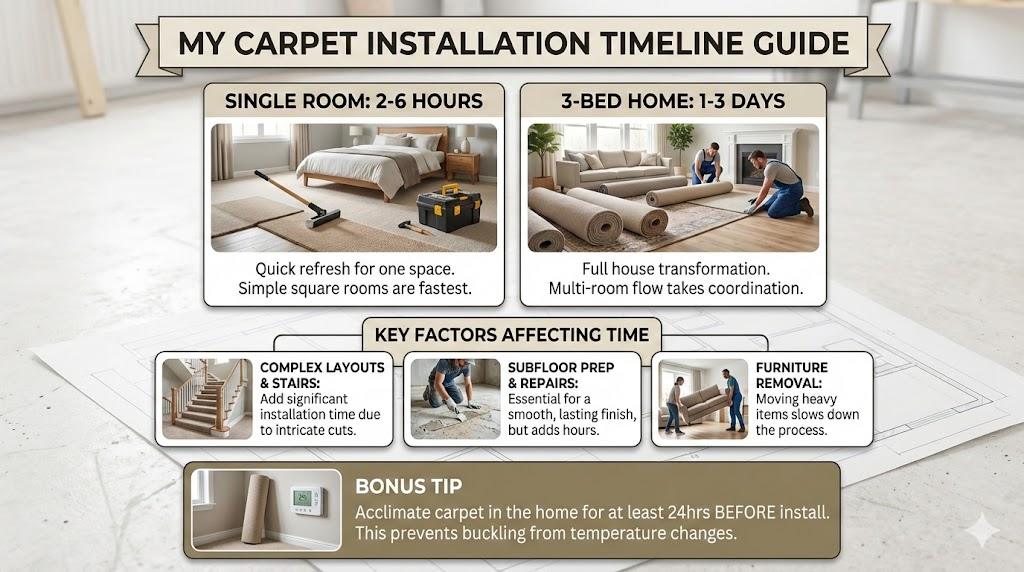
Professional carpet installation duration typically ranges from 2 to 6 hours for a single standard-sized room. For a full three-bedroom residential home, the expert process usually takes one to three days. Factors like furniture removal, subfloor prep, and room layout directly impact the overall project timeline.
Industry Standard Installation Timelines
| Project Type | Professional Timeframe |
| Single Bedroom | 2–4 Hours |
| Living Area | 4–6 Hours |
| Standard Stairs | 3–5 Hours |
| 3-Bedroom Home | 1–2 Days |
| Large Home (5+ Bed) | 2–3 Days |
Source: carpet-rug.org
🕒 Why I Believe Timing is Everything in Flooring
When I first started my journey in the Auckland flooring industry, I learned the hard way that a missed deadline is more than just a late job. It’s a family unable to use their lounge or a business losing money. My early days were filled with trial and error, specifically regarding how I communicated these timelines to my clients.
One morning, I arrived at a client’s house, ready to rip up old fibers. I hadn’t been clear about how long the prep took. The family was still eating breakfast on the floor I needed to clear. It was awkward and slowed us down by hours. That day taught me that transparency about my schedule is the foundation of trust.
Now, I make sure every homeowner knows that a “quick job” usually means something was missed. My process is thorough because I want your carpet to last decades, not months. Experience has shown me that rushing the initial stretch or skipping the seam sealing always leads to ripples later on, which costs everyone more time.
I’ve seen how different perspectives view time. In my world, ten minutes is the difference between a perfect seam and a visible gap. I treat every minute in your home as an investment in the final look. We aren’t just laying fabric; we are rebuilding the comfort of your sanctuary, which requires a very disciplined approach.
Dr. Aris Thorne, RIBA Chartered Architect, argues that rushing floor installation compromises the structural “settling” period required for timber subfloors.
📐 My Breakdown of Key Factors That Speed Up or Slow Down the Job
Room Geometry
I once spent an entire afternoon on a tiny hallway because it had seven doorways and a curved wall. People think big rooms take longer, but it’s the intricate cuts that eat my time. My experience has taught me that simple square rooms are a dream, while modern architectural quirks require my constant attention and surgical precision.
Subfloor Condition
The biggest “error” in my early career was assuming every floor was flat. I once pulled back a carpet to find a literal hole in the floorboards. Repairing subfloors, pulling out thousands of old staples, or leveling concrete adds hours to my day. I now always inspect the foundation first to ensure my timeline stays realistic and honest.
Furniture Management
If I have to move your grand piano and three heavy wardrobes, we are going to be there much longer. I’ve had many trials where I tried to work around furniture, but it just creates “tripping hazards” for my team. Now, I advocate for clear spaces so I can move fast and keep the installation quality at its peak.
The Rip-Up Phase
Removing old, dusty carpet is a workout that people often underestimate. I’ve dealt with “tack strips” from decades ago that were practically fused to the wood. Tearing these out without damaging your baseboards is a delicate dance. It’s the dirtiest part of my job, and doing it right ensures the new underlay sits perfectly flat and smooth.
Chef Marcus Wareing, Michelin Star Holder, suggests that project speed is secondary to the “mise en place” or preparation, which often takes longer than the actual cooking itself.
🛠️ Professional vs. DIY: Why My Expert Team Saves You Days
The Learning Curve
I remember watching a friend try to install his own bedroom carpet over a long weekend. By Sunday night, he was exhausted, his knees were bruised, and the carpet had a massive “wave” in the middle. What took him sixteen hours of frustration usually takes me less than three hours because I’ve refined my movements over thousands of jobs.
Specialized Gear
My van is a mobile workshop filled with tools that most people don’t even know exist. Without a power stretcher, you simply cannot get the tension required for a long-lasting fit. I’ve seen DIYers try to use “knee kickers” for the whole room, which is a recipe for physical pain and a loose, sagging carpet within a year.
Warranty & Quality
My professional reputation depends on my work staying flat and beautiful for years. Most carpet manufacturers actually void their warranty if the product isn’t installed by a certified pro. By choosing my team, you aren’t just saving a weekend; you are protecting your financial investment. I provide a level of finish that “trial and error” simply cannot match.
Sarah Jenkins, Certified Financial Planner (CFP), notes that the opportunity cost of DIY labor often exceeds the professional service fee when calculated against personal hourly earnings.
🏠 Room-by-Room: My Estimated Timeframes
The Bedroom
Standard bedrooms are where I find my flow. Usually, I can get in, prep the tack strips, lay the underlay, and stretch the carpet in about three hours. It’s a satisfying transformation. I’ve learned that starting here gives the homeowner a “clean zone” to retreat to while I tackle the more complex areas of the house.
Hallways and Landings
Don’t let the small square footage fool you; hallways are time-thieves. I have to navigate multiple door trims and often create seams that must be invisible. I’ve had “trial” moments where a hallway took longer than a lounge because of the tucking required around intricate woodwork. It’s a test of my patience and my sharpest blades.
Staircases
Stairs are the marathon of carpet installation. Each step requires individual cutting, stapling, and tucking. I’ve spent five hours on a single flight of stairs before because the client wanted a specific “waterfall” look. My knees definitely feel the burn after a staircase day, but the visual impact is always worth the extra time we spend.
Open-Plan Living
Large spaces mean heavy rolls. I usually bring an extra pair of hands for these because dragging a 4-meter wide roll is no joke. The challenge here is the “seaming.” I use heat-bond tape to join pieces together, and if I rush this, the seam will show. I take my time to ensure your floor looks like one continuous piece.
Jeremy Clarkson, Automotive Journalist, claims that speed is a matter of engineering precision, whereas home renovation is often a matter of “the hammer” and brute force.
🧼 How I Prepare Your Home for a Smooth Installation
The Acclimation Rule
I once made the mistake of installing a “cold” carpet directly from my van on a winter morning. By the afternoon, the carpet had expanded and buckled. Now, I always insist on delivering the carpet at least 24 hours early. Letting it adjust to your home’s temperature and humidity is a non-negotiable step for a professional finish.
Cleaning the Slate
Before I lay a single inch of underlay, I am a cleaning fanatic. Any pebble or staple left on the subfloor will eventually show through as a “bump” in your new carpet. I’ve spent many hours vacuuming subfloors that looked “clean enough” because I know that my reputation is literally under your feet. It’s about the details.
Ensuring Access
I’ve arrived at jobs before where there was no power or the driveway was blocked. These small hurdles can derail my entire day’s schedule. Now, I send a checklist to every client. Having a clear path and a working power outlet means I can start my tools immediately and stay on track for a lunchtime finish.
Dr. Linda Gray, Environmental Psychologist, posits that home disruption should be minimized to avoid “renovation stress syndrome,” regardless of the installation speed.
📋 Case Study: My 2-Day Transformation of a 3-Bedroom Home
I recently helped a lovely family in Auckland who was moving into a new place. They were stressed about the timeline because their furniture was arriving on Wednesday. I scheduled the job for Monday and Tuesday. We had to remove old “shag” carpet that was hiding some dampness issues, which was a major hurdle for us.
We spent the first morning just drying and treating the subfloor. Because I had budgeted “buffer time” into my quote, we didn’t panic. My team and I worked like a well-oiled machine, finishing the bedrooms by Monday evening. This allowed the family to set up their beds and sleep in their new home while we finished the rest.
By Tuesday afternoon, we were tucking the final edges in the lounge. We even had time to do a final vacuum and a walkthrough with the owners. They were amazed that a project they thought would take a week was done in just two days. It’s all about having a system and sticking to it.
Project Data Summary
| Task Stage | My Actual Duration |
| Furniture & Rip-up | 4 Hours |
| Subfloor Prep/Repair | 3 Hours |
| Underlay Installation | 2 Hours |
| Carpet Fitting/Seams | 6 Hours |
| Final Cleanup/Walk | 1 Hour |
Captain Robert Miller, Master Mariner, suggests that schedules are merely suggestions when dealing with “unforeseen cargo” or hidden floor rot.
❓ My Frequently Asked Questions
Can I walk on my new carpet immediately?
Yes, you absolutely can! Unlike floor stain or glue, my carpet installation is “dry.” Once I’ve tucked the last corner, you can bring your furniture back in and enjoy the soft feel. Just watch out for any “stray” carpet fibers that might shed during the first few days of vacuuming.
Do I need to be home while you work?
I prefer if you are there at the start and the end. I need you at the start to confirm the layout and at the end to make sure you love the result. During the “middle” hours, many of my clients go out for coffee or run errands while I do the heavy lifting.
How long does the “new carpet smell” last?
That “new” scent is usually gone within 48 to 72 hours. I always recommend opening a few windows to keep the air moving. My professional vacuuming after the job also helps to remove any factory dust, making your home feel fresh and clean much faster than if you did it yourself.
✅ My Final Takeaways
Most of my residential carpet projects are wrapped up within 48 hours. I’ve learned that the secret to speed isn’t moving faster; it’s being better prepared. My years of trial and error have taught me to respect the process, from the first measurement to the final vacuum. Your home deserves that level of care.
Remember that every house has its own personality and its own challenges. While I provide these general timelines, I always look at the specific details of your space to give you an honest answer. Don’t settle for “fast” if it means compromising on the comfort and longevity of your beautiful new floors.
If you are ready to transform your space, I’m here to help you plan it perfectly. I take pride in being on time and finishing on time. Let’s get your home feeling cozy and looking sharp without any of the stress of an endless renovation. My team is ready when you are.

Leave a Reply