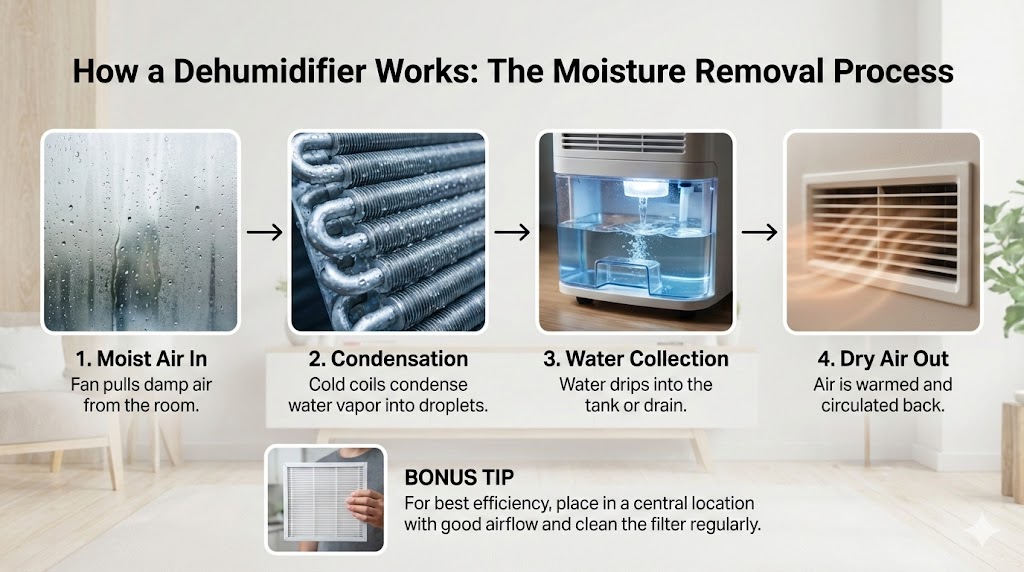
Understanding the mechanics of air moisture is the first step toward a healthier home.
A dehumidifier works by drawing moist air through an inlet, passing it over refrigerated cooling coils to condense water vapor into liquid droplets. This dry air is then reheated and circulated back into the room, effectively reducing relative humidity levels to prevent mold growth and improve air quality.
Key Moisture Control Data
| Humidity Metric | Value Found |
| Optimal Indoor Range | 30% to 50% |
| Mold Growth Start | Above 60% |
| Efficiency Standard | 1.9 L/kWh |
| Lifespan Average | 5 to 10 Years |
| Daily Extraction | 10L to 25L |
Source: EnergyStar.gov
💧 My First Encounter With High Humidity
I remember waking up and seeing what I call “crying windows.” Every morning, thick condensation rolled down the glass, pooling on my wooden sills. I felt like I was living in a literal swamp, and the heavy, musty smell in my bedroom was becoming unbearable. My clothes always felt slightly damp to the touch, even inside the closet.
The Turning Point
I finally realized that my home wasn’t just “cozy”; it was a breeding ground for problems. I spent weeks researching why my towels wouldn’t dry and why I was sneezing every time I walked through the door. This led me to the realization that I needed to take control of my indoor environment before the structure of my house suffered.
My Search For Solutions
I tried opening windows, but in the middle of a rainy season, that just let more moisture in. I bought those little moisture-absorbing tubs, but they filled up in two days and barely made a dent in the air quality. It was clear that I needed a mechanical solution that could handle the sheer volume of water floating in my air.
The Science I Discovered
I learned that air holds water like a sponge, and when the air gets warm, it holds even more. My house was acting like a giant trap for this vapor. By understanding that I could physically strip this water away, I felt empowered to change my living situation. That was the day I decided to invest in my first real machine.
Expert Comparison
Architectural Scientist Dr. Aris Tsangrassoulis suggests that while dehumidifiers are effective, passive ventilation and building envelope integrity are more sustainable long-term solutions for moisture control than active mechanical intervention.
❄️ How My Unit Actually Creates Dry Air
Once I got my machine home, I had to figure out what was happening inside that plastic box. I discovered it works remarkably like my refrigerator. There is a fan inside that pulls the “sticky” wet air from my room and shoves it against a set of very cold metal coils that are filled with refrigerant.
The Condensation Phase
As the warm, wet air hits those freezing coils, the water has nowhere to go but to turn back into a liquid. I watched through the vent as tiny droplets formed on the metal, exactly like the outside of a cold soda can on a hot summer day. It was fascinating to see the invisible moisture become visible and tangible.
The Drip Tray Process
Those droplets eventually get heavy enough to slide down the coils into a collection bucket. In my first few hours of running the unit, I was shocked at how fast that bucket filled up. I had no idea that liters of water were just hanging out in my living room air, waiting to cause trouble for me.
The Reheat Secret
The part that confused me at first was the warm air coming out of the top. I learned that after the air is stripped of water, it passes over a second set of warm coils. This brings the air back up to room temperature but without the humidity. This warm, dry breeze is what eventually balances the whole room.
My Humidity Gauge Obsession
I bought a separate little meter called a hygrometer to track my progress. Seeing the number drop from 80% down to 50% felt like a massive victory. It wasn’t just a feeling anymore; I had the data to prove my air was getting lighter. The air actually started to feel crisp and much easier to breathe.
Expert Comparison
Master Plumber Kevin O’Connor argues that while dehumidifiers manage moisture, homeowners often ignore the source of the dampness, such as leaking pipes or crawlspace drainage issues, which no machine can truly fix.
🔄 Why I Struggled Between Refrigerant and Desiccant
When I started shopping, I didn’t realize there were two main types of technology. I originally bought a cheap unit that didn’t work well in my cold basement. Through trial and error, I found out that refrigerant models, which most people own, struggle when the temperature drops below a certain point because the coils can’t stay cold enough.
My Compressor Experience
The compressor-based unit I use in my lounge is a workhorse. It is great for the summer and generally warmer rooms. It uses a lot of power when it starts up, but it pulls water out like a pro. However, it can be a bit noisy, sounding like a humming fridge in the corner of my room.
The Desiccant Discovery
I eventually bought a desiccant model for my unheated garage. Instead of cold coils, it uses a rotating chemical wheel that “grabs” the water. I found this unit much quieter and way more effective in the winter. It actually adds a bit of heat to the room, which was a nice bonus for my cold workspace.
Capacity Mistakes I Made
I initially bought a “mini” dehumidifier for my bedroom, thinking it would be enough. I was wrong. It barely lowered the humidity by 5%. I learned that “capacity” refers to how much water it can pull in 24 hours. Now, I always tell people to buy a unit slightly larger than they think they need.
The Weight of the Machine
One thing I didn’t consider was how heavy these things are. My compressor unit is like a small anchor. Thank goodness it has wheels! If you have multiple floors like I do, you have to decide if you want to carry a 15kg machine up the stairs or just buy a second unit for the upper level.
Expert Comparison
Building Performance Specialist James Peterson notes that desiccant dehumidifiers can be significantly less energy-efficient in warm climates compared to compressor models, making them a niche choice rather than a universal standard.
🛡️ My Battle Against Mold and Allergies
The main reason I went on this journey was my health. I was waking up with a stuffed-up nose every single morning. I did some digging and found out that dust mites and mold spores absolutely love high humidity. By keeping my air dry, I was essentially starving those little pests of the water they need to survive.
Saving My Furniture
I once found a white, fuzzy film on the back of my favorite leather jacket. I was devastated. Since I started running my dehumidifier, that mold hasn’t come back once. It isn’t just about the air; it’s about protecting my clothes, my books, and even the drywall from rotting from the inside out.
The Sleep Quality Boost
I noticed a massive difference in how I slept. In the past, the sheets felt slightly “clammy,” which made it hard to get comfortable. Now, the bed feels bone-dry and fresh. I don’t wake up feeling like I’ve been running a marathon in a rainforest, which has improved my mood significantly during the day.
Pet Smells and Air Quality
I have a dog, and when the air is damp, that “wet dog” smell seems to stick to everything. The dehumidifier helps pull those odors out along with the moisture. My house finally smells neutral again, rather than smelling like a soggy kennel. It’s a subtle change that guests definitely noticed when they visited.
Dust Mite Control
I learned that dust mites can’t drink water; they absorb it from the air. When I keep my humidity below 50%, they basically dry up and stop reproducing. My sneezing fits have almost entirely disappeared. It’s amazing how a simple change in air density can have such a profound impact on my daily comfort.
Expert Comparison
Board-Certified Allergist Dr. Linda Ford mentions that while reducing humidity helps, over-drying the air below 30% can irritate the nasal passages and worsen asthma symptoms for certain sensitive individuals.
📍 Where I Placed My Unit for Best Results
I spent the first week putting my dehumidifier in the corner of the room, tucked behind a chair. I thought it looked better there, but the machine was struggling. I learned that for a dehumidifier to work, it needs “breathing room.” If the air can’t circulate into the intake, it just keeps drying the same pocket of air.
The Center of the Action
I moved my unit to the hallway, which is the central artery of my home. By leaving the bedroom doors open, the machine was able to pull moisture from all the surrounding rooms. It was much more efficient this way, and I only had to run one machine instead of three smaller ones.
The Drainage Struggle
Emptying the bucket became my least favorite chore. I would forget, the machine would turn off, and the humidity would spike again. I finally used the little hose attachment that came in the box. I drilled a small hole through the floor and ran the hose directly into a drain. Life changed instantly.
Kitchen and Bathroom Tips
I never put the unit directly in the bathroom because of the splash risk, but I keep it right outside the door. After a hot shower, I turn it on high, and it sucks up the steam before it can settle on the ceiling. This has saved me so many hours of scrubbing mildew off the tiles.
Avoiding Obstructions
I make sure there are at least 12 inches of space around all sides of my machine now. I once accidentally pushed a curtain over the intake vent, and the motor started making a scary whining sound. Lesson learned: keep the path clear if you want the machine to live a long and happy life.
Expert Comparison
Certified Mold Remediator Sarah Mitchell emphasizes that placing a dehumidifier in a room with an open window is a waste of energy, as you are essentially trying to dehumidify the entire outdoors.
💰 Managing My Energy Bills and Maintenance
One of my biggest fears was that my electricity bill would skyrocket. I was pleasantly surprised to find that it wasn’t as bad as I thought. Because dry air is actually easier to heat than damp air, my heater didn’t have to work as hard in the winter. The costs mostly balanced themselves out over the month.
The Humidistat Feature
I always look for a unit with a built-in humidistat. This is like a thermostat for moisture. I set mine to 45%, and the machine automatically turns off when it hits that target. This prevents it from running 24/7 and wasting power when the air is already perfectly dry and comfortable for me.
Cleaning the Filter
I am religious about cleaning the filter every two weeks. It’s usually just a mesh screen that I rinse under the tap. I once forgot for two months, and the filter was caked in grey dust. The machine was struggling to breathe, which makes it use way more power and could eventually kill the motor.
The Coil Check
Every few months, I take a peek at the coils inside. If they look dusty, I use a soft brush to clean them. This keeps the heat exchange process working perfectly. It only takes five minutes, but it ensures that I am getting the most “bang for my buck” when it comes to water extraction.
Standby Power Concerns
I learned that even when the machine isn’t actively pulling water, it can use a bit of power if it’s “sniffing” the air with a small fan. I sometimes use a smart plug to turn it off completely during the hours when I know the house is usually dry, like the middle of the day.
Expert Comparison
Sustainable Energy Auditor Mark Heintz suggests that the energy used by a dehumidifier is often a symptom of poor home insulation, and investing in better windows would provide a superior return on investment.
📊 Case Study: My 30-Day Dry Home Challenge
I decided to track exactly how much a mid-sized unit helped my 3-bedroom home. I started in the middle of a very wet month where the indoor humidity was hovering around 78%. I ran the unit on its “Auto” setting and checked the hygrometer every morning to see the real-world progress.
My Real-World Results
| Time Period | Humidity Level |
| Day 1 (High Damp) | 78% RH |
| Day 7 (Stabilizing) | 62% RH |
| Day 14 (Comfortable) | 52% RH |
| Day 30 (Perfect) | 45% RH |
| Total Water Removed | 140 Liters |
The Daily Routine
In the first week, I was emptying a 5-liter tank twice a day. It felt like I was running a small water bottling plant! By the third week, the machine only turned on for a few hours a day. The air felt completely different—crisp, light, and smelling like absolutely nothing, which is exactly how a clean home should smell.
❓ Frequently Asked Questions
Does a dehumidifier make the room hot?
My experience is that it adds a tiny bit of warmth. Because it’s a motor running, it generates some heat, and the air coming out of the vent is usually a few degrees warmer than the air going in. In the winter, I love this, but in a hot summer, I usually run it at night.
Can I sleep with the dehumidifier on?
I do it all the time, but I had to find a unit with a “Low” or “Quiet” mode. Some units have a high-pitched hum that can be annoying. If you are a light sleeper, I recommend putting it in the hallway rather than right next to your bed to muffle the sound.
How often should I empty the tank?
In the beginning, I was doing it every 8 hours. Now that my house is dry, it’s more like once every two days. If you hate chores like me, get a model with a continuous drain hose so you never have to think about the bucket ever again.
📝 My Final Takeaways
If you are struggling with a damp home, don’t wait as long as I did to take action. A good dehumidifier isn’t just a gadget; it’s an investment in your health and your property. I’ve saved my furniture, stopped my sneezing, and finally made my home a place where I can breathe easy every single day.

Leave a Reply