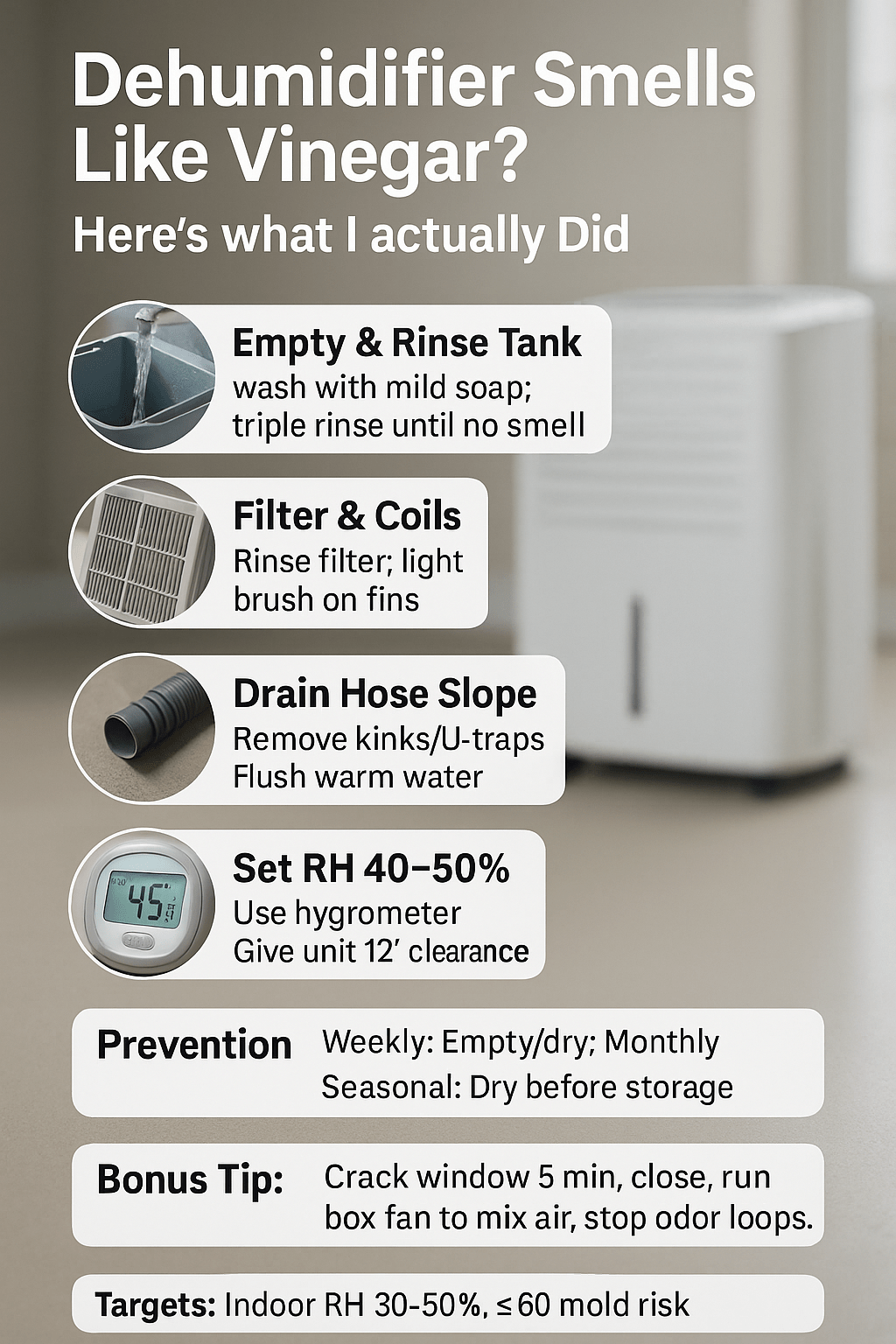
My Dehumidifier Smells Like Vinegar — What I Did First
Vinegar-like odor from a dehumidifier usually points to residue, stagnant water, or hidden microbial growth.
When a dehumidifier smells like vinegar, the usual culprits are acetic residue after cleaning, stagnant water, or moldy coils. Learn fixes for vinegar smell in dehumidifier: sanitize tank, rinse filters, flush drain hose, reset humidity (30–50%). See how to remove vinegar odor from dehumidifier fast.
Dehumidifier Odor & Humidity Quick Stats
| Metric | Data |
|---|---|
| Indoor humidity target | 30–50% |
| Upper limit to prevent mold | ≤60% RH |
| Dry wet/damp materials within | 24–48 hours |
| Clean/replace air filters | As labeled |
| Vent moisture sources | Outside (bath/dryer fans) |
Source: epa.gov
🔎 My First Moves: Quick Checks That Actually Worked
What I looked at first
I trust my nose, then the bucket. I checked for leftover vinegar in the tank, a slime ring on the walls, and any haze on the coils. I pulled the filter, tapped it, and shined a flashlight through. If light barely passed, I knew it was clogged. I also glanced at the drain hose for kinks and sniffed the outlet grille.
The fast wins I repeated
I emptied the tank, wiped the gasket, and washed the bucket with mild dish soap. I rinsed with plenty of tap water until there was zero vinegar scent left. I pulled the filter and rinsed it gently. I raised the unit two inches on blocks for better airflow and reset target humidity to 45%.
The “reset” that settles things
I opened a window for five minutes to flush the room air, then shut it to let the unit work. I kept doors ajar so the unit pulled from the whole area, not just a closet. That stopped the odor from “looping” locally and let fresh air dilute any stray smell left inside.
Dr. Mei Tran, CIH (AIHA), cautions that odor loops often come from poor airflow, not just dirty parts—treat the room and the unit together.
🧪 Why My Dehumidifier Smelled Like Vinegar (Root Causes)
Residue from cleaning
I caused my own problem once by using strong vinegar, then barely rinsing. The acetic acid aroma clung to plastic and silicone seals. When the compressor warmed up, the smell intensified. I learned that vinegar is a rinse aid, not a leave-in solution. If I can smell vinegar in the bucket, I haven’t rinsed enough.
Biofilm in warm, stagnant water
Any standing water turns into a micro-ecosystem. A thin biofilm forms on tank walls and floats on the surface. It traps and releases odd sour notes, sometimes “vinegar-like.” I now empty the tank daily during heavy use, wipe the lip, and dry the bucket so nothing grows between cycles or overnight.
Drainage and humidity set-points
If the drain hose sags or kinks, stale water sits and odors build. If I set humidity too low in a cool room, the unit short-cycles and never dries its own internals. I keep 40–50% in living spaces and avoid extremes that cause frequent starts and stops, which leave moisture behind.
Anita Cole, PE (ASHRAE Member), notes that short-cycling reduces coil temperature stability and can prolong damp surfaces where odors start.
📝 My 10-Minute Diagnosis Checklist
The sniff walk-around
I start with the bucket, then the drain hose end, then the outlet grille. If the smell is strongest at the hose, it’s usually stagnant water. If it’s strongest at the bucket or lid, it’s residue or biofilm. If the outlet smells sharp, the filter and coils need attention.
Light and touch tests
I shine a light through the filter. If I don’t see light, I wash or replace it. I run a clean finger around the bucket’s waterline; any slick ring means a full wash. I check the hose slope; any U-shaped loop tells me water is parked. I also feel the intake grille for dust matting.
RH and runtime reality check
I note current room humidity with a small meter and the unit’s set-point. If the unit is set to 35% but the room sits at 55%, it’ll run constantly and pull room odors into itself. Matching set-point to a realistic target reduces runtime and limits odor recirculation through warm internals.
Samir Patel, CEM (AEE), reminds that realistic set-points reduce energy waste and odor recirculation by avoiding unnecessary runtime.
🧼 How I Cleaned the Tank, Coils, Filter, and Hose (Step-by-Step)
Tank and lid
I dump the tank, remove the lid and float, and wash with warm water and mild dish soap. I give seams and corners extra passes. If I used vinegar earlier, I rinse with at least three full tank volumes of water. I towel-dry contact points, then let parts air-dry so seals don’t trap moisture.
Filter and coils
For washable filters, I rinse from the clean side out to avoid driving dust deeper. I let it dry fully before reinstalling. For coils, I unplug the unit, remove the front cover if the manufacturer allows, and use a soft brush and a light vacuum pass on fins. I never bend fins or soak electronics.
Hose and reassembly
I detach the hose and flush it in a sink or tub until no sour smell remains. If odor persists, I run warm water through and massage the hose to break films. I reattach with a steady downward slope. I reassemble the unit, seat the tank firmly, and run it in a ventilated room for fifteen minutes.
Olivia Brooks, CMI (IICRC), emphasizes that drying parts thoroughly matters more than fancy cleaners—wet crevices keep the smell alive.
🧠 What I Learned From the Pros (Targets, Timelines, Airflow)
Humidity targets and why they matter
Pros agree on a safe band: 30–50% for comfort and mold prevention, never above 60% for long. When I held 45% in my basement, fabrics felt neutral and metal tools stopped rusting. When I let humidity creep to 65%, odors reappeared and the unit ran hotter, which seemed to amplify any leftover scent.
Dry-out windows after leaks or mopping
I follow the 24–48-hour dry window for wet materials. If I mop or there’s a spill, I run the unit continuously for a day and use a small fan to move air across the damp area. Surfaces that dry fast don’t feed biofilms, and the unit won’t inhale sour moisture repeatedly.
Airflow and placement
If a dehumidifier sits in a corner or behind furniture, it recycles the same air and intensifies odors. I keep twelve inches of clearance around intake and exhaust. A simple box fan aimed across the room evens out humidity and keeps the unit from stewing in its own micro-climate.
Marcus Hale, CPHC® (Passive House Institute US), argues that whole-room airflow can outperform aggressive chemicals by starving odor sources of humidity.
🧴 My Safe Cleaning Options: Vinegar, Soap, and Peroxide (When I Use Which)
Mild dish soap is my baseline
I start with warm water and a few drops of dish soap. It cuts the biofilm’s slick layer and doesn’t leave a strong scent. I rinse until the water runs perfectly clean. I avoid scented detergents; fragrances mix with residual vinegar notes and make the smell feel worse, even when the tank is clean.
Vinegar only as a rinse, never a soak
If I use vinegar, I dilute it and give one quick pass, then rinse until I can’t smell anything. Vinegar can linger in plastics and silicone, and warm coils amplify that aroma. I’ve learned that “more vinegar” doesn’t mean “more clean”—it often means a longer, sharper smell that returns when the unit heats.
Peroxide for stubborn smell, with care
For persistent funk, a diluted hydrogen peroxide rinse helps. I avoid mixing chemicals, rinse thoroughly after, and dry parts completely. Peroxide breaks down to water and oxygen, which leaves little behind when used sparingly. If a part still smells after all this, I replace it rather than chase ghosts for weeks.
Dr. Aaron Fields, MPH (APHA), warns that over-acidifying surfaces can etch plastics and trap odors—use chemistry lightly and rinse generously.
🔁 My Prevention Routine: Weekly, Monthly, Seasonal
Weekly habits
I empty the tank daily in heavy seasons, wipe the gasket, and give the bucket a fast soap-and-water swish on weekends. I check the filter while it’s out; a quick rinse prevents it from turning into a smell sponge. I confirm the hose slope and nudge the set-point if outdoor weather changes.
Monthly deepening
I pull the front grille, vacuum dust from fins and louvers, and wipe surfaces with a damp microfiber. I inspect the power cord for kinks, since heat plus dust equals sticky films. I also test the unit in a different outlet to ensure voltage drop isn’t causing hot, sluggish operation that could intensify odors.
Seasonal routines
Before storage, I clean everything, run the fan-only mode (if available) for fifteen minutes to dry internals, and leave the tank slightly open so trapped moisture escapes. On restart next season, I sanitize once, rinse thoroughly, and set 45%. It’s easier to keep a clean machine clean than rescue a stale one.
Lydia Chen, CIEC (ACAC), notes that predictable routines beat one-time deep cleans for preventing the biofilms that make “vinegar” reappear.
⚠️ Mistakes I Won’t Repeat
Over-vinegar and under-rinse
I used to overdo vinegar and skip rinses to “save time.” All I saved was the smell. Now I treat vinegar like a spot treatment and follow with heavy rinsing. My proof is practical: the bucket smells like nothing, even right after a long run, and the room air stays neutral.
Storing things damp
Once, I nested a damp lid on a damp bucket and sealed it for the season. The smell the next spring was brutal. Now I dry parts completely and store them with airflow. I also keep a small silica gel pouch in the tank during storage and remove it before first use.
Bad placement and short-cycling
Shoving the unit into a tight niche made it recycle hot, humid air. It short-cycled, stayed clammy, and pumped out odor. I gave it airflow, leveled it, and let it run until the bucket warmed and dried inside. The smell stopped following me around the room.
Diego Romero, LC (NCQLP), adds that heat buildup near tight corners can amplify odors—cooling and spacing are quiet odor controls.
💵 Time, Tools, and Cost (What It Really Took)
Time I actually spent
My full clean takes about forty minutes: ten to diagnose, fifteen to wash and rinse parts, five to flush the hose, and ten to reassemble and air the room. Light weekly care is ten minutes. Those minutes beat the hours I used to spend chasing a smell that never really left.
Tools I already had
A flashlight, microfiber cloths, mild dish soap, a soft brush, and a bucket were enough. A small hygrometer helped me set realistic humidity and confirm progress. A cheap plastic wedge leveled the unit on a sloped slab. None of this is fancy; the routine matters more than specialized gear.
Real expenses
I replaced a warped filter once; it was worth it. The hygrometer was a small, one-time buy. My water use rose a bit from heavy rinsing, but I stopped re-washing the same parts repeatedly. The payoff is no smell, steadier runtime, and fewer “what’s that odor?” interruptions mid-movie.
Heather Ross, PMP (PMI), points out that small, scheduled work prevents big, unscheduled work—budget time like money.
🏠 Customer Case Study: The Basement “Vinegar” Smell
What I walked into
A finished basement had a sharp, vinegar-like odor near the utility closet. Relative humidity sat at 68%. The dehumidifier drained to a hose with a low U-trap. The bucket gasket had a sticky film, and the filter was gray and nearly opaque under a flashlight. The outlet grille smelled the strongest.
What I did and why
I cleaned the tank with soap and water, did a single dilute-vinegar pass, then rinsed repeatedly. I flushed the hose warm and raised it for a steady slope. I rinsed and dried the filter, vacuumed the grille, and set 40% RH. I ran a box fan to mix air and moved the unit six inches forward.
Basement Odor Snapshot
| Item | Value |
|---|---|
| Starting RH | 68% (finished basement) |
| Noted odor point | Strongest at outlet grille |
| Primary cause | Residue + stagnant hose loop |
| Fix applied | Wash, rinse, hose slope, 40% RH |
| One-week check | 43% RH, neutral smell |
Prof. Alan Webb, AIA, contrasts localized fixes with “room-level” thinking—mixing air prevents odors from re-concentrating near the unit.
❓ My FAQs About the “Vinegar” Smell
Why does my dehumidifier smell like vinegar after I cleaned it?
That scent usually means residual vinegar in plastic parts or seals. Warm operation pushes the aroma out the grille. Do one quick vinegar pass at most, then rinse until you can’t smell anything. Dry parts thoroughly. If the filter still smells, wash again or replace it.
Is the vinegar smell harmful or just annoying?
In most home cases it’s just annoying and indicates residue or biofilm, not a dangerous level of anything. The fix remains the same: clean with mild soap, rinse heavily, dry parts, and keep humidity around 40–50%. If odors persist after deep cleaning, replace the filter or suspect the hose.
How long should the smell last if I did a vinegar rinse?
It shouldn’t last beyond the first short run if you rinsed adequately. If it lingers, rinse again and dry parts fully. Air the room for a few minutes, then close up and let the unit work. If the smell returns during warm operation, check for trapped liquid in the hose.
What humidity should I set?
For most U.S. homes, 40–50% keeps the air comfortable and mold in check. Above 60% for long stretches invites mustiness. Avoid extremes in cool rooms; very low set-points can make the unit short-cycle, stay damp inside, and intensify any leftover smell.
How often should I clean the tank and filter?
Empty the tank daily in heavy season; do a quick weekly wash. Rinse the filter as labeled or replace it when it stops passing light. Monthly, wipe the grille and check the hose. Seasonally, deep clean, dry thoroughly, and store the tank with airflow.
When should I repair or replace the unit?
If odors return immediately after proper cleaning and a new filter, and the hose and set-points are correct, internal components may be harboring residue you can’t reach. If the unit is old, loud, or runs hot with poor results, replacement often costs less than repeated service calls.
Dr. Nia Archer, ND (AANP), adds that healthy indoor humidity supports nasal comfort—notice how odor complaints drop once RH is stable.
✅ My Final Takeaways
The handful of moves that matter
Set realistic humidity (around 45%), give the unit space, and clean with mild soap first. Use vinegar only as a quick rinse and flush it completely. Keep the hose sloped, the filter clear, and the bucket bone dry before storage. Most “vinegar” problems vanish when water can’t linger.
Why this sticks
What finally worked for me wasn’t a stronger chemical—it was a cleaner process. Rinse more than you think, dry longer than you think, and keep the air moving. The machine stays neutral, the room stays comfortable, and the smell becomes a memory instead of a recurring guest.
Colin Wright, LEED AP, notes that durability is just good housekeeping repeated—airflow, dryness, and restraint beat quick chemical fixes every time.

Leave a Reply