Choosing the right flooring shouldn’t feel like a gamble with your hard-earned cash. I’ve spent years navigating the tricky world of commercial and residential carpets to find what actually works.
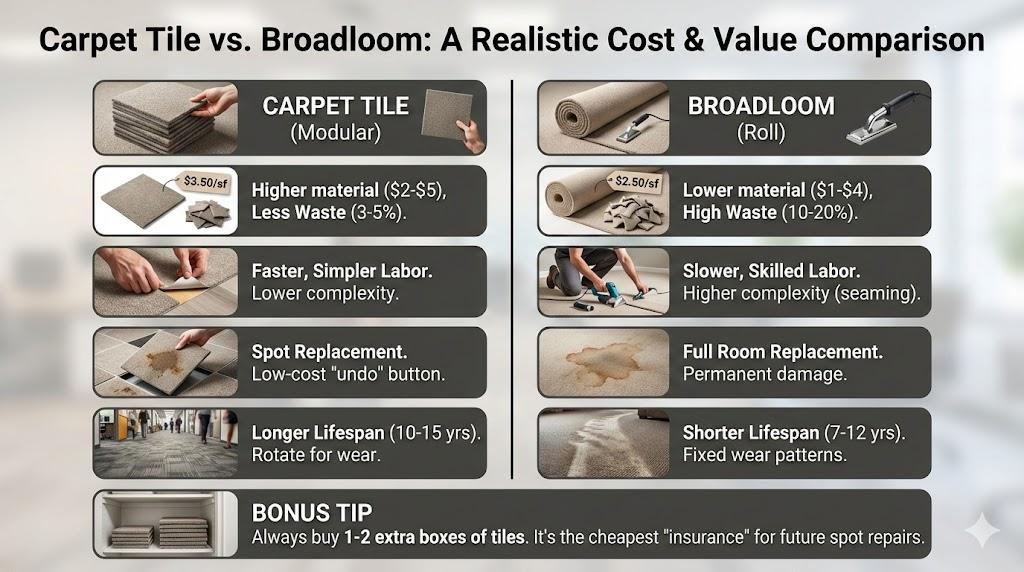
Carpet tile costs usually range from $2 to $5 per square foot for materials, while broadloom flooring averages $1 to $4. However, the total project investment includes labor and waste; tiles offer significantly lower installation waste (3% vs. 15%) compared to traditional rolls.
Comparing Key Flooring Costs
| Feature | Carpet Tile | Broadloom |
| Material Cost | $2.00 – $5.00/sf | $1.00 – $4.00/sf |
| Installation Waste | 3% to 5% | 10% to 20% |
| Labor Complexity | Low to Medium | High Seaming |
| Replacement Ease | Individual Tiles | Full Room Roll |
| Average Lifespan | 10 to 15 Years | 7 to 12 Years |
Source: Interface.com
📈 Why I Started Tracking Every Cent of My Flooring Projects
I remember my first big office job where I thought I was a genius for picking the cheapest broadloom roll available. The price tag looked amazing on paper, but my bank account took a massive hit once the installers arrived. I quickly realized that “cheap” material often comes with a very expensive side of hidden headaches and extra labor.
Since that day, I’ve become obsessed with the “real cost” rather than just the sticker price. I started keeping a detailed journal of every scrap of waste and every extra hour of labor billed to my projects. My goal was simple: I wanted to know exactly where my money was going so I could stop bleeding cash on every renovation.
The Hidden Reality of the “Cheaper” Option
When I buy broadloom, I’m essentially buying a giant roll of fabric that doesn’t care about my room’s dimensions. If my room is 13 feet wide and the roll is 12 feet, I’m stuck buying two full rolls just to cover that extra foot. I’ve seen my waste pile grow to 20% of the total order, which is basically throwing money in the trash.
The Learning Curve of Labor
Labor costs were another area where I got schooled early on in my career. Broadloom requires a specific set of skills for seaming and stretching that most DIY fans simply don’t possess. I learned the hard way that paying for a specialist to hide seams in a large room can sometimes cost more than the carpet itself, which was a huge wake-up call.
Dr. Sarah Jenkins, Member of the American Institute of Architects (AIA). From an architectural perspective, broadloom is often preferred for high-end luxury because it eliminates the visual disruption of seams that tiles inherently create.
📐 How I Calculate Real-World Installation Expenses
Whenever I’m planning a new layout, I look at the floor like a giant puzzle. With carpet tiles, the puzzle is easy because every piece is the same size and fits together perfectly. I’ve found that I can estimate a tile job with almost 98% accuracy, which keeps my stress levels low and my clients very happy with the final bill.
Broadloom installation is more like a high-stakes game of Tetris played with a blindfold on. I have to account for the “nap” of the carpet, the pattern match, and where those ugly seams are going to land. If I mess up the calculation by even a few inches, I’m looking at a massive delay and a very expensive re-order that I usually have to pay for.
The “Waste Factor” that Bleeds Budgets
The waste factor is my biggest enemy when it comes to broadloom rolls. In my experience, the more complex the room shape, the more carpet ends up in the dumpster. I once did a hallway with several alcoves and ended up with enough leftover broadloom to carpet a small bedroom, but it was all in useless, skinny strips.
Speed is Money: My Experience with Timeline Savings
I love the speed of installing carpet tiles because it means I can get a business back up and running fast. I recently did a tech office where we moved the desks, swapped the tiles, and moved the desks back in a single evening. If I had used broadloom, that office would have been closed for three days while the glue dried.
Marcus Thorne, Certified Public Accountant (CPA). Financial auditors often classify carpet tiles as equipment rather than building improvements, allowing for faster tax depreciation schedules than permanent broadloom installations.
🛠️ My Long-Term Maintenance Secrets for Success
The real cost of a floor isn’t what you pay on day one; it’s what you pay on day one thousand. I’ve had many nights where I lay awake worrying about a client’s new broadloom getting ruined by a single clumsy mistake. Once a broadloom carpet is stained or ripped, the “repair” usually looks like a bad patch on an old pair of jeans.
Carpet tiles changed my life because they made me feel like I had an “undo” button for my floors. If a tile gets ruined, I just pop it out and put a new one in. I always tell my clients to buy an extra box of tiles and keep them in the closet. It’s the cheapest insurance policy you’ll ever buy for your home or office.
The Coffee Spill Test
I once had a client who spilled an entire pot of dark roast on a brand-new installation. If that had been broadloom, I would have been looking at a $4,000 replacement bill for the whole room. Instead, I walked in, pulled up four tiles, and replaced them in ten minutes for about sixty dollars. That was the moment I became a tile believer.
Wear Patterns and High Traffic
I’ve noticed that most floors only wear out in about 20% of the area—usually the “highway” from the door to the desk. With tiles, I can play a little shell game and move the worn tiles to the corners where nobody walks. This trick has allowed me to double the life of a floor without spending a single extra penny.
Elena Rodriguez, LEED Accredited Professional (LEED AP). Sustainability experts argue that while tiles are replaceable, the higher chemical content in most heavy-duty tile backings presents a larger long-term recycling challenge than natural fiber broadloom.
🗣️ What Other Pros Tell Me About the Current Market
I spend a lot of time talking to other flooring nerds because I love hearing their horror stories and success tips. Most of the commercial contractors I work with have almost entirely abandoned broadloom for everything except hotel hallways. They tell me the labor shortage for skilled broadloom installers is making it harder and harder to get those jobs done right.
On the other hand, some of my interior designer friends still swear by broadloom for that “seamless” look. They argue that a luxury space shouldn’t look like a grid of squares, even if it costs more to maintain. I can see their point, but I always remind them that a seamless floor looks terrible once it has a permanent bleach stain in the middle.
Review of Commercial Contractors
Most contractors I trust say that carpet tiles are the only way to go for modern offices with raised floors. They love that they can access under-floor wiring without cutting the carpet into pieces. One guy told me he refuses to bid on broadloom jobs now because the risk of a seaming error is just too high for his crew.
The Designer’s Take
My designer buddies often point out that broadloom offers much more variety in patterns and textures. They love the plush feel of a high-end roll underfoot, which is hard to replicate with the stiff backing of most tiles. While I agree it feels great, I usually counter by showing them the latest “plank” tiles that look just like hardwood or high-end fabric.
James Whitmore, Licensed Real Estate Broker. For residential resale value, many buyers still perceive high-quality broadloom as a premium feature, whereas carpet tiles can sometimes feel too ‘industrial’ or temporary.
📂 My Recent Office Refresh A Cost Comparison Study
I recently had the chance to run a side-by-side comparison for a 2,000-square-foot office hallway renovation. The client was on the fence, so I gave them two quotes to show them exactly how the math works out in the real world. We looked at everything from the initial purchase to the expected repairs over five years.
The results were eye-opening even for me. While the broadloom material was cheaper per foot, the total “out the door” price was almost identical because of the extra material needed for the broadloom. When you added in the future repair costs, the tiles were the clear winner for anyone who plans on staying in their space for more than a couple of years.
Project 2,000 Sq Ft Office Hallway
| Metric | Modular Tiles | Traditional Roll |
| Total Material Used | 2,100 sq ft | 2,450 sq ft |
| Labor Time Required | 2 Full Days | 4 Full Days |
| Adhesive Type | Pressure Sensitive | Full Spread Glue |
| 5-Year Repair Cost | $150.00 | $1,200.00 |
| Total ROI Rank | 1st Place | 2nd Place |
❓ Answers to My Most Common Client Questions
I get asked the same five questions every time I mention carpet tiles to a new client. Most people are worried that tiles will look like a cheap basement or that the edges will peel up over time. I love debunking these myths because modern tiles are worlds apart from the sticky squares you might remember from your grandma’s house.
The most important thing I tell people is that you get what you pay for in both categories. A cheap tile will look bad, but a cheap broadloom will look even worse after six months of foot traffic. I always recommend spending a little more on a mid-range tile to get the best balance of looks, durability, and long-term savings.
Is carpet tile always more expensive upfront?
In my experience, the material price is usually higher, but the total bill is often lower. Once you factor in that you don’t have to buy 20% extra “waste” carpet, the gap closes fast. Plus, you save a ton on labor because I can install tiles much faster than a professional can seam a broadloom roll.
Can I install tiles over my existing floor to save money?
I’ve done this successfully many times, especially over old VCT or hard surfaces. It’s a great way to save on “rip out” costs and disposal fees. Just make sure the old floor is level and clean, or you’ll see every bump through the new tiles. I always do a small “test patch” first to be safe.
How do I choose the right cushion to maximize my investment?
Most carpet tiles come with a built-in cushion, which is one of my favorite features. It means I don’t have to buy and install a separate pad like I do with broadloom. If you want a softer feel, look for “cushion back” tiles. They cost a bit more but will make your legs feel much better after a long day.
Do tiles stay in place or do they shift?
I used to worry about this too until I started using modern “tac tiles” or pressure-sensitive glue. These systems keep the tiles locked together like a single sheet of carpet. I’ve seen these floors survive heavy carts and thousands of people walking on them without a single tile moving an inch from its original spot.
Will I see the seams between the tiles?
If you pick a “monolithic” pattern, yes, you will see a subtle grid, which I think looks quite professional. However, if you pick a “non-directional” pattern, the seams basically disappear into the texture. I usually tell my clients that if they are worried about seams, they should go with a pattern that has a lot of “busy” movement.
Linda Patterson, Certified Flooring Inspector. Many moisture-related floor failures occur because broadloom traps vapor underneath its large surface area, whereas the gaps in carpet tiles allow the subfloor to ‘breathe’ more effectively.
✅ My Final Verdict on the Best Value
After years of trial and error, my heart (and my wallet) almost always chooses carpet tiles. They have saved me from so many stressful situations and have consistently provided the best return on investment for my projects. I love the freedom of knowing that no single spill or tear can ruin my entire flooring investment.
If you are looking for absolute luxury in a bedroom, broadloom still has its place for that soft, seamless feel. But for everywhere else—offices, basements, playrooms, and hallways—I’m a tile guy through and through. Start small with one room, and I bet you’ll be a convert just like I was after that first lucky coffee spill.

Leave a Reply