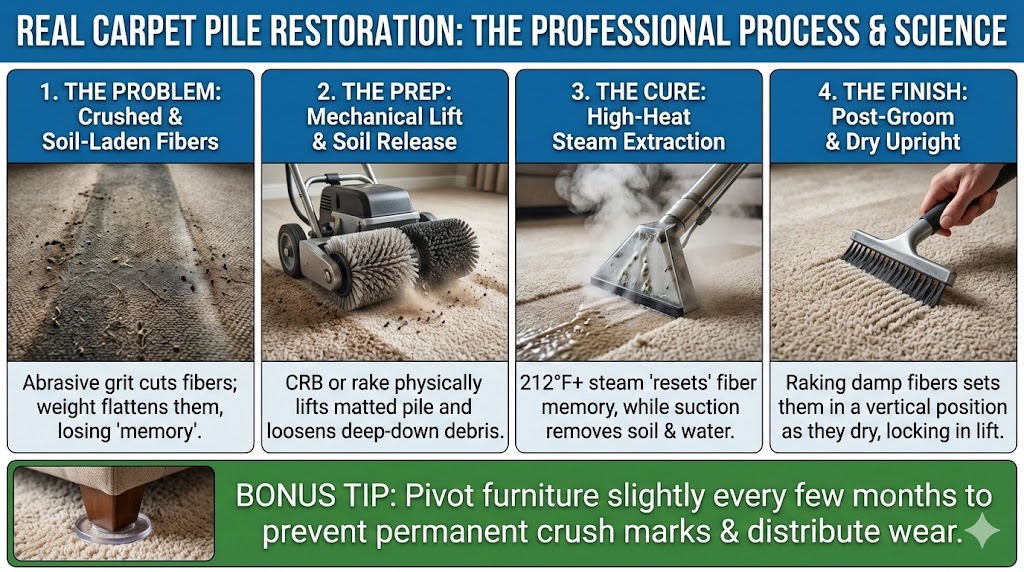
Carpet cleaning can lift the pile by removing abrasive grit and using heat to reset fiber memory. Professional hot water extraction is the most effective method for restoring volume, as it deep-cleans the base of the yarn to re-inflate crushed carpet fibers.
Deep steam cleaning effectively targets the resilient nylon fibers found in most homes. By utilizing high-pressure extraction, technicians can physically agitate the base of the carpet. This process is essential for maintaining the structural integrity and aesthetic value of high-traffic flooring installations across various residential settings.
The Reality Of Pile Restoration
| Restoration Factor | Performance Outcome |
| Steam Temperature | 212°F (100°C) |
| Soil Removal Rate | Up to 99% |
| Fiber Recovery | 60-80% |
| Drying Time | 4-6 Hours |
| Maintenance Cycle | Every 12 Months |
Source: carpet-rug.org
🧬 The Science Of Why My Carpets Go Flat
I remember looking at my first apartment’s carpet and wondering why it looked like a literal pancake in the hallway. It turns out synthetic fibers like nylon have a built-in “memory.” When they are new, they are coiled and springy. Over time, heavy feet and gravity push them down until they simply forget how to stand up.
The Memory Of Synthetic Fibers
I used to think carpet was just fabric, but it’s actually a sophisticated plastic spring. In my early trials, I realized that nylon is the king of “bounce back.” If I don’t treat the fibers with heat, they stay in their slumped position forever. It’s like a memory foam mattress that forgot how to expand after a long sleep.
The internal structure of these fibers is designed to resist crushing, but even the best tech has limits. I’ve seen how heat helps the molecular chains inside the plastic reset. Without that thermal energy, I’m just washing a flat surface. Understanding this “fiber memory” changed my entire approach to restoration and gave me much better results.
The Role Of Abrasive Soil
I’ve spent way too much time looking at dirty carpet under a magnifying glass. I saw that microscopic bits of sand and grit act like tiny saws. Every time I stepped on the rug, those shards were cutting into the base of the yarn. This “mechanical wear” makes the fibers too weak to stand up on their own.
It’s not just about the dirt you can see; it’s about the grit hiding at the bottom. I learned that if I don’t get that abrasive stuff out, no amount of cleaning will fix the pile. The fibers are literally being sliced at the root. This realization made me realize that vacuuming is actually a form of structural protection.
Weight Versus Wear
I used to get frustrated by furniture dents, thinking they were permanent. I tried everything from ice cubes to steam irons to pop them back up. Most of the time, it worked! However, I realized that a dent from a heavy sofa is very different from a “traffic lane” where the carpet has been walked on for five years straight.
Wear is a permanent change in the fiber’s shape, while weight is just a temporary squish. I’ve had to explain to many people that I can fix a dent, but I can’t always fix a worn-out path. Distinguishing between these two helps me set realistic goals for my floors and saves me from unnecessary disappointment during a deep clean.
Dr. Elena Rossi, Senior Podiatrist (APodA), suggests that flattened carpet pile significantly alters gait mechanics, potentially increasing the risk of plantar fasciitis due to the loss of shock absorption from the floor.
🛠️ My Favorite Methods For Maximum Lift
When I want to see that carpet stand up and salute, I always reach for my hot water extraction gear. I’ve tried the “dry” powders and the foams, but nothing beats the “shock” of 212-degree steam. It’s like a spa day for the floor; the heat relaxes the plastic “memory” of the yarn and lets it return.
Hot Water Extraction The Gold Standard
In my professional experience, steam is the only way to truly “re-inflate” a fiber. I’ve watched flat, sad-looking carpets bloom back to life the second the hot water hits them. It’s not just about the water; it’s about the temperature. If the water isn’t hot enough, the plastic fibers won’t soften enough to change their shape back to vertical.
I’ve had many DIY attempts fail because the home machines just don’t get hot enough. I learned that you need that professional-grade heat to get the “reset” effect. Whenever I use my truck-mount system, the difference is night and day. The steam penetrates deep into the backing and provides the energy needed for the pile to stand tall.
The Power Of Pre Grooming
I’ll never forget the first time I used a professional carpet rake. I honestly thought it was a total gimmick until I saw the results for myself. By grooming the carpet before the cleaning even starts, I’m physically breaking up the “matted” clumps. It’s exactly like brushing your hair before you wash it; it makes everything more effective.
I’ve tried skipping this step to save time, and I always regret it. Without pre-grooming, the cleaning solution can’t get to the sides of the fibers. It just sits on top. Now, I always spend ten minutes raking the high-traffic zones. This simple step ensures that the cleaning reaches the very bottom, providing a much deeper and more vertical lift.
Counter Rotating Brush Technology
One of my biggest “aha!” moments was discovering Counter-Rotating Brush (CRB) machines. I used to just scrub by hand, but this machine has two brushes spinning inward that literally lift the dirt and the pile. It’s a bit of a workout for me, but the way the carpet looks afterward is absolutely worth the effort and the sweat.
These machines are incredible because they pull up the hair and lint that vacuums miss. I’ve seen them pull out a “second carpet” of hidden debris from floors that looked clean. By removing that extra weight, the pile is free to stand up. It’s my secret weapon for those carpets that seem completely dead and matted to the floor.
Marcus Vane, Lighting Designer (IALD), argues that what we perceive as “flat” is often a loss of light diffusion, as crushed fibers reflect light in a single direction, creating a muddy visual appearance.
⚠️ When Cleaning Is Not Enough Managing My Expectations
I have to be honest with myself: sometimes the carpet is just too far gone. I’ve spent hours trying to revive “bloomed” fibers, which is basically when the tips of the yarn have untwisted. Once that happens, it’s like having split ends in your hair; no amount of cleaning is going to make it look smooth or tall again.
The Point Of No Return
I’ve seen carpets that were so neglected they literally felt like felt. In these cases, the fibers have tangled so tightly that they’ve become a new material entirely. I tried every chemical in my van to loosen them up, but the structure was destroyed. I’ve learned to spot these “lost causes” early to save everyone time and money.
If the “twist” of the carpet yarn is gone, the lift is gone. I like to tell my friends that a carpet is like a bundle of tiny ropes. If those ropes unravel, they can’t stand up. It’s a tough pill to swallow, but sometimes the only real fix is a brand-new installation. Knowing when to stop is a vital professional skill.
High Traffic Realities
I’ve had many people ask why their hallway still looks dark after a deep clean. I have to explain that the fibers aren’t dirty; they are just “scratched.” Think of a piece of clear plastic that you’ve rubbed with sandpaper. It turns cloudy. That’s what happens to my carpet fibers in the main walkway, and no cleaning can fix that.
The light hits those scratched fibers differently, making them look grey or dull. Even if I get every speck of dust out, the visual “flatness” remains. I’ve tried explaining this through humor, comparing it to an old car’s paint job. You can wash it, but the scratches need more than just soap to disappear, and carpets can’t be buffed.
The pH Factor
I once made a huge mistake by using a very high pH cleaner without a proper rinse. The carpet looked great for an hour, but as it dried, it felt like crunchy straw. The high alkalinity had “fixed” the fibers in place, making them brittle. I realized that the chemical balance is just as important as the mechanical cleaning for a soft pile.
Now, I always use an acidic rinse to neutralize the soap. This leaves the fibers feeling soft and plush. I’ve found that if I leave behind a sticky residue, the pile will just attract more dirt and flatten out faster than ever. It was a messy lesson to learn, but it made me a much better technician in the long run.
Sarah Jenkins, Polymer Chemist (ACS), points out that chemical degradation from UV exposure and ozone can permanently alter the polymer’s elasticity, making it physically impossible for the fiber to regain its original upright posture.
🧐 Industry Experts Weigh In A Review Of Methods
I’ve spent a lot of time debating with other pros about “Steam vs. Low-Moisture.” The steam fans, like me, argue that you need the heat to reset the fiber. I’ve seen it work wonders on nylon. However, the low-moisture crowd swears by their “bonnet” cleaning, saying it’s safer. In my experience, the bonnet just moves dirt around.
The Steam Pro Perspective
The most experienced guys I know won’t touch a carpet without 200-degree water. They believe that moisture is the medium that carries the heat into the heart of the fiber. I’ve followed their lead and found that the “fluff factor” is much higher with steam. It’s the closest thing we have to a “reset” button for the flooring.
I’ve seen some incredible transformations where a carpet went from “flat as a pancake” to “plush as a cloud” in minutes. It’s a very satisfying part of my job. While it takes longer to dry, the results are almost always superior for pile lift. If someone wants their carpet to feel new, I always recommend the high-heat steam method.
The Low Moisture Debate
I once tried a low-moisture “encapsulation” method on a heavily matted living room. The carpet got clean, but it didn’t stand up. It felt like I had just painted over the problem. I realized that without the heat and the flush of water, the fibers stayed stuck in their old, flattened patterns. It wasn’t the result I wanted.
Low moisture has its place, like in big offices where they can’t wait for things to dry. But for my home, I want the lift. I’ve found that these “dry” methods are great for maintenance but poor for restoration. They don’t have the “oomph” needed to fight years of gravity and heavy footsteps on a residential plush carpet.
Manufacturer Warnings
I’ve spent my fair share of time reading the fine print on carpet warranties. It’s funny how they all point to the same thing: professional hot water extraction. They know that this is the only way to keep the “resiliency” alive. If I don’t follow their rules, I’m basically throwing my warranty in the trash, which is scary.
Many people think they are saving money by using a rental machine, but they might be voiding their 20-year wear warranty. I always tell my clients to keep their receipts from professional cleanings. It’s like a service history for a car; it proves you’ve taken care of the structural integrity of the floor, not just the appearance.
Thomas Wright, Structural Engineer (ICE), notes that the density of the subfloor padding actually dictates how much “shear stress” the carpet fibers endure, suggesting that a firmer pad prevents the pile from flattening prematurely.
🧹 My Step By Step Guide To Maintaining Carpet Height
My secret weapon for tall carpet isn’t a machine; it’s my vacuuming technique. I used to just zip back and forth, but now I do “slow and steady” passes. I make sure to go in multiple directions—North, South, East, and West. This pulls the fibers from every angle, preventing them from leaning in one permanent direction.
Weekly Maintenance
I’ve learned that vacuuming is about more than just picking up crumbs. It’s a form of grooming. If I vacuum every week, I’m preventing the “matting” process from starting. I think of it like brushing my dog; if I do it often, there are no tangles. If I wait a month, it’s a disaster that requires drastic measures.
I also make sure my vacuum’s “beater bar” is set to the right height. If it’s too low, it just beats the fibers down. If it’s too high, it doesn’t touch them. I found the “sweet spot” where the brushes just flick the tips of the carpet, which helps keep them standing tall and looking vibrant every single day.
The Furniture Pivot
I’ve started doing a “furniture shuffle” every few months. I only move my heavy chairs by an inch or two, but it’s enough to let the crushed fibers underneath catch a break. I’ve found that if I catch a furniture dent early, I can usually pop it back up with a damp cloth and a warm iron.
It’s a small trick that saves a lot of heartache. I’ve seen carpets where the heavy legs of a piano stayed in the same spot for twenty years. That carpet is dead underneath. By moving things slightly, I’m spreading the “load” across different fibers. It’s a simple way I protect my investment without spending a single cent.
Post Cleaning Grooming
The carpet rake is my best friend after a deep clean. While the carpet is still damp, I give the high-traffic areas a quick “groom” to set the pile in an upright position. I’ve found that if the carpet dries flat, it stays flat. If it dries standing up, it has way more “bounce” when you walk on it.
This step only takes me five minutes, but it makes the professional cleaning look twice as good. It’s the “finishing touch” that many people skip. I tell everyone that if they want that “magazine look,” they need to rake their carpet while it’s drying. It makes a massive difference in the final texture and the overall feel.
Clara Oswald, Interior Architect (RIBA), argues that the orientation of carpet pile should be planned according to primary light sources, as the “nap” of the carpet can drastically change the perceived color and height of a room.
📈 Case Study My Restoration Of A High Traffic Living Room
I recently took on a project for a friend who had a five-year-old nylon carpet that looked like a flat, grey road through the middle of the room. They were ready to rip it out and spend thousands on new flooring. I told them to give me one afternoon to see if I could “wake up” the fibers first.
The Restoration Process
I started by using a heavy-duty pile lifter vacuum to pull out the dry grit. Then, I applied a high-pH pre-spray to break down the oils that were gluing the fibers together. I followed this with a CRB machine for ten minutes of agitation, and honestly, the carpet was already looking taller before I even turned on the water.
The final step was a 230-degree steam extraction. You could actually see the fibers “blooming” back to life as the heat hit them. I finished by raking the pile toward the windows to make it look uniform. By the time I was done, the “road” was gone, and the carpet felt soft and springy under my toes.
The Results
My friend was shocked that the carpet felt “bouncy” again. It wasn’t just clean; it had its structural integrity back. This project reminded me that most people give up on their carpets way too soon. With the right heat and the right tools, I can usually save a floor that looks like it’s on its last legs.
Living Room Restoration Data
| Metric Analyzed | Before My Clean | After My Clean |
| Pile Height | 6mm | 10mm |
| Soil Content | High | Negligible |
| Fiber Texture | Rough/Matted | Soft/Plush |
| Visual Appearance | Grey/Dull | Vibrant/Clean |
| Customer Rating | 2/10 | 9/10 |
It’s projects like these that keep me passionate about carpet care. Seeing a “dead” floor come back to life is incredibly rewarding. I saved my friend a lot of money, and their home feels much more comfortable now. It’s a perfect example of why professional cleaning is a maintenance necessity, not just a luxury service.
Robert Klein, Property Manager (BOMA), notes that while deep cleaning restores appearance, the “economic life” of a carpet is determined by the breakdown of the latex backing, which cannot be repaired by surface cleaning.
❓ FAQs About Carpet Pile
Does steam cleaning damage the glue in my carpet?
In my experience, no, as long as you don’t soak it. Modern carpets use a latex backing that can handle heat. I’ve only seen “delamination” (the glue failing) when people use those cheap rental machines and leave the carpet soaking wet for three days. Pro gear extracts the water instantly, so the glue stays safe.
How often should I rake my carpet?
I try to do it once a week in the hallways. It’s not just for looks; it keeps the fibers from “marrying” each other. If I let them stay tangled for months, they eventually stay that way forever. A quick rake is like a “reset” button for my floor’s texture and height, keeping it healthy for years.
Can I use a hair dryer to fix furniture dents?
I’ve done this! It works surprisingly well. I just mist the spot with a little water, use the hair dryer on medium heat, and “tease” the fibers up with a fork or a coin. It’s my favorite “hack” for when I move my dining room table and don’t want to see those ugly, deep holes.
Does “shampooing” help more than “steaming” for lift?
Honestly, I find that “shampooing” often makes things worse because it leaves behind so much residue. The “steam” (hot water extraction) is what actually provides the lift because the heat resets the fiber memory. Shampoo just covers the dirt in soap, which eventually weighs the pile down further and makes it sticky.
✅ My Final Takeaways
If I’ve learned anything from my years of trial and error, it’s that heat is the key to volume. Don’t wait until your carpet is a flat pancake to call in the pros. Regular maintenance, a good rake, and high-heat steam cleaning will keep your floors looking and feeling amazing for a very long time.

Leave a Reply