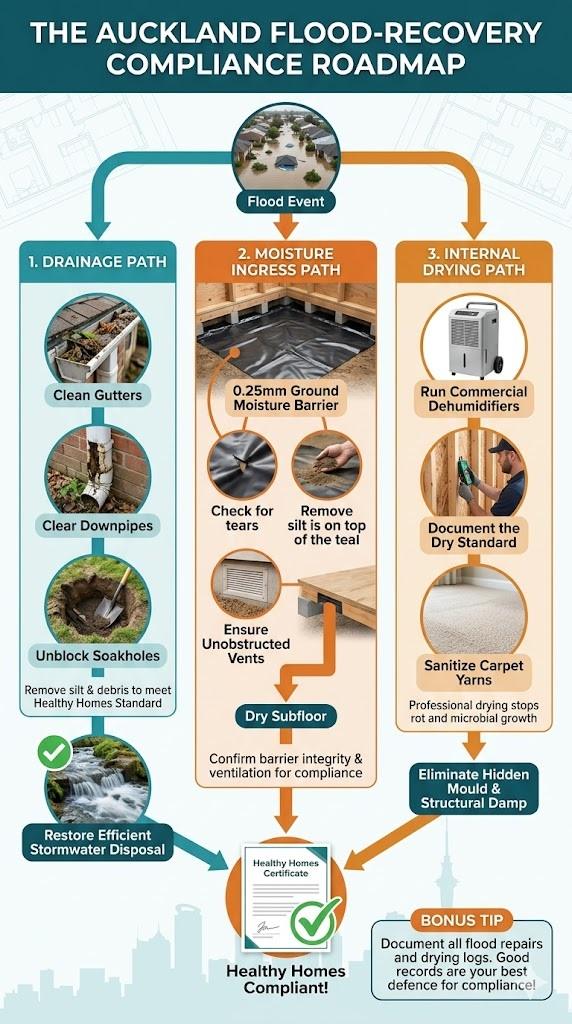
Auckland property owners have had a rough trot lately. Between the Anniversary Weekend floods and Cyclone Gabrielle, many rentals took a hammering. You might have replaced the plasterboard and cleaned the carpets, but that doesn’t mean your property still meets the strict Healthy Homes Standards for moisture and drainage.
To ensure a rental meets Healthy Homes Standards, any flood restoration work must address moisture ingress by ensuring ground moisture barriers are intact and drainage systems remain clear of debris. Failure to maintain these specific structural elements can result in significant financial penalties for landlords.
Post-Flood Compliance Checklist
| Compliance Area | Standard Requirement | Post-Flood Risk |
| Drainage System | Efficient storm water disposal | Silt and debris blocking drains |
| Moisture Barrier | 0.25mm polythene ground cover | Silt buildup or tearing during repair |
| Guttering | Must be clear and functional | Organic debris and structural sagging |
| Subfloor Vents | Unobstructed airflow | Blocked by silt or temporary hoarding |
Source: BRANZ: Maintaining Your Stormwater System (2013)
🌧️ Why Surface Repairs Aren’t Enough for Compliance
Just because the walls look white and the carpet feels dry doesn’t mean you’re compliant. In my experience as an LBP, I often see “repaired” homes where the drainage is still compromised. Silt from Auckland floods often settles in soakholes and pipes, meaning your “efficient drainage” is now a ticking time bomb.
Meeting the moisture ingress standard requires more than a mop. You need to ensure that the subfloor is effectively ventilated and that any ground moisture barrier hasn’t been displaced or covered in mud. If the barrier is buried under an inch of silt, it can’t do its job of stopping rising damp.
-
Check that soakholes are cleared of fine Auckland clay.
-
Ensure the polythene barrier is wiped down or replaced if contaminated.
-
Verify that subfloor vents are 100% clear of debris -> this allows airflow to carry away residual dampness.
In the world of forensic accounting, “following the money” reveals the truth; in building science, “following the vapour” reveals the hidden damage.
🛠️ From the Builder’s Bench: The Hidden Moisture Trap
I remember visiting a bungalow in Remuera that had been “professionally cleaned” after a pipe burst. The carpets were dry, but my moisture meter went off the charts near the skirting boards. The water had wicked up the timber framing, hidden behind the new paint. This is where moisture ingress becomes a long-term structural nightmare.
Professional flood restoration involves more than just aesthetics. We use industrial dehumidifiers to pull moisture out of the “bones” of the house. As a builder, I know that if that timber stays at a high moisture content, you’re looking at rot and a failed Healthy Homes inspection within six months.
-
Use professional-grade moisture meters on timber yarns and framing.
-
Deploy high-capacity dehumidifiers for at least 48 -> 72 hours.
-
Monitor humidity levels until they reach the “dry standard” for Auckland’s climate.
While a biologist might see a flood as a catalyst for new life, a restorer sees it as a catalyst for destructive microbial growth.
🧼 Restoring Textiles and Carpet Without Failing the Standard
When we look at carpets, we aren’t just looking at the surface. The yarns and the backing materials can trap silt and bacteria that a standard vacuum won’t touch. If your rental carpet smells “musty” after a flood, it’s likely failing the “dry and clean” intent of the Healthy Homes legislation.
To truly restore a flooded carpet, we focus on the integrity of the yarns. If the backing textiles have delaminated due to prolonged soaking, the carpet is a goner. However, if caught early, a deep antimicrobial clean and rapid drying can save the floor and keep your property compliant and healthy for tenants.
-
Assess if the carpet yarns are still securely attached to the backing.
-
Apply NZ-approved sanitisers to eliminate bacteria from floodwater.
-
Hire a professional blower to ensure the subfloor and underlay are bone-dry.
In culinary arts, resting a steak allows juices to redistribute; in restoration, “resting” a wet material only allows mould to colonise.
Key Takeaways for Auckland Landlords
-
Drainage is Priority One: Clear your gutters and soakholes of all silt.
-
The Subfloor Secret: Ensure your ground moisture barrier isn’t buried under flood debris.
-
Dry the Structure: Surface-dry isn’t “Healthy Homes” dry.
-
Professional Help: Use IICRC-certified restorers to document the drying process for insurance and compliance.
Frequently Asked Questions
Does a flooded home automatically fail Healthy Homes?
Not necessarily, but it requires a re-assessment of the moisture ingress and drainage sections to ensure no new blockages or damage occurred during the event.
Can I dry the house myself with a home heater?
It’s a bad idea. Home heaters just warm the air; they don’t remove moisture. You need a commercial dehumidifier to actually pull the water out of the building materials.
Should I replace my ground moisture barrier after a flood?
If it is covered in silt or was moved during the flood, it is often cheaper and safer to replace it with fresh 0.25mm polythene to ensure compliance.
Auckland Flood & Moisture Resources
This article is part of our Tenancy & Social Impact Hub. Explore more professional resources below:
- Is Your Auckland Rental Habitual After a Flood? The Legal “Unlivable” Guide
- Power Bills & Dehumidifiers: Fairly Calculating and Splitting Costs in Auckland