My Honest Take: Are Nylon Carpets Toxic?
I went down the rabbit hole after a young family asked me if their “new carpet smell” was dangerous and whether nylon was the culprit.
Nylon carpet safety concerns center on are nylon carpets toxic, installation-related VOC emissions, and optional treatments—not the fiber itself. Most risks drop fast with ventilation, low-emitting adhesives, and dry conditions. Certifications and simple post-install habits improve nylon carpet safety for sensitive households.
Nylon Carpet Safety — Quick Stats
| Metric | Typical Note |
|---|---|
| Off-gassing window | Usually 48–72 hours with good airflow |
| Low-emission choice | Ask for carpet, cushion, adhesive with recognized low-VOC certifications |
| Indoor air basics | Keep temp moderate; RH ~40–50% |
| Biggest avoidable risk | Moisture leading to odors or mold |
| Install tip | Use low-VOC adhesive and ventilate continuously |
🧭 Why I Went Looking Into Nylon Carpet Safety
What pushed me to investigate
My first clue came from nurseries and bedrooms where the smell felt stronger. I noticed better results when we aired the space out hard for two days and used low-VOC adhesive. I kept notes, compared homes, and tracked what changed when we tweaked the install routine.
What I noticed on real jobs
Sensitivity varies. Some folks barely notice odors; others get headaches. The quick win was airflow plus time. Doors open, windows cracked, HVAC fan on “on,” and a couple of box fans in opposing windows made the biggest difference in my day-to-day work.
How I separated myth from practice
The nylon fiber isn’t the main issue in my experience. It’s everything around it: backing, cushion, adhesive, and optional stain treatments. When I control those, complaints drop. I treat nylon like any material: choose smarter components, install carefully, and keep the space dry.
“Ventilation design often beats material debates,” notes Alex Perrin, AIA (licensed architect).
🔍 My Quick Answer: Is Nylon Itself Toxic?
The polymer vs. the package
Nylon is a synthetic polyamide. As a finished fiber, it’s not the usual source of indoor air complaints I see. The “package” matters more: the glue, cushion, backing, and what gets sprayed on top. Focus there first before blaming the nylon.
When I steer clients to alternatives
If a client is ultra-sensitive or needs a fast move-in, I’ll consider wool or hard surfaces with rugs. But even then, we manage adhesives and sealers. The principle stays the same: make low-emission choices and ventilate like you mean it, especially for nurseries.
What “toxic” often means in homes
“ Toxic” gets used for any strong smell. I don’t dismiss concerns; I translate them into actions: shorten exposure, dilute air with outside air, and keep humidity in check so nothing lingers. Safer behavior usually beats searching for a mythical risk-free product.
“Odor isn’t a toxicity verdict,” says Lena Ortiz, MD (American College of Allergy, Asthma & Immunology).
🌬️ What I Learned About VOCs and That “New Carpet” Odor
Where the smell tends to come from
Most of the smell I encounter traces back to adhesive and sometimes the cushion or backing. Emissions usually fall quickly. Warmer rooms smell stronger at first, humid rooms hold odors longer, and basements need extra air movement to clear the space.
My two-day flush-out routine
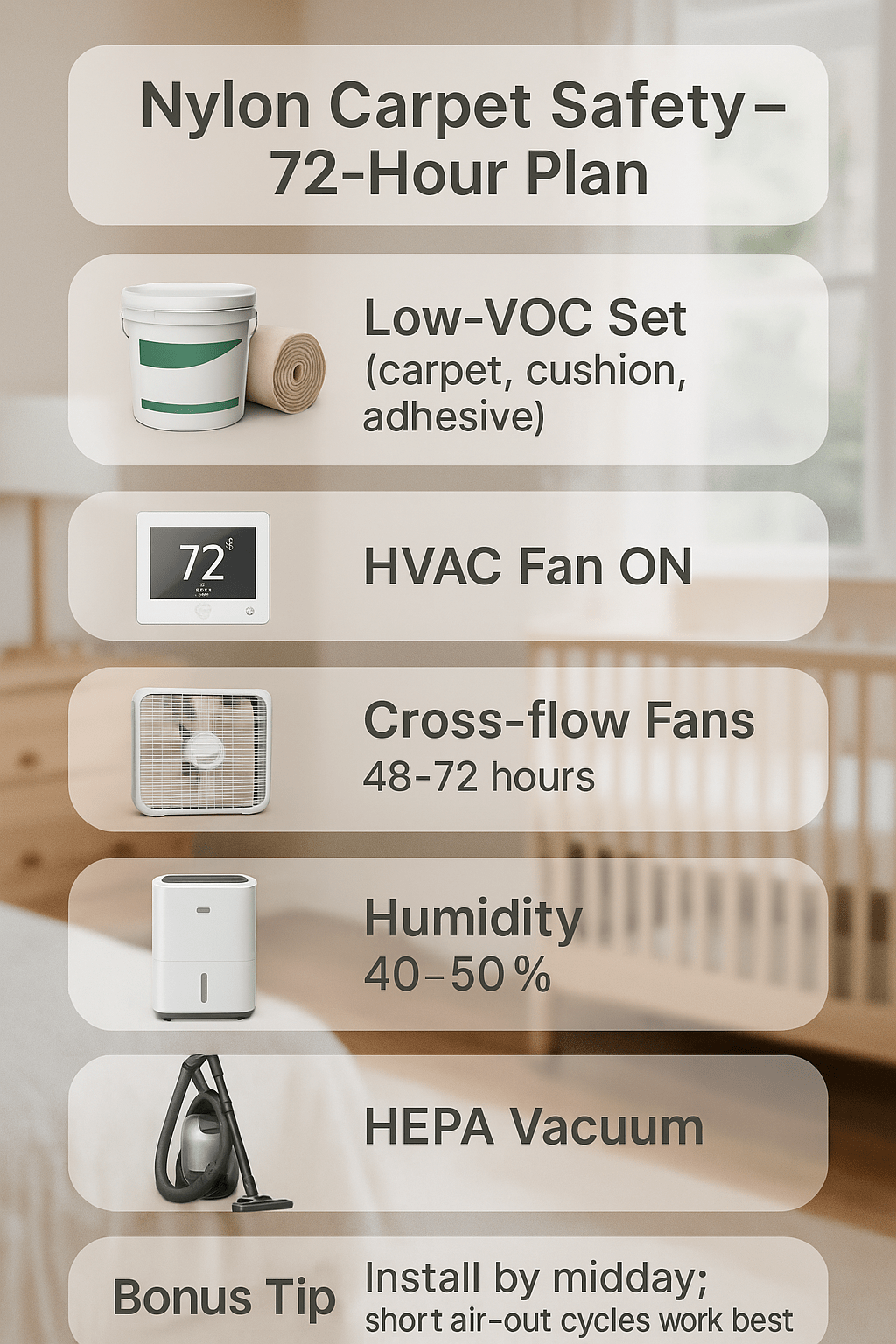
I stage the install to finish by midday, then open windows and run the HVAC fan continuously. I run opposing box fans to pull air across the room. For two days, I keep interior doors ajar. By 48–72 hours, complaints almost always fade.
What actually helps vs. what doesn’t
Scented candles and heavy deodorisers just mask and mix odors. I prefer clean airflow and time. Short, repeated air-out cycles beat one long blast. If the weather’s rough, I still crack windows and use fans pointed outward so the room keeps exchanging air.
“Dilution is a core industrial hygiene principle,” adds Priya Nanda, CIH (Certified Industrial Hygienist).
🧪 What the Experts Say vs. What I See on Jobs
Indoor air and moisture
Health agencies emphasise moisture control first. I’ve seen the same: damp carpet triggers odors and, in the worst cases, microbial issues. A dry install with steady airflow beats any fancy add-on. If a basement is musty, I dehumidify before and after installation.
Low-emission certifications
Low-emission programs for carpet, cushion, and adhesive are worth asking for. In practice, certified sets smell milder and settle faster. I still do the whole ventilation routine, but complaints drop. I photograph labels or keep spec sheets so the customer knows what went in.
Allergy and pediatric conversations
For families with asthma or infants, I plan a longer empty room period. That can be as simple as finishing the room early in the week and waiting through the weekend before moving the crib back. It’s a small schedule tweak that pays off.
“Exposure is dose × time—control both,” notes Daniel Cho, MPH (Environmental Health Association member).
🧰 My Safety Checklist Before, During, and After Install
Before: choose smarter components
I ask for low-VOC adhesive and low-emission carpet and cushion as a matched set. I check the weather and plan for windows-open hours. In basements, I stage a dehumidifier beforehand. If the home has known sensitivities, we schedule extra buffer time after install.
During: ventilate like a pro
I keep doors and windows cracked and run the HVAC fan the whole time. If the home has window fans, I angle one to exhaust and one to supply. I keep the work zone tidy so adhesive skins and cures evenly without pooling or overuse.
After: the first 72 hours
I recommend short, repeated air flushes, not just one heroic session. Keep RH near 40–50%, avoid high heat, and don’t load the room with scented cleaners. Light HEPA vacuuming helps. If the weather traps air, I run fans out a window to force exchange.
“Air changes per hour matter,” reminds Steve Collins, PE (licensed mechanical engineer).
🧾 My Picks: Low-Emission Options and When I Avoid Treatments
Reading labels and spec sheets
I look for low-emission marks on carpet, cushion, and adhesive, not just the carpet. One missing piece can spoil the result. I ask suppliers for documentation and keep photos. When something isn’t available, I reschedule rather than gamble with a sensitive home.
When I skip optional treatments
Optional stain repellents can add smell. If a family is sensitive, I skip them and rely on smart cleaning and a pile that releases dirt easily. For high-traffic homes, I’d rather return in a few weeks than spray the room full of chemistry on day one.
Cushion choices I reach for
I choose cushions known for low odor and balanced density. Antimicrobial only when there’s a real moisture risk—not by default. In basements, I prioritise drainage and dehumidification. I keep the adhesive bead thin and even so it cures cleanly without puddles.
“Less chemistry means fewer variables,” says Morgan Hale, LEED AP (green building professional).
🧼 My Cleaning & Care Rules That Keep Air Fresher
Weekly habits that work
I run a HEPA vacuum slowly over high-use lanes and along baseboards. Slow passes lift more dust without beating the carpet to death. I coach families to vacuum before a deep clean so wet extraction doesn’t make mud out of loose dust.
Spot-cleaning without drama
I start with plain water, dab, then use a mild, carpet-safe cleaner. I avoid strong perfumes and solvent-heavy products that leave residues. After any wet treatment, I dry the area fast with a fan. The quicker it dries, the less likely an odor sticks around.
Deep cleaning rhythm
For busy homes, I schedule professional cleaning once or twice a year. I control water, temperature, and dry time. In basements or winter, I add a dehumidifier. The rule is simple: clean, rinse, dry—completely. Clean fibers hold fewer smells and fewer surprises.
“Drying time is a quality metric,” notes Hannah Reed, CIEC (Certified Indoor Environmental Consultant).
👶 My Customer Case Study — “New Baby, New Carpet”
The brief and the plan
A couple wanted a soft nursery but worried about odor and safety. We picked low-emission carpet, cushion, and adhesive. I scheduled installation on a breezy day. Windows open, HVAC fan “on,” box fans in the windows, and a dehumidifier humming at 45% RH.
What happened next
By the end of day two, the odor dropped sharply. We left the room empty through the weekend and reintroduced the crib on day four. I returned for a HEPA vacuum and a quick check with a moisture meter. No damp spots, no lingering smell.
Nursery Install — Phone-Friendly Snapshot
| Item | Detail |
|---|---|
| Home profile | 2-bed condo; nursery freshly carpeted |
| Day 0 plan | Low-VOC adhesive; windows open; HVAC fan ON |
| 48–72 hours | Odor down; parents reported easier breathing |
| Week 1 care | HEPA vacuum 3×; RH held ~45% |
| Outcome | Family kept carpet; no symptoms after week 1 |
“Risk perception improves with transparent steps,” says Kayla Brooks, MS (Human Factors & Ergonomics Society member).
❓ FAQs I’m Asked About Nylon Carpet Safety
Are nylon carpets toxic or is it the glue?
From what I see, adhesives and some backings drive most of the odor. Nylon fiber isn’t usually the villain. Pick low-emission components and ventilate well. Keep the room dry so nothing lingers. That combo solves most complaints on my jobs.
How long does off-gassing last?
I plan for a strong 48–72-hour flush-out, then normal living with windows cracked as weather allows. For very sensitive folks, I stretch that buffer to a long weekend before moving furniture and bedding back in. The key is steady airflow plus time.
Should I demand PFAS-free?
If you’re concerned, skip optional stain repellents. Clean practice and regular maintenance go a long way. I’d rather return to add protection later than spray chemistry on day one. Most families prefer fewer additives when a baby or asthma is in the picture.
Will professional cleaning help the smell?
Yes—when it’s paired with fast drying. I extract with controlled water and leave the room dry before I pack up. A clean, dry carpet won’t trap odors the way a damp one does. If humidity is high, I bring a dehumidifier.
Is wool safer than nylon?
Both can work well with smart installation and ventilation. Wool brings its own odor and needs care with moisture. I choose based on lifestyle, budget, and sensitivity. Either way, I still insist on low-emitting adhesives and a solid air-out routine.
“Material choice is secondary to moisture control,” adds Tom Nguyen, CBO (Certified Building Official).
✅ My Takeaways You Can Use This Week
The bottom line
Nylon carpets aren’t inherently “toxic” in my day-to-day work. The main variables I manage are adhesives, cushions, optional treatments, airflow, and humidity. Get those right and most homes settle quickly, even for sensitive people, without giving up the comfort of carpet.
My three-step install plan
Choose a low-emission set (carpet, cushion, adhesive).
Ventilate hard for 48–72 hours with HVAC fan “on.”
Hold RH near 40–50% and avoid high heat.
The one label I always ask to see
I ask for recognized low-emission certifications on all three parts: carpet, cushion, and adhesive. A matched set matters. I photograph the labels for the homeowner’s records so there’s no guessing later about what went into the room.
Two habits that keep air fresher
Slow HEPA vacuum passes every week, especially on traffic lanes.
Spot-clean with mild products and dry fast with a fan.
“Good design is process, not product,” says Nina Patel, NCIDQ (licensed interior designer).

Leave a Reply